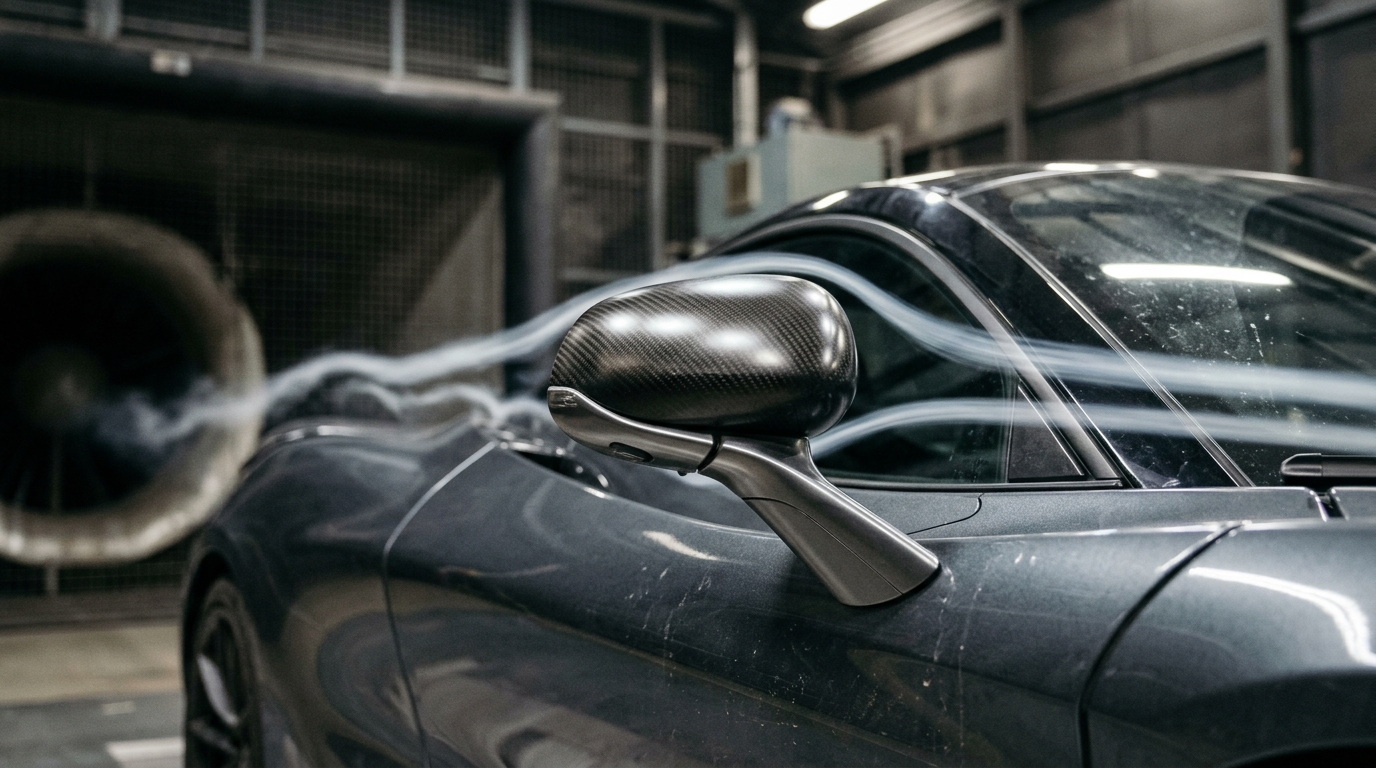
Researchers have demonstrated that a specific geometric modification to a passenger car’s side-view mirror can significantly reduce aerodynamic drag, with experimental validation confirming an 18.25% decrease in the drag coefficient compared to a standard baseline design. Published in the journal Discover Vehicles, the study combines computational fluid dynamics (CFD) with physical wind tunnel testing to evaluate the aerodynamic performance of isolated mirror geometries. The primary objective was to minimize the drag force generated by the mirror, a component that, despite its small size, contributes a measurable portion to the total aerodynamic resistance of a vehicle. By applying a gradient-based adjoint optimization framework, the team identified a surface profile that suppresses flow separation and narrows the low-pressure wake region, leading to a more efficient airflow around the component.
The research addresses a specific challenge in automotive aerodynamics: the reduction of drag at the component level without altering the vehicle’s overall frontal area. Side-view mirrors are mounted on the exterior of vehicles to provide rear and side visibility, but their bluff-body shape creates a turbulent wake that increases fuel consumption. Previous studies have indicated that the drag generated by side mirrors accounts for approximately 2 to 7% of a vehicle’s total aerodynamic drag. The study aims to provide a practical design pipeline that can be adapted to other vehicle exterior components, offering a method for manufacturers to improve fuel economy through targeted geometric adjustments.
The computational methodology employed a gradient-based adjoint optimization framework within the ANSYS Fluent software. Four candidate mirror designs, labeled ID1 through ID4, were initially evaluated through turbulent CFD simulations using the k-ω Shear Stress Transport (SST) turbulence model. This model is widely used in engineering applications because it balances the near-wall accuracy of the k-ω formulation with the free-stream robustness of the k-ε model, making it suitable for flows involving adverse pressure gradients and boundary-layer separation. The adjoint solver was configured for incompressible, isothermal Reynolds-Averaged Navier-Stokes (RANS) based flow optimization, using second-order spatial discretization and Least Squares Cell-Based gradient evaluation. The drag coefficient (Cd) was selected as the primary minimization objective, with convergence monitored over 2,000 iterations to ensure solution stability.
To validate the numerical setup, the researchers used the Ahmed Body, a simplified geometric model extensively studied for its ability to replicate the near-wake region of automobiles. The simulation was run at a 25-degree slant angle, a configuration known to exhibit high-drag characteristics due to substantial separation bubbles and strong streamwise vortices. The computed drag coefficient for the Ahmed Body was 0.289, which deviated by only 3.46% from the experimentally reported value of 0.298 by S.R. Ahmed. This close agreement confirmed the reliability of the numerical framework in predicting bluff-body separation and wake dynamics.
Among the four initial candidate designs, Mirror ID4 exhibited the lowest baseline drag coefficient of 0.367, making it the selected base design for further optimization. The adjoint solver identified surface regions most sensitive to drag reduction and deformed them to improve aerodynamic performance. The resulting optimized geometry achieved a drag coefficient of 0.320 in the CFD analysis, representing a 15.31% reduction relative to the base design. This improvement was attributed to a more favorable rear pressure distribution, where the adjoint solver redistributed surface curvature to suppress flow separation. The pressure contour maps revealed that the optimized mirror had a reduced suction peak and an improved rear-surface pressure plateau, indicating enhanced pressure recovery and a narrower wake region compared to the baseline.
Experimental validation was conducted in a closed-circuit wind tunnel to confirm the computational trends. The test section had dimensions of 1200 mm in height, 700 mm in length, and 700 mm in width, with a blockage ratio of 0.0612, which is considered low and suitable for reliable aerodynamic measurements. Force measurements were performed using three load cell transducers arranged in a multi-axis sting balance configuration to resolve drag, lift, and normal force components independently. The freestream velocity was varied between 15 m/s and 30 m/s, and the drag force was recorded directly from the horizontal-axis load cell. The reported drag coefficients represent the mean across all four tested velocities, confirming Reynolds-number independence over the tested range. The experimental setup was designed to minimize variations in flow due to external factors, ensuring reproducible results.
The wind tunnel experiments yielded an 18.25% drag reduction for the optimized mirror, with an experimental drag coefficient of 0.303 compared to the base design’s 0.357. The deviation between the CFD and experimental results was 2.7% for the base design and 5.3% for the optimized design, both within acceptable ranges for this type of analysis. This consistency between computational and experimental approaches validates the effectiveness of the adjoint optimization method. The optimized mirror demonstrated a more attached flow field, with the freestream velocity recovering more rapidly downstream and the wake region showing a substantial reduction in the size and intensity of recirculating structures. This controlled vortex interaction reduces base pressure drag by limiting the momentum deficit in the wake.
To provide a practical benchmark, the researchers also tested two commercially deployed sedan mirrors: the Toyota Corolla 2005 and the Toyota Axio 2013. Under identical wind tunnel conditions, the optimized mirror outperformed both production designs. The Toyota Corolla 2005 mirror had a drag coefficient of 0.460, while the Toyota Axio 2013 mirror had a coefficient of 0.394. The optimized mirror achieved experimental drag reductions of 34.1% and 23.1% compared to the Corolla and Axio mirrors, respectively. These comparisons highlight the potential for significant aerodynamic improvements in existing vehicle designs through targeted component optimization.
The study also analyzed the impact of the optimized mirror on fuel consumption. Using a model based on the power required to overcome aerodynamic drag, the researchers calculated that the optimized mirror consumes 0.012 L/100 km per mirror, compared to 0.0145 L/100 km for the base design. This corresponds to a fuel saving of 17.3% when switching to the optimized design. For the Toyota Corolla 2005 mirror, the potential fuel saving was 35.9%, and for the Toyota Axio 2013 mirror, it was 32.6%. These fuel savings correspond to proportional reductions in CO₂ emissions at the mirror-drag contribution level.
The findings indicate that the gradient-based adjoint method is a powerful and computationally efficient tool for component-level aerodynamic optimization. Unlike traditional parametric studies, which require multiple solver runs for each design variable, the adjoint method computes the sensitivity of the objective function with respect to all design variables in a single solver pass. This efficiency makes it particularly suitable for complex geometries with many potential design parameters. The study demonstrates that combining adjoint CFD optimization with wind tunnel experimental validation provides a robust and practical design pipeline. Future work may involve integrating a complete vehicle model for mirror-body optimization, conducting transient simulations for precise wake characterization, and evaluating the structural and manufacturability constraints of the optimized geometry. The results offer a clear pathway for automotive manufacturers to enhance fuel efficiency through aerodynamic refinement of exterior components.
Subject of Research: Experimental characterization and adjoint optimization of side-view mirror geometry for aerodynamic drag reduction
Article Title: Experimental characterization and adjoint optimization of side-view mirror geometry for aerodynamic drag reduction
Article References: Rahman, M. S., Sakib, M. A. S., Rimi, K. N., Hasan, M. M., Islam, M., & Mahbub, T. (2026). Experimental characterization and adjoint optimization of side-view mirror geometry for aerodynamic drag reduction. Discover Vehicles, 2(1), Article 23. https://doi.org/10.1007/s44465-026-00029-w
Image Credits: AI Generated
DOI: 10.1007/s44465-026-00029-w
Keywords: Experimental, characterization, adjoint, optimization, side-view, mirror, geometry, aerodynamic, drag, reduction, scientific research
News Source: Denise Maddox. (November 8, 2026). Optimized Car Mirror Design Cuts Aerodynamic Drag by 18%. Scienmag.