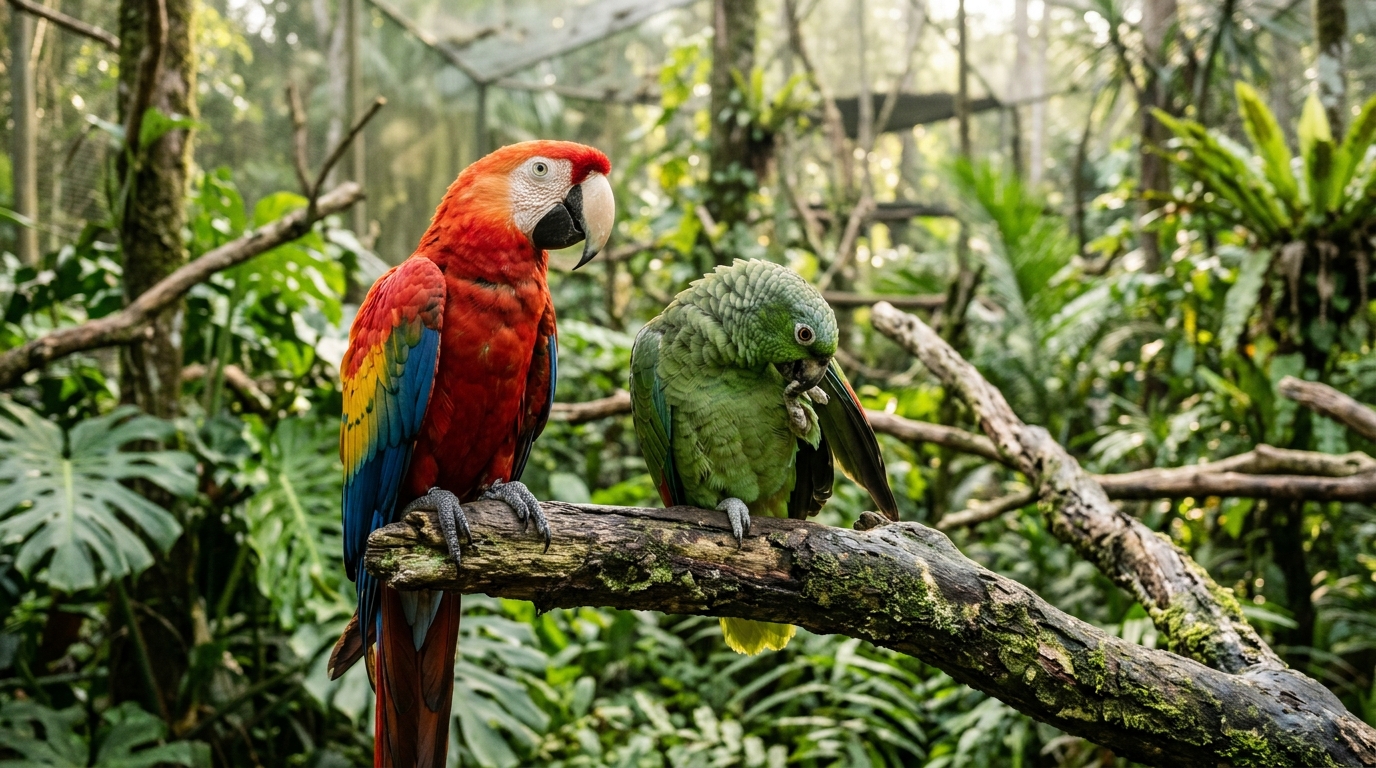
A large-scale bacterial profiling study of healthy captive parrots has revealed high levels of interspecific and intraspecific variation in gastrointestinal microbiota composition, finding that host species and owner identity serve as the primary drivers of microbial diversity while no universal core bacterial community exists across species. Through 16S rRNA profiling, the research team examined both faecal and oral microbiota samples collected from 286 individual birds representing 66 different parrot species.
The research addresses a substantial knowledge gap regarding the bacterial communities of parrots, order Psittaciformes, which represent the most popular pet birds kept across the globe. Contemporary estimates indicate that approximately half of the world’s total parrot population currently resides in captivity. Despite their widespread presence in domestic environments, captive parrots are known to be vulnerable to numerous health issues, with digestive and behavioural disorders ranking as the most frequently reported conditions in these birds. Scientific understanding indicates that such health disorders can be linked to the gastrointestinal tract microbiota either directly or through the gut-brain axis. Nevertheless, the gastrointestinal microbiota of parrots has remained largely unexplored prior to this profiling effort, an absence of fundamental data that has directly limited the potential for the therapeutic use of probiotics within veterinary clinical practice. To overcome these limitations, the authors sought to evaluate how bacterial diversity varies both across distinct host species and among individuals within the same species.
A primary outcome of this comprehensive profiling was the complete absence of any core operational taxonomic unit or bacterial genus shared across the faecal or oral samples of all 286 individuals or all 66 species examined. Despite the absence of a universally shared core bacterial group, specific genera predominated within particular sampling sites. In the oral cavity, the bacterial genera Corynebacterium and Streptococcus were represented in more than 90 percent of the oral samples evaluated. In contrast, the genus Lactobacillus emerged as the predominant bacterial group within the lower digestive tract, being detected in 75 percent of the analysed faecal samples, underscoring pronounced compositional divergence between oral and gut environments.
The investigation demonstrated substantial interspecific and intraspecific variation across both the faecal and oral bacterial communities. Statistical analyses identified host species identity and owner identity as the two most important factors governing microbial composition and diversity among the birds. While individual parrots belonging to the same host species or the same host genus shared similar bacterial communities, deeper phylogenetic lineages exhibited only low levels of phylosymbiosis. The degree to which host evolutionary relationships mirrored microbial community structure also differed depending on anatomical location. Specifically, similarities in the composition of the parrot oral microbiota were more strongly aligned with host phylogeny than the similarities observed in the faecal microbiota, indicating that evolutionary heritage corresponds more closely with oral bacterial structure than with faecal community assemblages.
In addition to host taxonomy and ownership, the researchers evaluated the influence of temporal and demographic variables on parrot microbial communities. The date of sample collection exerted minor yet statistically significant effects on overall microbial composition across the sampled population. Furthermore, host sex was found to exert an additional significant effect specifically on the composition of the oral microbiota. By establishing the presently most comprehensive characterisation of parrot gastrointestinal tract microbiota and its structural variation, the study provides a critical empirical reference for subsequent research investigating the physiological effects of gastrointestinal bacteria and guiding the development of novel veterinary therapeutics.
Subject of Research: Gastrointestinal microbiota composition and variation in captive parrots
Article Title: Captive parrot interspecific and intraspecific variation in gastrointestinal microbiota composition revealed by large-scale profiling
Article References: Marková, K., Schmiedová, L., Grymová, V., Těšický, M., Kreisinger, J., & Vinkler, M. (2026). Captive parrot interspecific and intraspecific variation in gastrointestinal microbiota composition revealed by large-scale profiling. Animal Microbiome. https://doi.org/10.1186/s42523-026-00621-1
Image Credits: AI Generated
DOI: 10.1186/s42523-026-00621-1
Keywords: parrot microbiome, gastrointestinal bacteria, captive birds, 16S rRNA profiling, veterinary health, microbial diversity, faecal microbiota, oral microbiota, phylosymbiosis, animal health, Captive, parrot
News Source: Morgan Morrow. (November 8, 2026). Large-Scale Study Maps Microbiome Variation Across 66 Captive Parrot Species. Scienmag.