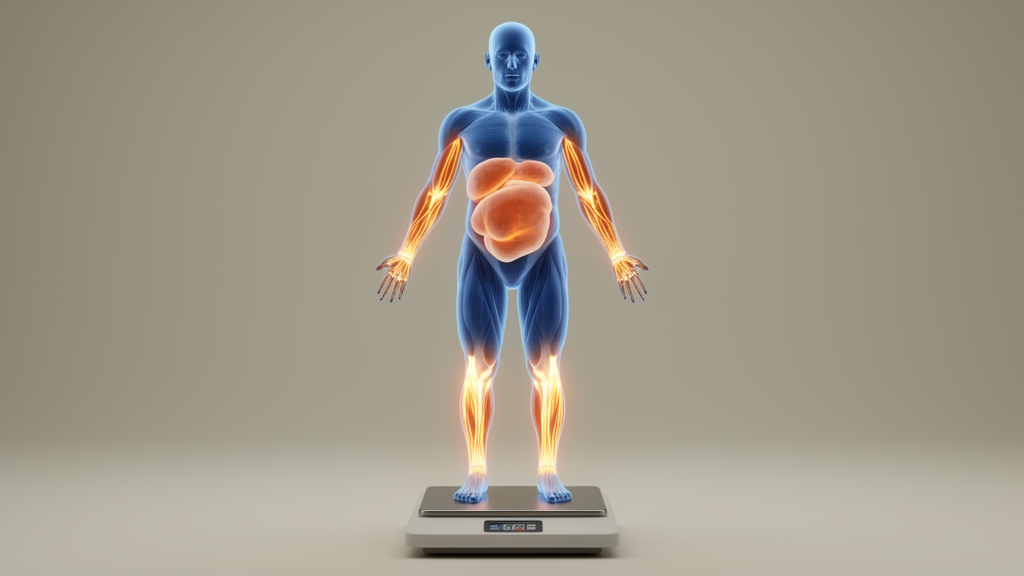
People taking incretin-based therapies such as semaglutide and tirzepatide lose not only fat but also a measurable amount of lean body mass, according to a new meta-analysis of phase 3 randomized trials published in BMC Endocrine Disorders. The analysis, which pooled dual-energy X-ray absorptiometry (DXA) measurements from five trials involving 569 adults with obesity or type 2 diabetes, found that trial-level point estimates consistently favored lower lean mass with incretin-based therapy than with the comparator, although the authors graded the certainty of the evidence as very low.
The researchers, Birkan Alaycı and Öykü Zeynep Gerçek, searched PubMed, Scopus and Cochrane CENTRAL to 23 March 2026, with an update on 4 September 2026, and searched Web of Science on 6 September 2026. They included phase 3 randomized trials of GLP-1 receptor agonists or dual GIP/GLP-1 receptor agonists versus placebo or an active comparator lasting at least 24 weeks, with DXA-derived lean body mass and fat mass reported. Mean differences were pooled using a random-effects approach with the Hartung–Knapp–Sidik–Jonkman adjustment, separately for placebo-controlled trials in obesity and active-comparator trials in type 2 diabetes, with leave-one-out and Bayesian sensitivity analyses, Risk of Bias 2.0 assessment and GRADE certainty rating. Extracted values were independently audited.
In the two placebo-controlled obesity trials, which tested semaglutide 2.4 mg and tirzepatide over 68 to 72 weeks, lean body mass was 3.43 kg and 4.40 kg lower than with placebo, and fat mass was 6.99 kg and 12.30 kg lower. The pooled lean mass difference across those two trials was −3.95 kg, with a 95% confidence interval of −10.10 to +2.19 kg, an interval that includes zero. In the three active-comparator trials in type 2 diabetes, testing semaglutide 1.0 mg and liraglutide 1.8 mg over 26 to 52 weeks, lean mass differences were −0.78, −2.82 and −0.96 kg, pooling to −1.53 kg (95% CI −4.38 to +1.32 kg) with substantial heterogeneity, quantified at I² of 73%.
When all five trials were combined, the pooled lean body mass difference was −2.49 kg (95% CI −4.45 to −0.53 kg), with a prediction interval of −6.97 to +2.00 kg. However, this pooled estimate proved fragile: the confidence interval included zero whenever any one of three trials was omitted from the analysis. The pooled fat-mass difference of −5.29 kg (95% CI −10.78 to +0.21 kg) was itself compatible with no difference between the treatments and comparators.
The authors emphasize that the comparisons differ in population, drug, dose, comparator and analysis strategy, that heterogeneity cannot be explained, and that DXA lean mass is a composite compartment of unknown functional significance. In other words, while every trial-level point estimate pointed in the same direction — lower lean mass with incretin-based therapy, ranging from 3.4 to 4.4 kg versus placebo at obesity doses and 0.8 to 2.8 kg versus active comparators in type 2 diabetes — several trial-level and both stratum-level confidence intervals included zero, and the very low certainty rating means the findings should be interpreted with caution. The review was registered prospectively on PROSPERO (CRD420261323497) on 23 March 2026, and the article is published open access.
Subject of Research: DXA-measured lean and fat mass changes with GLP-1 and dual GIP/GLP-1 receptor agonist therapy in phase 3 trials
Article Title: DXA-measured lean and fat mass differences with incretin-based therapy versus comparators: a meta-analysis of phase 3 trials
Article References: Alaycı, B., & Gerçek, Ö. Z. (2026). DXA-measured lean and fat mass differences with incretin-based therapy versus comparators: a meta-analysis of phase 3 trials. BMC Endocrine Disorders. https://doi.org/10.1186/s12902-026-02679-z
Image Credits: AI Generated
DOI: 10.1186/s12902-026-02679-z
Keywords: GLP-1 receptor agonists, tirzepatide, semaglutide, lean body mass, fat mass, DXA, meta-analysis, obesity, type 2 diabetes, phase 3 trials, body composition, certainty of evidence
News Source: Ophelia Keating. (October 28, 2026). Incretin-based weight loss drugs may also trim lean mass, meta-analysis finds. Scienmag.