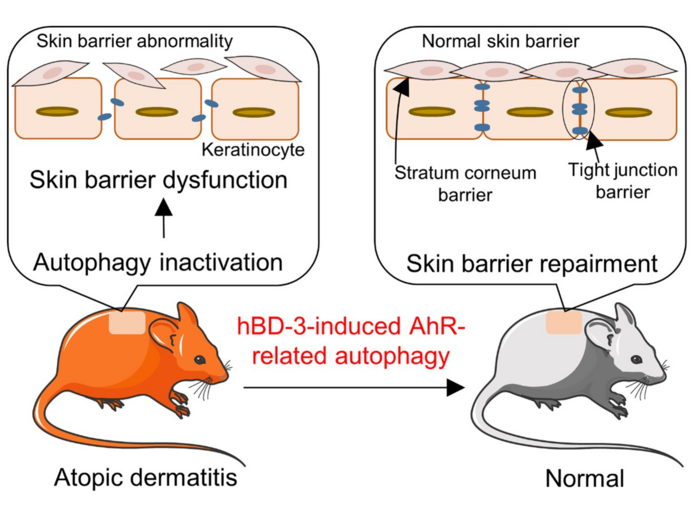
One of the characteristics of AD is the disruption of the outermost layer of the skin: the epidermal barrier. Inside the cells that line this barrier, a mechanism called autophagy is involved in their differentiation and antimicrobial activity. Autophagy is a process by which damaged cells are degraded. Linking these two phenomena, the team started off by scrutinizing the association between autophagy and skin barrier function in AD and then proceeded to investigate hBD-3, a regulator of autophagy, in combating the condition.
Credit: Juntendo University
One of the characteristics of AD is the disruption of the outermost layer of the skin: the epidermal barrier. Inside the cells that line this barrier, a mechanism called autophagy is involved in their differentiation and antimicrobial activity. Autophagy is a process by which damaged cells are degraded. Linking these two phenomena, the team started off by scrutinizing the association between autophagy and skin barrier function in AD and then proceeded to investigate hBD-3, a regulator of autophagy, in combating the condition.
Using the skin of human patients and mice with AD, the state of autophagy in affected cells was first analyzed. Molecules that typically drive autophagy and autophagic structures were reduced, suggesting that autophagy was indeed inhibited in these cells. When skin cells were examined closely to understand why autophagy was diminished, a class of molecules known as interleukins (which are typically released by our immune system) emerged as the culprits. Next, the role of autophagy in maintaining a healthy skin barrier was assessed by mutating mice to remove all programming for autophagy in the skin. These mice produced less proteins that are essential for developing a skin barrier. They were more susceptible to developing inflammation and lesions on their skin, similar to AD.
hBDs are biomolecules that have shown promise in restoring epidermal barrier function. Thus, the next focus was on understanding whether they play a role in restoring barrier function by regulating autophagy. Of the four types of hBDs found in human skin, one subtype, hBD-3, successfully increased autophagy in skin cells, which subsequently resulted in the development of skin barrier proteins. hBD-3 did so by activating the aryl hydrocarbon receptor (AhR) signaling—a cellular pathway responsible for proper barrier function. The researchers also confirmed this hypothesis in mice. When mice with AD were administered mBD-14 (the mouse analogue of hBD-3) they showed marked improvement in inflammation. However, this inflammation improvement was not observed in mice with a deficiency in skin autophagy or inhibition of AhR, highlighting the importance of autophagy and AhR as the mechanism of mBD-14/hBD-3 action.
“Thus, autophagy contributes to the pathogenesis of AD, and hBD-3 could be used for therapeutic purposes,” concludes Niyonsaba’s research group. This study gives dermatologists deeper insights into autophagy as a driving force behind AD and a possible solution to overcome it.
Background
Atopic dermatitis (AD): AD is a long-term skin condition that can affect people of any age, impact the quality of life and cause financial burden to the patients and their families. The dry, itchy rashes and scabs that accompany AD are typically managed by the use of soothing ointments and staying away from irritants.
Skin barrier: The skin barrier is essential in preventing exogenous chemicals and allergens from interacting with the sensitive immune cells in our skin. However, when this barrier is ruptured, as in AD, the skin ends up inflamed and prone to allergic reactions. Therefore, therapeutic options that restore a healthy skin barrier might be a long-term solution for treating AD.
Autophagy: Autophagy, which is Greek for ‘self-devouring’, is a process whereby cells engulf damaged internal components. The mechanism is a way for cells to either get rid of nonfunctional elements or eradicate toxins. Autophagy is typically triggered in stressful conditions like inflammation as a means of self-preservation. However, when autophagy is not functioning properly in such situations, conditions like AD arise.
Journal
Journal of Clinical Investigation
DOI
10.1172/JCI156501
Method of Research
Experimental study
Subject of Research
Animals
Article Title
Human-β-defensin-3 attenuates atopic dermatitis-like inflammation through autophagy activation and the aryl hydrocarbon receptor signaling pathway
Article Publication Date
1-Sep-2022