• HOME
  • NEWS
  • EXPLORE
    • CAREER
      • Companies
      • Jobs
    • EVENTS
    • iGEM
      • News
      • Team
    • PHOTOS
    • VIDEO
    • WIKI
  • BLOG
  • COMMUNITY
    • FACEBOOK
    • INSTAGRAM
    • TWITTER
Thursday, June 25, 2026
BIOENGINEER.ORG
No Result
View All Result
  • Login
  • HOME
  • NEWS
  • EXPLORE
    • CAREER
      • Companies
      • Jobs
        • Lecturer
        • PhD Studentship
        • Postdoc
        • Research Assistant
    • EVENTS
    • iGEM
      • News
      • Team
    • PHOTOS
    • VIDEO
    • WIKI
  • BLOG
  • COMMUNITY
    • FACEBOOK
    • INSTAGRAM
    • TWITTER
  • HOME
  • NEWS
  • EXPLORE
    • CAREER
      • Companies
      • Jobs
        • Lecturer
        • PhD Studentship
        • Postdoc
        • Research Assistant
    • EVENTS
    • iGEM
      • News
      • Team
    • PHOTOS
    • VIDEO
    • WIKI
  • BLOG
  • COMMUNITY
    • FACEBOOK
    • INSTAGRAM
    • TWITTER
No Result
View All Result
Bioengineer.org
No Result
View All Result
Home NEWS Science News Chemistry

In a pandemic, migration away from dense cities more effective than closing borders

Bioengineer by Bioengineer
November 17, 2020
in Chemistry
Reading Time: 3 mins read
0
IMAGE
Share on FacebookShare on TwitterShare on LinkedinShare on RedditShare on Telegram

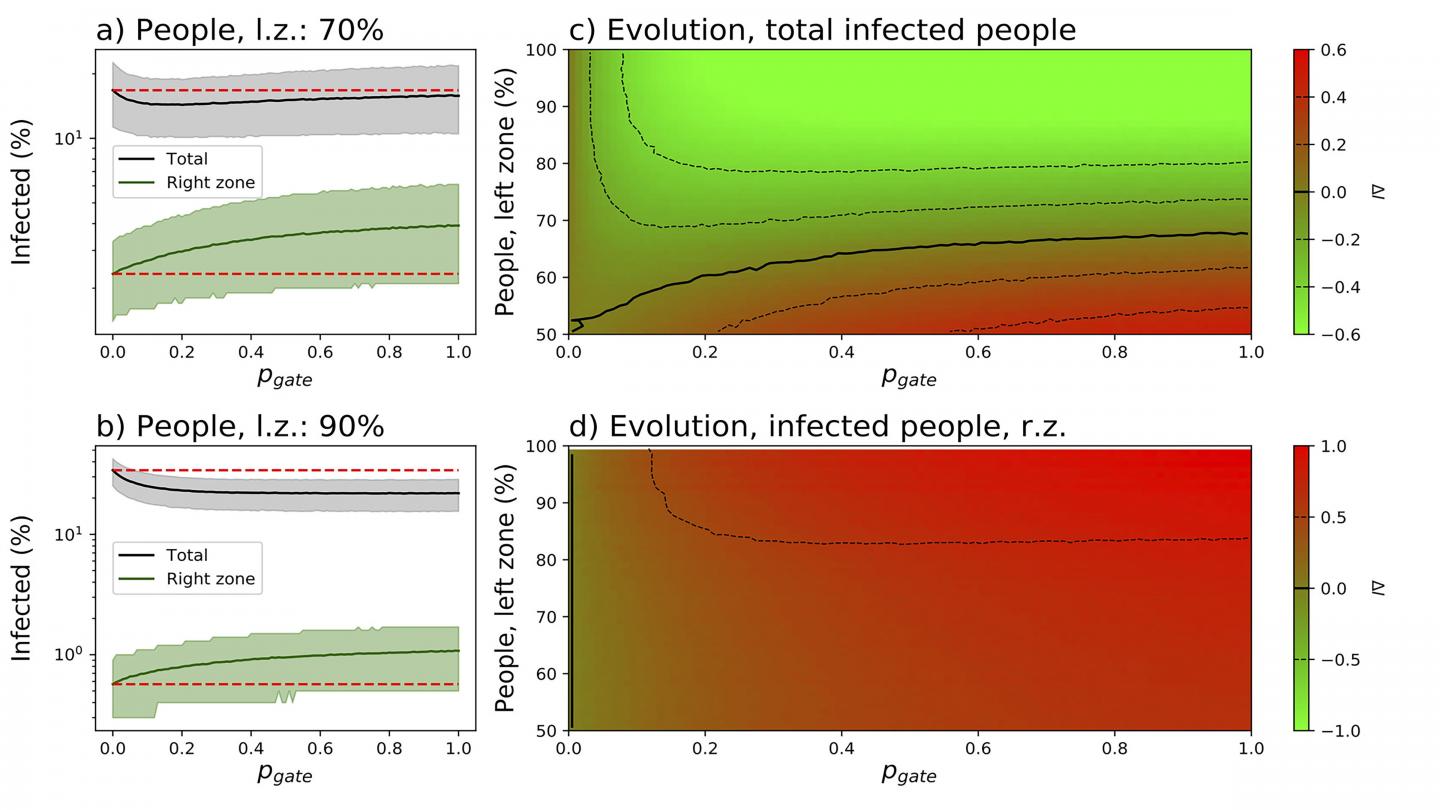
A simulation shows reducing population density in large cities decreases disease spread
IMAGE

Credit: Image courtesy of Massimiliano Zanin

WASHINGTON, November 17, 2020 — Pandemics are fueled, in part, by dense populations in large cities where networks of buildings, crowded sidewalks, and public transportation force people into tighter conditions. This contrasts with conditions in rural areas, where there is more space available per person.

According to common sense, being in less crowded areas during a pandemic is safer. But small town mayors want to keep people safe, too, and migration of people from cities to rural towns brings concerns. During the COVID-19 pandemic, closing national borders and borders between states and regions has been prevalent. But does it really help?

In a paper published in Chaos, by AIP Publishing, two researchers decided to put this hypothesis to the test and discover if confinement and travels bans are really effective ways to limit the spread of a pandemic disease. Specifically, they focused on the movement of people from larger cities to smaller ones and tested the results of this one-way migration.

“Instead of taking mobility, or the lack of mobility, for granted, we decided to explore how an altered mobility would affect the spreading,” author Massimiliano Zanin said. “The real answer lies in the sign of the result. People always assume that closing borders is good. We found that it is almost always bad.”

The model used by the authors is simplified, without many of the details that affect migration patterns and disease spread. But their focus on changes in population density indicates travel bans might be less effective than migration of people to less dense areas. The result was reduced spread of disease.

Zanin and collaborator David Papo placed a hypothetical group of people in two locations and assumed their travel was in random movement patterns. They used SIR dynamics, which is common in epidemiological studies of disease movement. SIR stands for susceptible, infected, and recovered — classifications used to label groups in a simulation and track disease spread according to their interactions.

They ran 10,000 iterations of the simulation to determine the resulting disease spread among people in two locations when migration is one way: from dense cities to less dense towns. They also studied the effect of “forced migration,” which moves healthy people out of dense cities at the onset of a pandemic.

The results showed that while movement from big cities to small towns might be slightly less safe for the people in small towns, overall, for a global pandemic situation, this reduction in the density of highly populated areas is better for the majority of all people.

###

“Collaboration between different governments and administrations is an essential ingredient towards controlling a pandemic, and one should consider the possibility of small-scale sacrifices to reach a global benefit,” Zanin said.

The article, “Travel restrictions during pandemics: A useful strategy?” is authored by Massimiliano Zanin and David Papo. The article will appear in Chaos on Nov. 17, 2020 (DOI: 10.1063/5.0028091). After that date, it can be accessed at https://aip.scitation.org/doi/10.1063/5.0028091.

ABOUT THE JOURNAL

Chaos is devoted to increasing the understanding of nonlinear phenomena in all areas of science and engineering and describing their manifestations in a manner comprehensible to researchers from a broad spectrum of disciplines. See https://aip.scitation.org/journal/cha.

Media Contact
Larry Frum
[email protected]

Related Journal Article

http://dx.doi.org/10.1063/5.0028091

Tags: Algorithms/ModelsAnthropologyChemistry/Physics/Materials SciencesEpidemiologyInfectious/Emerging DiseasesMathematics/StatisticsMedicine/HealthSocial/Behavioral ScienceSystems/Chaos/Pattern Formation/Complexity
Share13Tweet8Share2ShareShareShare2

Related Posts

AI and Physics Collaborate to Design Advanced Hydrogen Storage Materials

June 25, 2026

International Team Including Dresden Scientists Develops Novel Designer Proteins for Advanced Study of Living Tissue

June 25, 2026

New Study Uncovers Key Factors Driving Water Chemistry in Nanoscale Environments

June 25, 2026

Plasma Technology Extends Catalyst Lifespan in Hydrogen Production

June 24, 2026
Please login to join discussion

POPULAR NEWS

  • Saying Goodbye to PGY-6: Pediatric Fellowship Realities

    103 shares
    Share 41 Tweet 26
  • Multi-Hospital Study Reveals Long Covid Burden Is Twice as High as Current Estimates

    92 shares
    Share 36 Tweet 23
  • Detection of EDCs in Breast Milk and Infant Urine Up to Six Months Highlights Early Exposure Risks

    77 shares
    Share 31 Tweet 19
  • New Drug Candidate Developed at McMaster Shows Potential for Treating Brain Cancer

    58 shares
    Share 23 Tweet 15

About

We bring you the latest biotechnology news from best research centers and universities around the world. Check our website.

Follow us

Recent News

Tracking Lanthanide-Labeled Microplastics in Plants

POSTECH Researchers Slash Cost of Reconstituted Cell-Free Systems by 95%

AI and Physics Collaborate to Design Advanced Hydrogen Storage Materials

Subscribe to Blog via Email

Success! An email was just sent to confirm your subscription. Please find the email now and click 'Confirm' to start subscribing.

Join 82 other subscribers
  • Contact Us

Bioengineer.org © Copyright 2023 All Rights Reserved.

Welcome Back!

Login to your account below

Forgotten Password?

Retrieve your password

Please enter your username or email address to reset your password.

Log In
No Result
View All Result
  • Homepages
    • Home Page 1
    • Home Page 2
  • News
  • National
  • Business
  • Health
  • Lifestyle
  • Science

Bioengineer.org © Copyright 2023 All Rights Reserved.