Focusing on lung cancer screening subjects less likely to remain in a program — those with negative low-dose CT exams and those who still smoke — improves that program’s cost-effectiveness, while maximizing societal benefits
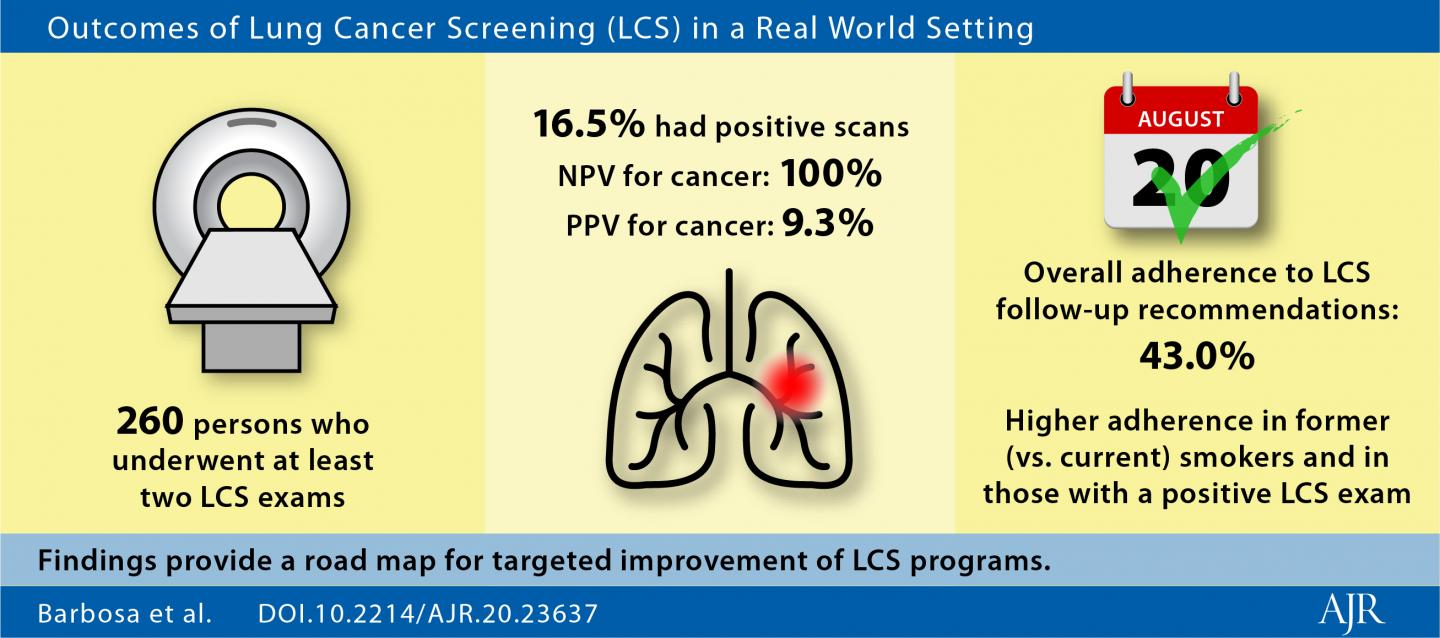
Credit: American Journal of Roentgenology (AJR)
Leesburg, VA, July 16, 2020–An Online First Accepted Manuscript published in ARRS’ American Journal of Roentgenology (AJR) finds that focusing on lung cancer screening (LCS) subjects less likely to remain in the program–those with negative low-dose CT (LDCT) exams and those who still smoke–can improve that program’s cost-effectiveness and maximize its societal benefits.
For people with a long history of smoking, LDCT LCS has been shown to decrease mortality; however, adherence to an LCS program remains significantly lower than in randomized controlled trials.
To assess real-world LDCT LCS performance and factors predictive of adherence to recommendations, three radiologists from the University of Pennsylvania’s Perelman School of Medicine retrospectively recorded patient demographics, smoking history and behavior changes, Lung-RADS category, PPV and NPV, and adherence to screening recommendations for 260 subjects returning for follow-up LDCT from 2014 to 2019.
Forty-three subjects (16.5%) had positive scans, of which 28/260 (10.8%) were Lung-RADS category 3, 8/260 (3.1%) were 4A, 6/260 (2.3%) were 4B, and 2/260 (0.8%) were 4X.
Four subjects were diagnosed with cancer: 3 lung, 1 metastatic melanoma.
Meanwhile, 143/260 (55%) subjects were current smokers at baseline, and 121/260 (46.5%) were current smokers during the last round of LCS.
Both LCS sensitivity and NPV were 100%, while specificity was 84.8% and PPV was 9.3%.
Overall adherence was 43%, though it increased progressively the higher the Lung-RADS category. Additionally, adherence was higher in former vs. current smokers (50% vs. 36.2%; p = 0.002). Ultimately, there were only two significant independent predictors of adherence: having smoked previously and a positive (? 3) Lung-RADS category.
“Our study demonstrates that a real-world LCS can perform similar to randomized controlled trials in regard to important performance metrics,” concluded first author Eduardo J. Mortani Barbosa, Jr.
Acknowledging that an economic incentive, such as an insurance premium reduction, could improve LCS adherence, Barbosa, Jr. et al. added that multimodal communication (i.e., face-to-face discussions with radiologists, letters from referring providers, reminders via electronic health records) should be investigated and incentivized.
“Such communications should emphasize that a negative LCS exam does not confer immunity to future lung cancer development,” the authors of this AJR article noted, “and that continued participation in LCS, combined with smoking cessation, is essential to accrue the maximum benefits of mortality reduction amongst persons with substantial smoking history.”
###
Founded in 1900, the American Roentgen Ray Society (ARRS) is the first and oldest radiological society in North America, dedicated to the advancement of medicine through the profession of radiology and its allied sciences. An international forum for progress in medical imaging since the discovery of the x-ray, ARRS maintains its mission of improving health through a community committed to advancing knowledge and skills with an annual scientific meeting, monthly publication of the peer-reviewed American Journal of Roentgenology (AJR), quarterly issues of InPractice magazine, AJR Live Webinars and Podcasts, topical symposia, print and online educational materials, as well as awarding scholarships via The Roentgen Fund®.
Media Contact
Logan K. Young
[email protected]
Original Source
https:/
Related Journal Article
http://dx.