• HOME
  • NEWS
  • EXPLORE
    • CAREER
      • Companies
      • Jobs
    • EVENTS
    • iGEM
      • News
      • Team
    • PHOTOS
    • VIDEO
    • WIKI
  • BLOG
  • COMMUNITY
    • FACEBOOK
    • INSTAGRAM
    • TWITTER
Thursday, May 14, 2026
BIOENGINEER.ORG
No Result
View All Result
  • Login
  • HOME
  • NEWS
  • EXPLORE
    • CAREER
      • Companies
      • Jobs
        • Lecturer
        • PhD Studentship
        • Postdoc
        • Research Assistant
    • EVENTS
    • iGEM
      • News
      • Team
    • PHOTOS
    • VIDEO
    • WIKI
  • BLOG
  • COMMUNITY
    • FACEBOOK
    • INSTAGRAM
    • TWITTER
  • HOME
  • NEWS
  • EXPLORE
    • CAREER
      • Companies
      • Jobs
        • Lecturer
        • PhD Studentship
        • Postdoc
        • Research Assistant
    • EVENTS
    • iGEM
      • News
      • Team
    • PHOTOS
    • VIDEO
    • WIKI
  • BLOG
  • COMMUNITY
    • FACEBOOK
    • INSTAGRAM
    • TWITTER
No Result
View All Result
Bioengineer.org
No Result
View All Result
Home NEWS Science News Health

Important signaling pathway in breast cancer revealed

Bioengineer by Bioengineer
January 24, 2019
in Health
Reading Time: 2 mins read
0
IMAGE
Share on FacebookShare on TwitterShare on LinkedinShare on RedditShare on Telegram

IMAGE

Credit: Kanazawa University


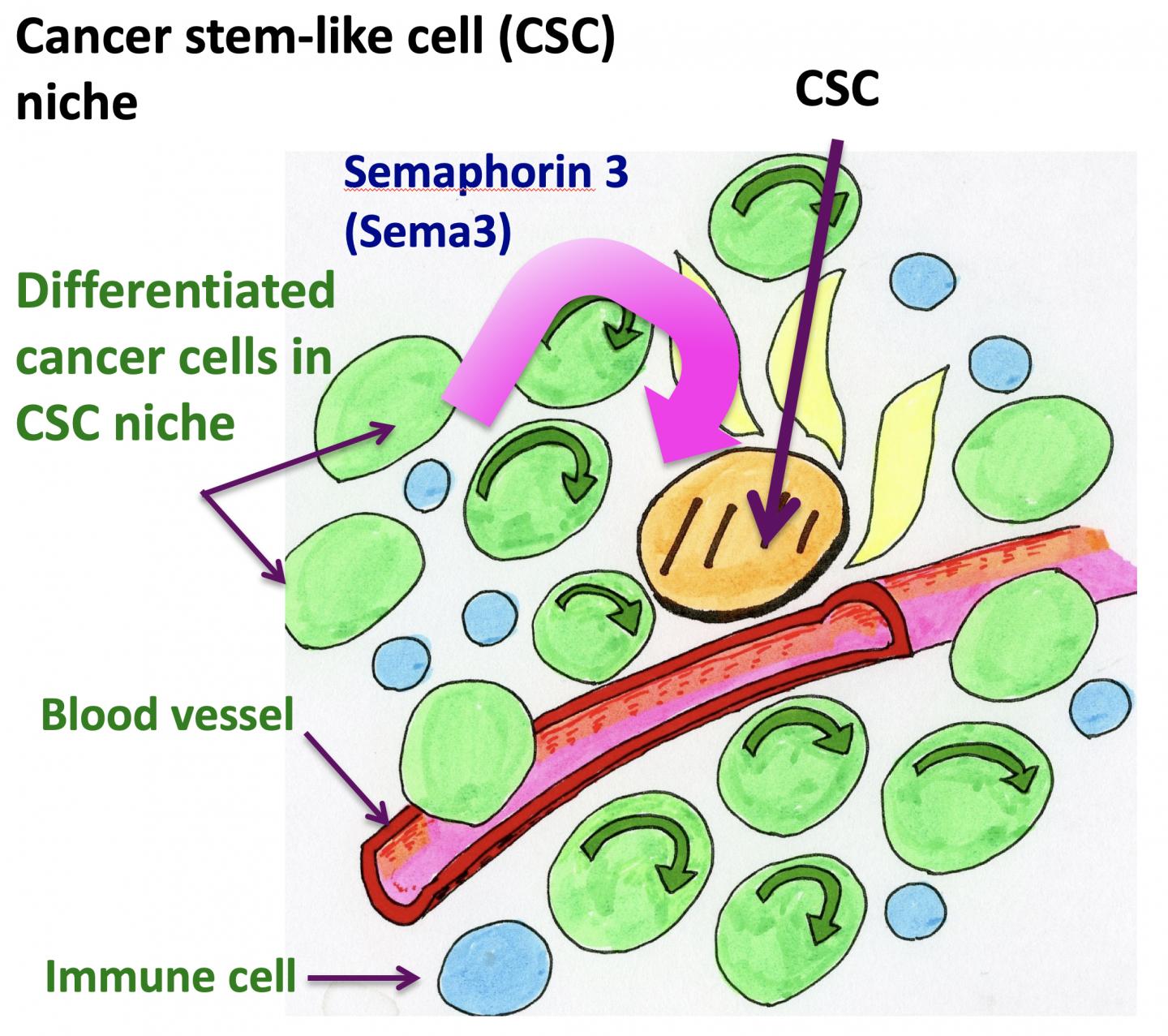
In breast cancer, one of the most common cancers in women, tumors contain a small amount of so-called cancer stem-like cells (CSCs). Being able to eliminate breast-cancer stem-like cells in a targeted way is essential for developing successful therapies — conventional treatments, such as chemotherapy or radiotherapy followed by drug intake, do not target CSCs. A better understanding of the processes generating CSCs in breast-cancer tumors is needed. Noriko Gotoh from Kanazawa University and colleagues have now uncovered a signaling pathway directly related to the proliferation of CSCs in breast cancer.

A property of stem cells is that they can self-renew and differentiate. Two types of stem-cell division can occur: symmetric or asymmetric (Fig. 1). In the former, two self-renewing stem cells are generated; in the latter, only one (and a differentiated cell). It is now believed that malignant CSCs have a higher tendency to divide symmetrically, thus increasing the number of CSCs. Gotoh and colleagues looked at how the microenvironment of CSCs, called the CSC niche, causes and sustains an increased rate of symmetric division.

The researchers started from the observation that a particular gene encoding a type of cytokine known as Semaphorin 3 (Sema3) was one of the most-expressed genes in the CSC niche (Fig. 2). (Cytokines are small proteins that, when released, affect the behavior of cells around them.) The production of Sema3 activates another protein, called MICAL3, the expression levels of which were also found to be high in the CSC niche.

Via a series of experiments in vitro, Gotoh and colleagues were able to confirm the critical roles of Sema3 and MICAL3 in breast cancer tumor development. Specifically, MICAL3 was shown to be required for tumor sphere formation (tumorigenicity is associated with spherical cell shapes). The scientists showed that Sema3-stimulated MICAL3 triggered a whole sequence of biomolecular interactions (a signaling pathway), ultimately resulting in induced symmetric division of CSCs, and hence their proliferation, in breast cancer (Fig. 3).

Having established this important pathway is highly relevant for developing treatments for breast cancer, because, quoting Gotoh and colleagues, “by inhibition of MICAL3 … or knockdown of each component in the signaling pathway, the symmetric cell division may be inhibited, leading to a reduction of breast-cancer stem-like cells.”

###

Media Contact
Yumiko Kato
[email protected]
81-762-645-963

Related Journal Article

http://dx.doi.org/10.1073/pnas.1806851116

Tags: Breast CancercancerCell BiologyMedicine/HealthMolecular Biology
Share12Tweet8Share2ShareShareShare2

Related Posts

Sleep Patterns Reveal Insights on Aging Clocks

May 14, 2026

Chinese Medical Journal Study Highlights Escalating Neurological Disease Burden in China

May 14, 2026

Study in Chinese Neurosurgical Journal Shows Minimally Invasive Techniques Effective for Treating Most Basilar Trunk Aneurysms

May 14, 2026

Tweaking Ligands Boosts Perovskite Solar Cells

May 14, 2026
Please login to join discussion

POPULAR NEWS

  • Research Indicates Potential Connection Between Prenatal Medication Exposure and Elevated Autism Risk

    842 shares
    Share 337 Tweet 211
  • New Study Reveals Plants Can Detect the Sound of Rain

    729 shares
    Share 291 Tweet 182
  • Salmonella Haem Blocks Macrophages, Boosts Infection

    62 shares
    Share 25 Tweet 16
  • Breastmilk Balances E. coli and Beneficial Bacteria in Infant Gut Microbiomes

    57 shares
    Share 23 Tweet 14

About

We bring you the latest biotechnology news from best research centers and universities around the world. Check our website.

Follow us

Recent News

Sleep Patterns Reveal Insights on Aging Clocks

Real-Time Digital Techniques Quantify Sensor Uncertainty

Chinese Medical Journal Study Highlights Escalating Neurological Disease Burden in China

Subscribe to Blog via Email

Enter your email address to subscribe to this blog and receive notifications of new posts by email.

Join 82 other subscribers
  • Contact Us

Bioengineer.org © Copyright 2023 All Rights Reserved.

Welcome Back!

Login to your account below

Forgotten Password?

Retrieve your password

Please enter your username or email address to reset your password.

Log In
No Result
View All Result
  • Homepages
    • Home Page 1
    • Home Page 2
  • News
  • National
  • Business
  • Health
  • Lifestyle
  • Science

Bioengineer.org © Copyright 2023 All Rights Reserved.