• HOME
  • NEWS
  • EXPLORE
    • CAREER
      • Companies
      • Jobs
    • EVENTS
    • iGEM
      • News
      • Team
    • PHOTOS
    • VIDEO
    • WIKI
  • BLOG
  • COMMUNITY
    • FACEBOOK
    • INSTAGRAM
    • TWITTER
Thursday, May 14, 2026
BIOENGINEER.ORG
No Result
View All Result
  • Login
  • HOME
  • NEWS
  • EXPLORE
    • CAREER
      • Companies
      • Jobs
        • Lecturer
        • PhD Studentship
        • Postdoc
        • Research Assistant
    • EVENTS
    • iGEM
      • News
      • Team
    • PHOTOS
    • VIDEO
    • WIKI
  • BLOG
  • COMMUNITY
    • FACEBOOK
    • INSTAGRAM
    • TWITTER
  • HOME
  • NEWS
  • EXPLORE
    • CAREER
      • Companies
      • Jobs
        • Lecturer
        • PhD Studentship
        • Postdoc
        • Research Assistant
    • EVENTS
    • iGEM
      • News
      • Team
    • PHOTOS
    • VIDEO
    • WIKI
  • BLOG
  • COMMUNITY
    • FACEBOOK
    • INSTAGRAM
    • TWITTER
No Result
View All Result
Bioengineer.org
No Result
View All Result
Home NEWS Science News Chemistry

Immunotherapy: Enhancing the therapeutic effectiveness of photothermal cancer treatments

Bioengineer by Bioengineer
September 16, 2020
in Chemistry
Reading Time: 2 mins read
0
IMAGE
Share on FacebookShare on TwitterShare on LinkedinShare on RedditShare on Telegram

IMAGE

Credit: by Zhongjian Xie, Minhua Peng, Ruitao Lu, Xiangying Meng, Weiyuan Liang, Zhongjun Li, Meng Qiu, Bin Zhang, Guohui Nie, Ni Xie, Han Zhang & Paras N. Prasad

The immunosuppression status within most tumors is a great challenge for the efficacy of immune checkpoint blockade, as no efficient or durable antitumor immune response would be set up or maintained. Ablation effect of photothermal therapy could cause immunogenic cell death and subsequently released damaged-associated molecular patterns act as an endogenous danger signal, hence improving the tumor immunogenicity. To improve the success rate of the therapeutic effect of immune checkpoint blockade, it would be desirable to combine with photosensitizers to potentiate antitumor immunity.

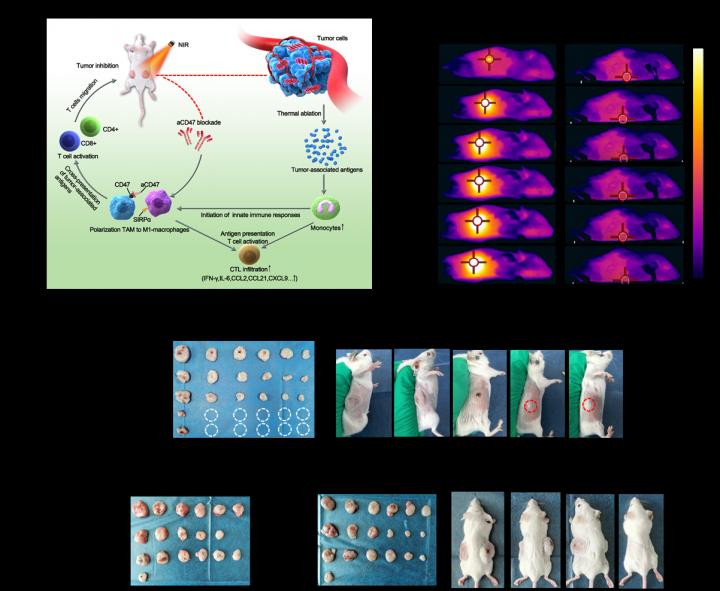
Anti-CD47 antibody (aCD47), a CD47/SIRPα axis blockade agent, has demonstrated excellent efficacy against various kinds of tumors. However aCD47 as monotherapy induces modest phagocytic activity and low response rate , resulting in failures in clinical trials. In a new paper published in Light Science & Application, a team of scientists, led by Professor Han Zhang and Professor Paras N. Prasad, reported the use of near-infrared light-induced heat to ablate tumor together with aCD47 for enhanced cancer treatment.

These scientists summarize the mechanism of this combination strategy:

    (1) BP based photothermal effect could not only directly destroy or even kill tumor cells, but also initiate the innate immune responses and trigger CTL mediated adaptive immunity, thus serving as an effective specific immunological stimulator to improve the inherently poor immunogenicity of tumors.

    (2) Light-irradiated BP in combination with aCD47, strongly suppresses proliferation and growth of cancer cells, exerting a significant synergistically enhanced antitumor effect.

    (3) BP based hyperthermic ablation plus aCD47 treatment may induce abscopal effect and promises for inhibition of metastatic cancers.

“In short, BP based photothermal effect moderates immunosuppression in a tumor microenvironment , which further enhances antitumor immunities to facilitate aCD47 blockade cancer immunotherapy. The innate and adaptive immunity activated by BP photothermal effect plus aCD47 combined therapy leads to promotion of local and systemic anticancer immune responses. This combination strategy provides a promising platform to enhance the therapeutic efficacy of aCD47 in solid tumors. Given the excellent biodegradability property of BP, it is possible that this light-induced synergistic therapy mode has great potential in biomedical applications and clinical translation.”

###

Media Contact
Paras N. Prasad
[email protected]

Related Journal Article

http://dx.doi.org/10.1038/s41377-020-00388-3

Tags: Chemistry/Physics/Materials SciencesOptics
Share12Tweet8Share2ShareShareShare2

Related Posts

On-Chip Ferroelectric Spherulites Enable Broadband Colored Skyrmion Generation — Chemistry

On-Chip Ferroelectric Spherulites Enable Broadband Colored Skyrmion Generation

May 14, 2026
Innovating an Affordable and Sustainable Marimba #ASA190 — Chemistry

Innovating an Affordable and Sustainable Marimba #ASA190

May 14, 2026

The Unseen Power Driving Growth

May 14, 2026

Examining and Overcoming Biases Surrounding Vocal Fry #ASA190

May 14, 2026
Please login to join discussion

POPULAR NEWS

  • Research Indicates Potential Connection Between Prenatal Medication Exposure and Elevated Autism Risk

    842 shares
    Share 337 Tweet 211
  • New Study Reveals Plants Can Detect the Sound of Rain

    729 shares
    Share 291 Tweet 182
  • Salmonella Haem Blocks Macrophages, Boosts Infection

    62 shares
    Share 25 Tweet 16
  • Breastmilk Balances E. coli and Beneficial Bacteria in Infant Gut Microbiomes

    57 shares
    Share 23 Tweet 14

About

We bring you the latest biotechnology news from best research centers and universities around the world. Check our website.

Follow us

Recent News

Smart City Policies Boost Aging Household Consumption Inequality

Genetically Targeted mTORC1 Inhibitor Uncovers Nuclear Control

IC-SNc Circuit Links Prepulse Inhibition Deficits in Parkinson’s

Subscribe to Blog via Email

Enter your email address to subscribe to this blog and receive notifications of new posts by email.

Join 82 other subscribers
  • Contact Us

Bioengineer.org Ā© Copyright 2023 All Rights Reserved.

Welcome Back!

Login to your account below

Forgotten Password?

Retrieve your password

Please enter your username or email address to reset your password.

Log In
No Result
View All Result
  • Homepages
    • Home Page 1
    • Home Page 2
  • News
  • National
  • Business
  • Health
  • Lifestyle
  • Science

Bioengineer.org Ā© Copyright 2023 All Rights Reserved.