A new study led by Marc Veldhoen, group leader at the Instituto de Medicina Molecular João Lobo Antunes (iMM; Portugal) and Associate Professor at Faculdade de Medicina de Lisboa (FMUL) and published today in the scientific journal PNAS (Proceedings of the National Academy of Sciences of the United States of America)* discovered that white blood cells that reside in the intestines, a specific group of immune cells called tissue resident lymphocytes, use sugar as an energy source and have a faster metabolism than lymphocytes that circulate in the blood. These findings, supported by the “la Caixa” Foundation, show that, during infections, the local availability of sugar in the gut can be helpful for the immune response and might have an impact in the faster resolution of an infection by the host,highlighting the importance of having a balanced diet for a healthy immune response.
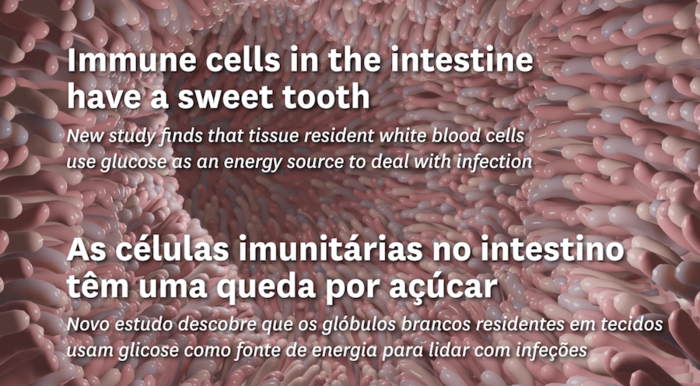
Credit: Andrés Azzolina, iMM
A new study led by Marc Veldhoen, group leader at the Instituto de Medicina Molecular João Lobo Antunes (iMM; Portugal) and Associate Professor at Faculdade de Medicina de Lisboa (FMUL) and published today in the scientific journal PNAS (Proceedings of the National Academy of Sciences of the United States of America)* discovered that white blood cells that reside in the intestines, a specific group of immune cells called tissue resident lymphocytes, use sugar as an energy source and have a faster metabolism than lymphocytes that circulate in the blood. These findings, supported by the “la Caixa” Foundation, show that, during infections, the local availability of sugar in the gut can be helpful for the immune response and might have an impact in the faster resolution of an infection by the host,highlighting the importance of having a balanced diet for a healthy immune response.
Lymphocytes are known to circulate through the body in blood vessels, acting as a surveillance system, but there is a specialized group of lymphocytes that reside permanently in tissues. In order to function properly, it’s important that cells adapt to their environment. In this study, the researchers found that a specific group of lymphocytes that reside in the intestinal wall adapt their metabolism to this tissue. “Circulating lymphocytes spend most their lifetime in the lymph nodes, where there is high availability of energy. It’s as if the lymph nodes are filled with lunch boxes. These cells can be permanently filled with energy, and even grab a box to go when they leave the lymph nodes to circulate through the body”, starts to explain Marc Veldhoen, leader of the study. However, the lymphocytes that reside in the tissues do not have the same amount of energy available. “These cells are constantly in a state of semi-activation, ready to respond to challenges, such as infections. We found that these resident lymphocytes are able to adapt to their environment in the gut, and regulate their activity depending on the availability of glucose”, adds Marc Veldhoen. “The glucose is rapidly taken by these cells to generate lactate or pyruvate, molecules that are used to produce energy.”, says Vanessa Morais, also group leader at iMM and collaborator in the study. In the gut, the resident lymphocytes are able to produce energy faster than circulating lymphocytes.
To test if glucose plays a role in the immune response to infection, researchers used a model of gut infection in mice. “We found that in mice infected with an intestinal pathogen, the local availability of glucose can determine the activation of the resident lymphocytes and to a faster clearance of infection”, explains Špela Konjar, first author of the study. These results show that resident lymphocytes are adapted to their environment, which in turn is used to regulate the response to infection. The effect of the local availability of glucose now discovered indicates that diet can affect the gut immune cells, highlighting the importance of having a balanced diet for the immune system.
This work was developed at iMM. This study was funded by the CaixaResearch Health program from “la Caixa” Foundation, the European Union’s Horizon 2020 Research and Innovation Programme, the European Molecular Biology Organization, the Portuguese Foundation for Science and Technology, and the European Regional Development Fund through the Lisbon Portugal Regional Operational Program.
* Špela Konjar, Cristina Ferreira, Filipa Sofia Carvalho, Patrícia Figueiredo-Campos, Júlia Fanczal, Sofia Ribeiro, Vanessa Alexandra Morais, and Marc Veldhoen. Intestinal tissue resident T cell activation depends on metabolite availability. PNAS. 2022
Journal
Proceedings of the National Academy of Sciences
DOI
10.1073/pnas.2202144119
Method of Research
Experimental study
Subject of Research
Animals
Article Title
Intestinal tissue resident T cell activation depends on metabolite availability.
Article Publication Date
15-Aug-2022