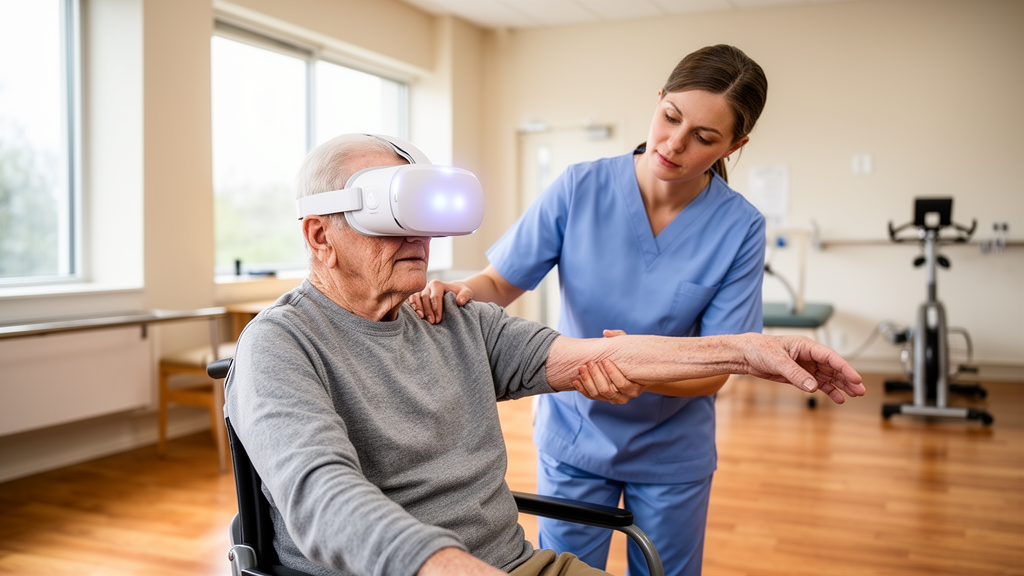
A single 60-minute session on an indigenously developed immersive virtual reality rehabilitation system called ReMind proved safe, feasible and well tolerated among 31 stroke patients in New Delhi, according to a new feasibility study published in the Bulletin of Faculty of Physical Therapy. Participants used the device for upper limb retraining for an average of 54.45 minutes without physiotherapist assistance, reported overwhelmingly positive experiences, and showed no statistically significant changes in vital signs or simulator sickness scores before and after the session. No serious adverse events were recorded.
The study, led by Zubina Khan, Rajeev Aggarwal, Harpreet S. Sachdeva, Venugopalan Y. Vishnu and Rohit Bhatia at the Department of Neurology of the All India Institute of Medical Sciences (AIIMS), New Delhi, was designed as an initial three-month phase to assess safety, acceptability and procedural aspects before a larger efficacy trial. That main trial is currently ongoing and has been prospectively registered with the Clinical Trials Registry–India. The researchers emphasize that the present study was not designed to test whether the device improves clinical outcomes, only whether patients can use it safely and independently.
ReMind was developed by SparshMind Innovation Private Limited in collaboration with the School of International Biodesign at AIIMS and IIT Delhi. It is an immersive VR rehabilitation system built specifically for the Indian rehabilitation context, with multilingual support intended to overcome language barriers that complicate stroke rehabilitation in linguistically diverse populations. The platform provides automated exercise monitoring, task-specific guidance, real-time performance feedback and positive reinforcement, and it was designed with affordability, accessibility and usability in mind. According to the authors, existing VR rehabilitation devices often face limitations related to accessibility and adaptability to individual rehabilitation needs, gaps that ReMind aims to address.
The rationale for the work rests on the scale of the problem. Stroke is the second leading cause of death and disability worldwide, affecting an estimated 15 million people annually according to the World Health Organization. Upper limb disability affects roughly 80 percent of stroke survivors, with about 30 percent experiencing severe functional limitations. Impairment may manifest as weakness, spasticity, loss of coordination or sensory deficits, making everyday activities such as dressing, eating and personal hygiene difficult and diminishing quality of life. In India, epidemiological data from ICMR indicate an incidence of one stroke every 40 seconds and a stroke-related fatality approximately every two minutes.
For the feasibility study, researchers recruited 31 patients from the neuro-physiotherapy outpatient department at AIIMS New Delhi. Inclusion criteria required a first-ever unilateral arterial stroke, either ischemic or hemorrhagic, in the subacute stage of three to six months or the chronic stage beyond six months; age of at least 18 years; a Modified Ashworth Scale spasticity score between 0 and 3; a Montréal Cognitive Assessment score of at least 18; and the ability to sit independently for at least 60 minutes. Exclusion criteria covered uncorrected auditory or visual disorders, uncontrolled medical conditions, recent musculoskeletal injuries or fractures in the affected limb, prior psychiatric illness, Parkinsonism or other neurodegenerative disorders, poorly controlled seizure disorders, and any impairment preventing safe use of the VR system.
The participant group was predominantly male, at 84 percent, with a mean age of 51 years. Most patients, 77 percent, had ischemic stroke, while 23 percent had intracerebral hemorrhage. Among those with ischemic strokes, 74 percent were anterior circulation strokes and 23 percent were posterior circulation strokes. A total of 81 percent of participants were in the chronic stage and 19 percent in the subacute stage, with no participants in the acute phase. Hypertension was the most common risk factor at 74 percent, followed by diabetes mellitus at 39 percent, and the mean Modified Rankin Scale score was 2, indicating moderate baseline disability.
Each participant completed a single 60-minute session that began with a calibration process to evaluate movement capabilities, followed by guided repetitive task training delivered in the presence of a trained physical therapist who supervised for safety. After initial setup and guidance, participants operated the device autonomously, and the duration of this independent interaction was documented. The training consisted of five immersive VR games targeting different movement patterns. Pluck and Place involved forward reaching with shoulder flexion and elbow extension, plus grasp, hold, release, forearm rotation and wrist stabilization. Punch It required repetitive punching of beach balls in indicated directions. Smash Them used bilateral reaching and striking movements demanding bilateral coordination and visuomotor integration. Match It involved picking up cylindrical objects and matching them to patterns on a board, and Tower Power required multidirectional reaching and touching of buttons and targets. The games also embedded cognitive exercises such as pattern recognition, decision-making, strategic planning and problem-solving, with difficulty progressively increasing.
Safety was assessed with the Simulator Sickness Questionnaire, a validated 16-symptom tool covering nausea, oculomotor symptoms and disorientation, administered before and after each session, alongside physiological measures of blood pressure, pulse and oxygen saturation. There was no clinically or statistically significant difference in any vital sign parameter. The mean total SSQ score after the session was 4.6, with sub-scores of 0.3 for nausea, 0.5 for oculomotor symptoms and 0.4 for disorientation, and none of the pre-to-post comparisons reached statistical significance. Three participants reported mild symptoms, including sweating, discomfort or increased eye strain; in one participant the eye strain represented a worsening of pre-existing mild eye strain. These symptoms occurred during the latter part of the session, were self-limiting and resolved spontaneously within a few minutes of rest without intervention. No participant discontinued the session, and no delayed or serious adverse events were observed.
Feedback from a customized questionnaire was strongly positive. For comfort, 71 percent of respondents rated the device as very good and 19.3 percent as good, while 6.4 percent expressed discomfort. For the overall experience, 74.2 percent described it as very good and 19.4 percent as good, with 3.2 percent reporting a bad experience. A total of 87.1 percent expressed willingness to incorporate VR therapy into their daily routine, 90.3 percent reported no difficulties during the 60-minute session, and 93.5 percent reported feeling safe while using the device. All participants successfully completed the full set of VR games, although some found tasks demanding fine motor control or prolonged attention, such as Match It and Tower Power, more challenging, primarily due to mild fatigue or difficulty with controller manipulation. The authors attribute these difficulties to first-time exposure to VR-based rehabilitation and residual motor impairments associated with stroke.
The authors are careful to frame the findings within the study’s limits. Because the design involved only a single session, no conclusions can be drawn about long-term safety, adherence, usability or therapeutic benefit. The study did not include patients in the acute phase of stroke recovery, participants generally had preserved cognitive and functional abilities, and the customized feedback questionnaire was not formally psychometrically validated, so its results should be interpreted as descriptive. The authors note that comfort and satisfaction may influence engagement with rehabilitation, and that prior studies have linked greater engagement to better clinical outcomes through active participation and repetitive task practice, while stressing that future randomized controlled trials with larger, more diverse samples are needed to assess the long-term efficacy and safety of the device, including its use in home settings and in combination with other therapies.
Subject of Research: Feasibility and safety of a single-session immersive virtual reality upper limb rehabilitation device in subacute and chronic stroke patients
Article Title: Feasibility and safety of immersive virtual reality training device (ReMind) in post-stroke rehabilitation
Article References: Khan, Z., Aggarwal, R., Sachdeva, H. S., Vishnu, V. Y., & Bhatia, R. (2026). Feasibility and safety of immersive virtual reality training device (ReMind) in post-stroke rehabilitation. Bulletin of Faculty of Physical Therapy, 31(1), Article 45. https://doi.org/10.1186/s43161-026-00384-5
Image Credits: AI Generated
DOI: 10.1186/s43161-026-00384-5
Keywords: stroke rehabilitation, virtual reality, ReMind, upper limb, feasibility study, simulator sickness, repetitive task training, physiotherapy, AIIMS New Delhi, patient safety, immersive technology, neurorehabilitation
News Source: Cassandra Pierce. (October 28, 2026). Immersive VR Device ReMind Proves Safe and Feasible for Stroke Rehabilitation. Scienmag.