• HOME
  • NEWS
  • EXPLORE
    • CAREER
      • Companies
      • Jobs
    • EVENTS
    • iGEM
      • News
      • Team
    • PHOTOS
    • VIDEO
    • WIKI
  • BLOG
  • COMMUNITY
    • FACEBOOK
    • INSTAGRAM
    • TWITTER
Friday, July 10, 2026
BIOENGINEER.ORG
No Result
View All Result
  • Login
  • HOME
  • NEWS
  • EXPLORE
    • CAREER
      • Companies
      • Jobs
        • Lecturer
        • PhD Studentship
        • Postdoc
        • Research Assistant
    • EVENTS
    • iGEM
      • News
      • Team
    • PHOTOS
    • VIDEO
    • WIKI
  • BLOG
  • COMMUNITY
    • FACEBOOK
    • INSTAGRAM
    • TWITTER
  • HOME
  • NEWS
  • EXPLORE
    • CAREER
      • Companies
      • Jobs
        • Lecturer
        • PhD Studentship
        • Postdoc
        • Research Assistant
    • EVENTS
    • iGEM
      • News
      • Team
    • PHOTOS
    • VIDEO
    • WIKI
  • BLOG
  • COMMUNITY
    • FACEBOOK
    • INSTAGRAM
    • TWITTER
No Result
View All Result
Bioengineer.org
No Result
View All Result
Home NEWS Science News Chemistry

Image release: Galaxies in the Perseus Cluster

Bioengineer by Bioengineer
November 12, 2020
in Chemistry
Reading Time: 2 mins read
0
IMAGE
Share on FacebookShare on TwitterShare on LinkedinShare on RedditShare on Telegram

Images show effect of environment on galaxies
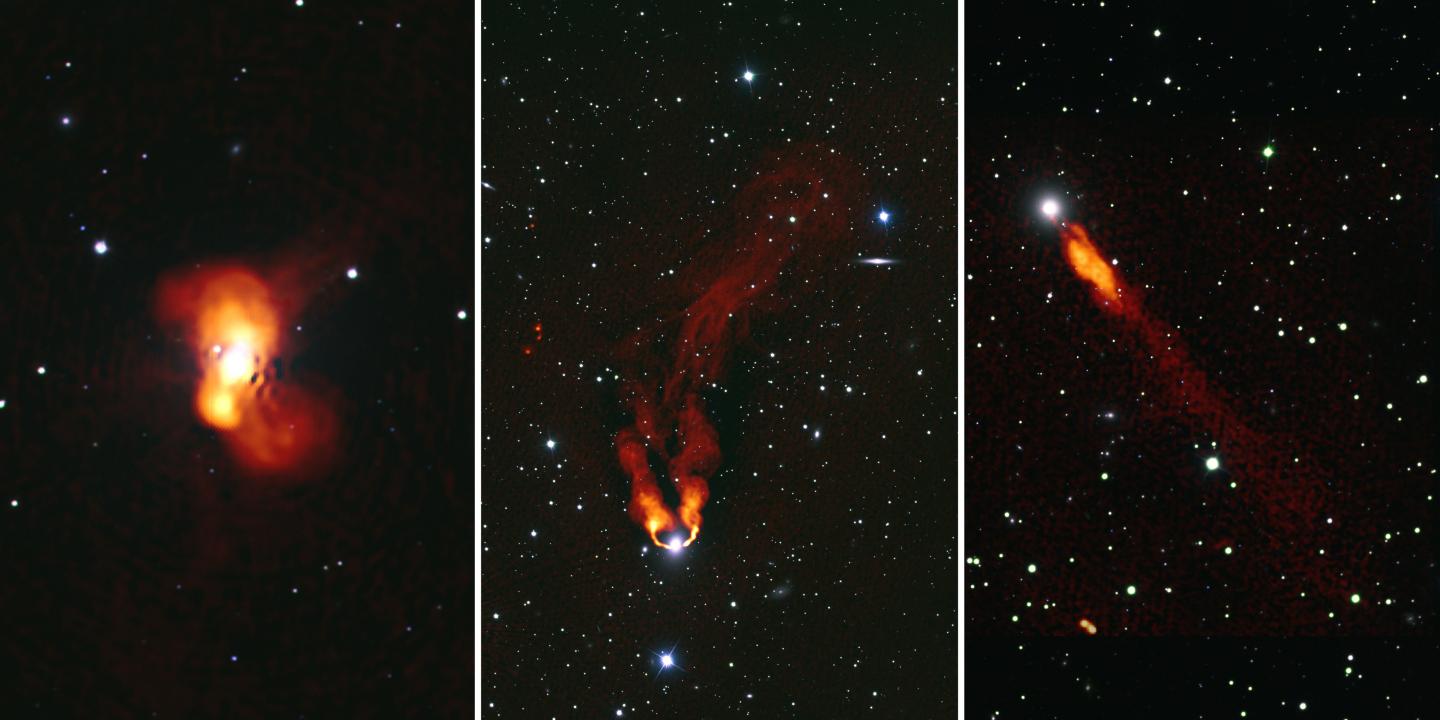
IMAGE

Credit: M. Gendron-Marsolais et al.; S. Dagnello, NRAO/AUI/NSF; Sloan Digital Sky Survey.

For galaxies, as for people, living in a crowd is different from living alone. Recently, astronomers used the National Science Foundation’s Karl G. Jansky Very Large Array (VLA) to learn how a crowded environment affects galaxies in the Perseus Cluster, a collection of thousands of galaxies some 240 million light-years from Earth.

Left: The giant galaxy NGC 1275, at the core of the cluster, is seen in new detail, including a newly-revealed wealth of complex, filamentary structure in its radio lobes.

Center: The galaxy NGC 1265 shows the effects of its motion through the tenuous material between the galaxies. Its radio jets are bent backward by that interaction, then merge into a single, broad “tail.” The tail then is further bent, possibly by motions within the intergalactic material.

Right: The jets of the galaxy IC 310 are bent backward, similarly to NGC 1265, but appear closer because of the viewing angle from Earth. That angle also allows astronomers to directly observe energetic gamma rays generated near the supermassive black hole at the galaxy’s core.

Such images can help astronomers better understand the complex environment of galaxy clusters, which are the largest gravitationally-bound structures in the universe, and which harbor a variety of still poorly-understood phenomena.

“These images show us previously-unseen structures and details and that helps our effort to determine the nature of these objects,” said Marie-Lou Gendron-Marsolais, an ESO/ALMA Fellow in Santiago, Chile. She and a number of international collaborators are announcing their results in the Monthly Notices of the Royal Astronomical Society.

###

The National Radio Astronomy Observatory is a facility of the National Science Foundation, operated under cooperative agreement by Associated Universities, Inc.

CREDIT: M. Gendron-Marsolais et al.; S. Dagnello, NRAO/AUI/NSF; Sloan Digital Sky Survey.

Media Contact
Dave Finley
[email protected]

Tags: AstronomyAstrophysicsChemistry/Physics/Materials SciencesSpace/Planetary Science
Share12Tweet8Share2ShareShareShare2

Related Posts

Scientists create new method to control quantum states in 2D materials

Scientists create new method to control quantum states in 2D materials

July 10, 2026
Scientists Capture Cosmic Drift Preceding Star Birth

Scientists Capture Cosmic Drift Preceding Star Birth

July 10, 2026

Artificial Intelligence Transforms Material Synthesis Methods

July 10, 2026

Computer Chip Uses Vibrations for Memory Storage

July 10, 2026
Please login to join discussion

POPULAR NEWS

  • Detection of EDCs in Breast Milk and Infant Urine Up to Six Months Highlights Early Exposure Risks

    77 shares
    Share 31 Tweet 19
  • New Drug Candidate Developed at McMaster Shows Potential for Treating Brain Cancer

    58 shares
    Share 23 Tweet 15
  • KTU Researchers Explore Ultrasound’s Role in Enhancing Blood Flow Beyond Diagnostics

    53 shares
    Share 21 Tweet 13
  • 高齢者の骨粗鬆症治療の持続性比較

    51 shares
    Share 20 Tweet 13

About

We bring you the latest biotechnology news from best research centers and universities around the world. Check our website.

Follow us

Recent News

Machine Learning Speeds Radiopharmaceutical Discovery and Personalizes Dosimetry

Scientists create new method to control quantum states in 2D materials

Measles Vaccine Usage Trends in Children Aged 12-47 Months, 2015-2025

Subscribe to Blog via Email

Enter your email address to subscribe to this blog and receive notifications of new posts by email.

Join 84 other subscribers
  • Contact Us

Bioengineer.org © Copyright 2023 All Rights Reserved.

Welcome Back!

Login to your account below

Forgotten Password?

Retrieve your password

Please enter your username or email address to reset your password.

Log In
No Result
View All Result
  • Homepages
    • Home Page 1
    • Home Page 2
  • News
  • National
  • Business
  • Health
  • Lifestyle
  • Science

Bioengineer.org © Copyright 2023 All Rights Reserved.