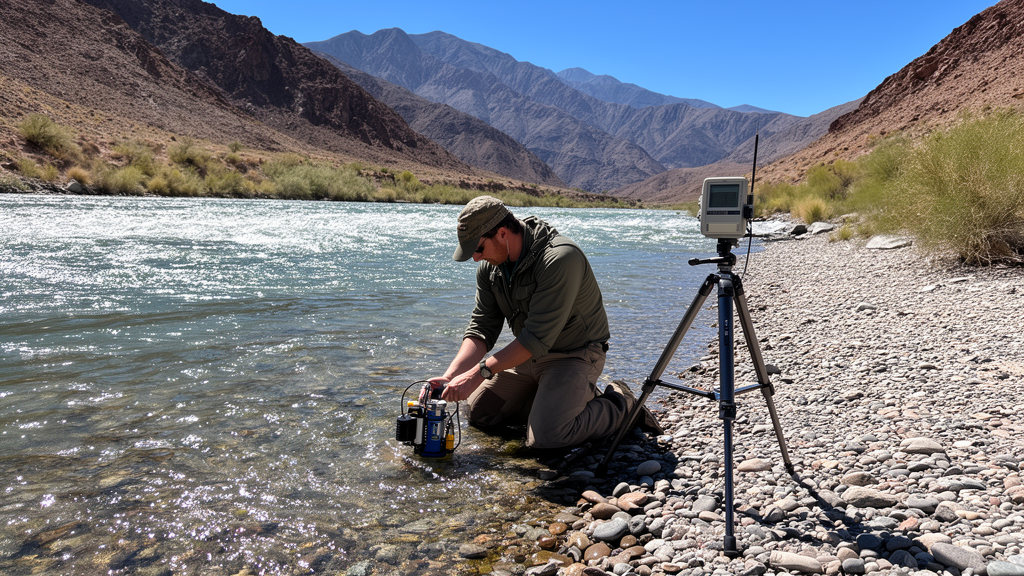
Researchers have developed and evaluated three machine learning frameworks to predict daily riverflow in the Kashkan River Watershed of Iran, finding that a model combining regression trees with random search optimization offered the highest predictive accuracy. The study, published in the journal AI in Civil Engineering, addresses the challenge of water scarcity by applying stochastic artificial intelligence techniques to hydrological data. By integrating optimization algorithms with standard regression tree models, the team aimed to enhance the reliability of streamflow estimates amidst the inherent uncertainties of natural water systems. The primary objective was to determine whether systematic hyperparameter optimization could reduce prediction errors and improve the robustness of data-driven hydrological forecasting.
The research focused on the Kashkan River, a waterway approximately 270 kilometers long located in Lorestan Province that ultimately flows into Karkheh Dam Lake in Khuzestan Province. The river exhibits significant variability in flow, ranging from a low of 3.5 cubic meters per second to a peak of 4,600 cubic meters per second. This hydrological variability, combined with recent transitions toward more turbulent and flood-prone conditions, necessitated the use of advanced data-driven modeling techniques. The study utilized historical daily data records obtained from the Iran Water Resources Company database, covering the period from 2017 to 2018. This dataset encompassed key hydrological parameters necessary for modeling the river’s complex and nonlinear streamflow dynamics.
The methodology centered on the regression tree (RT) model, selected for its high interpretability, ability to handle nonlinear relationships, and relatively low computational burden. Regression trees operate by recursively partitioning data to identify homogeneous groups, creating an interpretable decision structure that requires minimal preprocessing. To enhance the performance of this baseline model, the researchers implemented two distinct optimization strategies: Random Search (RS) and Bayesian Optimization (BO). Random search involves generating random design vectors to navigate constraint boundaries, while Bayesian optimization uses a probabilistic surrogate model and an acquisition function to efficiently converge toward optimal hyperparameter configurations. These strategies were applied to create two hybrid models: the Random Search Regression Tree (RSRT) and the Bayesian Optimization Regression Tree (BORT).
The dataset was divided into training and testing subsets using a 70/30 split to ensure an equitable evaluation of model efficacy. This preprocessing step aimed to eliminate redundancy and bolster model generalizability, particularly given the constraints of the limited dataset size. The performance of the three models—baseline RT, RSRT, and BORT—was assessed using five widely recognized metrics: root mean square error (RMSE), mean absolute error (MAE), Nash–Sutcliffe efficiency (NSE), Scatter Index (SI), and coefficient of determination (R2). Additionally, the study employed Wilson Score Interval-based uncertainty quantification to investigate the impact of computational uncertainties and the implications of modeling risks, providing a more rigorous and transparent predictive architecture.
The results indicated that the RSRT model demonstrated superior performance and accuracy metrics in streamflow modeling compared to the other configurations. In terms of correlation, the RSRT model achieved the highest coefficient with an R value of 0.9915, indicating a strong linear relationship between predicted and actual values. The BORT model followed with an R value of 0.9862, while the baseline RT model recorded a lower correlation of 0.9694. These findings suggest that the random search algorithm effectively enhanced the model’s generalization capacity, allowing it to track river flow more accurately than the unoptimized or Bayesian-optimized counterparts. The tight clustering of data points along the 1:1 line for RSRT further supported its enhanced predictive stability.
Quantitative analysis of error metrics confirmed the advantage of the RSRT framework. The model achieved the lowest MAE of 0.1136 cubic meters per second and the lowest RMSE of 0.2485 cubic meters per second. This represented a 22.9% improvement in MAE over the BORT model and a 54.4% improvement over the baseline RT model. Similarly, the RSRT model improved RMSE by 28.1% compared to BORT and by 47.4% compared to RT. The Scatter Index for RSRT was 0.1200, which was 28.1% lower than BORT and 47.4% lower than RT, demonstrating greater structural agreement with the actual hydrograph. These reductions in error metrics highlight the significant impact of optimization strategies on minimizing prediction deviations in hydrological modeling.
Uncertainty analysis using the Wilson Score Interval method provided further insights into the reliability of the models. The mean values across all models exhibited a notable degree of consistency, ranging from 2.06 to 2.10, suggesting that the central tendencies of the predictions remained stable regardless of the modeling technique. However, the standard deviation varied slightly, with the baseline RT having the lowest value of 1.8786, followed by RSRT at 1.8901, and BORT at 1.8946. The Weighted Uncertainty Bound (WUB) values indicated that BORT had the highest value of 17.02, compared to 16.98 for RSRT and 16.87 for RT. Despite these subtle differences, the RSRT model was identified as demonstrating the most balanced performance, achieving a slightly better WUB coverage than RT and a tighter standard deviation than BORT, indicating more reliable predictions when combining accuracy and uncertainty handling.
Additional validation techniques, including Regression Receiver Operating Characteristic (RROC) analysis and probability density function (PDF) diagrams, further supported the superiority of the RSRT model. The RROC analysis, which visualizes model error through overestimation and underestimation, showed that RSRT achieved the lowest Area Over the RROC Curve (AOC) of 489.477. This value was significantly lower than the AOC for BORT (939.0935) and the baseline RT (1764.0942), indicating that RSRT had the least cumulative error in both prediction directions. The PDF diagrams revealed that the prediction errors for RSRT were closely grouped around zero, with a sharp and narrow peak. This model exhibited the lowest standard deviation of errors at 0.25 and the smallest bandwidth of 0.02, signifying a higher level of confidence and accuracy compared to the wider error distributions observed in the BORT and RT models.
The study acknowledges several limitations that affect the interpretation of the results. A primary constraint is the short time span of the dataset, which covers only two years of daily discharge data from 2017 to 2018. This limited temporal coverage may not adequately represent long-term hydrological variability, seasonal anomalies, or the impact of extreme events. Furthermore, the diversity of model inputs was limited due to the unavailability of detailed hydrological data, such as precipitation, temperature, and upstream flow conditions. These factors suggest that while the models performed well within the tested scope, their generalizability to broader or more extreme hydrological scenarios remains to be fully established.
The findings suggest that integrating regression tree models with stochastic optimization algorithms can significantly enhance the accuracy and robustness of riverflow predictions. The RSRT model, in particular, demonstrated the ability to capture the nonlinear dynamics of the Kashkan River Basin more effectively than traditional or less optimized approaches. The study highlights the importance of systematic hyperparameter optimization in data-driven hydrological modeling, offering a pathway for improved decision-making in water resources management. Future research is recommended to incorporate longer time series and more comprehensive hydrological variables to further enhance model robustness. Additionally, the integration of hybrid physical-data-driven approaches and statistical hypothesis testing could provide deeper insights into the significance of performance differences among models, ensuring that observed improvements are not due to random variation.
The study represents the first simultaneous application of both Bayesian Optimization and Random Search techniques to optimize regression tree models for surface water streamflow prediction. This dual-approach methodology was designed to address specific gaps in existing hydrological modeling, which often rely on single-model architectures and narrow optimization strategies. By integrating these distinct optimization algorithms, the researchers aimed to capture the underlying uncertainties and nonlinearities in streamflow data that conventional approaches may fail to fully represent. The framework also introduced novel interpretability features, including visual analytics and quantitative uncertainty metrics, to establish a more transparent predictive architecture for water resource management.
Validation of the models extended beyond standard error metrics to include a detailed analysis of error distribution intervals. Out of 126 test samples, the RSRT model achieved an accuracy surpassing 99 percent in 42 instances, representing 33 percent of the total dataset. The BORT model recorded 43 samples within this lower error range, while the baseline RT model achieved this level of precision in 23 samples. These results indicate that while all three models performed well, the optimized variants provided a higher frequency of highly accurate predictions. The analysis of error percentages across distinct intervals further demonstrated the stability of the RSRT model in maintaining low error rates across the majority of the test set.
The discussion section of the study quantifies the relative improvements of the hybrid models against the baseline configuration. The BORT model achieved approximately a 7.4 percent improvement in accuracy compared to the unoptimized regression tree, while the RSRT model outperformed the baseline by approximately 11 percent. These figures underscore the comparative superiority of the random search algorithm in exploring the parameter space effectively. The findings align with broader trends in the field where optimization-assisted machine learning has shown promise in enhancing forecast accuracy for complex environmental systems. The consistent delivery of lower prediction errors and higher correlation with observed discharge by the RSRT model confirms its efficiency under the highly nonlinear dynamics of the Kashkan Basin.
Despite the promising results, the authors emphasize the need for future research to address the current limitations of the dataset. The recommendation includes incorporating longer time series data and more comprehensive hydrological variables to enhance model robustness and generalization. Additionally, the study suggests the integration of hybrid physical-data-driven approaches to further improve accuracy and interpretability in complex environments. Future work is also encouraged to incorporate uncertainty quantification during the model training phase, potentially through Monte Carlo simulations or repeated runs with varied random seeds. Statistical hypothesis testing methods, such as t-tests or analysis of variance, are proposed to validate the significance of performance differences among models, ensuring that observed improvements are not attributable to random variation.
Subject of Research: Evaluation of stochastic AI models for riverflow estimation in the Kashkan River Watershed
Article Title: Stochastic artificial intelligence models for water resources management: innovative riverflow estimation amidst uncertainty
Article References: Poursaeid, M. (2025). Stochastic artificial intelligence models for water resources management: innovative riverflow estimation amidst uncertainty. AI in Civil Engineering, 4(1), Article 19. https://doi.org/10.1007/s43503-025-00062-w
Image Credits: AI Generated
DOI: 10.1007/s43503-025-00062-w
Keywords: machine learning, riverflow prediction, hydrology, regression trees, Bayesian optimization, random search, water resources management, Kashkan River, uncertainty quantification, artificial intelligence, Stochastic, artificial
News Source: Blake Davidson. (November 10, 2026). Hybrid AI models improve riverflow prediction accuracy in Iran. Scienmag.