• HOME
  • NEWS
  • EXPLORE
    • CAREER
      • Companies
      • Jobs
    • EVENTS
    • iGEM
      • News
      • Team
    • PHOTOS
    • VIDEO
    • WIKI
  • BLOG
  • COMMUNITY
    • FACEBOOK
    • INSTAGRAM
    • TWITTER
Tuesday, June 2, 2026
BIOENGINEER.ORG
No Result
View All Result
  • Login
  • HOME
  • NEWS
  • EXPLORE
    • CAREER
      • Companies
      • Jobs
        • Lecturer
        • PhD Studentship
        • Postdoc
        • Research Assistant
    • EVENTS
    • iGEM
      • News
      • Team
    • PHOTOS
    • VIDEO
    • WIKI
  • BLOG
  • COMMUNITY
    • FACEBOOK
    • INSTAGRAM
    • TWITTER
  • HOME
  • NEWS
  • EXPLORE
    • CAREER
      • Companies
      • Jobs
        • Lecturer
        • PhD Studentship
        • Postdoc
        • Research Assistant
    • EVENTS
    • iGEM
      • News
      • Team
    • PHOTOS
    • VIDEO
    • WIKI
  • BLOG
  • COMMUNITY
    • FACEBOOK
    • INSTAGRAM
    • TWITTER
No Result
View All Result
Bioengineer.org
No Result
View All Result
Home NEWS Science News Biology

Illuminating the path to hearing recovery

Bioengineer by Bioengineer
April 16, 2024
in Biology
Reading Time: 3 mins read
0
Schematic diagram illustrating the activation mechanism of GPR156 in comparison with representative class C GPCRs, mGlu2, and GABAB receptors
Share on FacebookShare on TwitterShare on LinkedinShare on RedditShare on Telegram

Professor Yunje Cho’s research team from the Department of Life Sciences at Pohang University of Science and Technology (POSTECH, Republic of Korea) has collaborated with Professor Kwang Pyo Kim’s group from the Department of Applied Chemistry at Kyung Hee University (KHU, ROK), Professor Vsevolod Katritch’s team from the University of Southern California (USC, USA), and Professor Carol V. Robinson from the University of Oxford (UK) to uncover the mysteries surrounding a specific receptor protein associated with hearing. Their findings have recently been published in the online edition of Nature Structural & Molecular Biology.
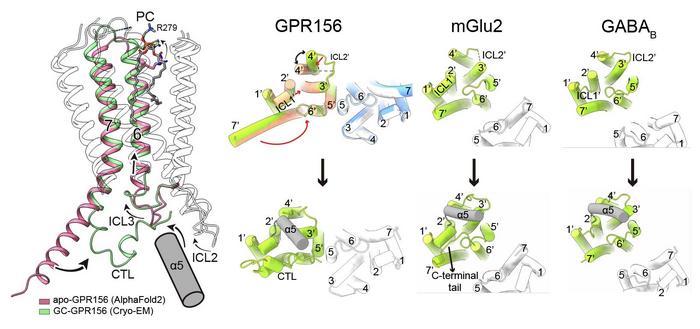
Schematic diagram illustrating the activation mechanism of GPR156 in comparison with representative class C GPCRs, mGlu2, and GABAB receptors

Credit: POSTECH

Professor Yunje Cho’s research team from the Department of Life Sciences at Pohang University of Science and Technology (POSTECH, Republic of Korea) has collaborated with Professor Kwang Pyo Kim’s group from the Department of Applied Chemistry at Kyung Hee University (KHU, ROK), Professor Vsevolod Katritch’s team from the University of Southern California (USC, USA), and Professor Carol V. Robinson from the University of Oxford (UK) to uncover the mysteries surrounding a specific receptor protein associated with hearing. Their findings have recently been published in the online edition of Nature Structural & Molecular Biology.


Deep within the inner ear lie the cochlea, responsible for sound detection, and the vestibular apparatus, which oversees balance. Cells within these regions harbor a class C orphan G-protein-coupled receptor (GPCR) called GPR156. When this receptor is activated, it binds with G-proteins inside the cell, facilitating signal transmission. Unlike its counterparts, GPR156 exhibits sustained activity even in the absence of external stimuli, playing a pivotal role in upholding auditory and balance functions. Unveiling the structural and functional intricacies of GPR156 holds promise for devising interventions for individuals with congenital hearing impairments.


The research team employed cryo-electron microscopy (cryo-EM) analysis to delve into the GPR156 in the Go-free and Go-coupled states, achieving unprecedented resolution. Their investigation unearthed the mechanisms behind GPR156’s ability to maintain heightened activity sans activators.


Their analysis confirmed that GPR156 activation hinges on its interaction with abundant lipids in the cell membrane, triggering structural shifts upon engagement with G-proteins in the cytoplasm. Notably, unlike conventional GPCRs, GPR156 exhibits flexibility in altering the structure of the seventh helix as it traverses the cell membrane, thereby facilitating binding with G-proteins and orchestrating signal activation to detect sound. This study represents a crucial step forward in unraveling the structural dynamics and activation mechanisms of GPR156.


Professor Yunje Cho of POSTECH remarked, “Congenital hearing and balance impairments afflict numerous individuals. I am hopeful that our research will pave the way for groundbreaking treatments and drug discoveries to alleviate their suffering.”


This research received financial support from the National Research Foundation of Korea.


Journal

Nature Structural & Molecular Biology

DOI

10.1038/s41594-024-01224-7

Article Title

Constitutive activation mechanism of a class C GPCR

Article Publication Date

8-Feb-2024

Share12Tweet8Share2ShareShareShare2

Related Posts

How Screens Are Reshaping Childhood: New Research Reveals the Developing Brain Integrates Experience Until Age 25, Impacting Mental Health Deeply — Biology

How Screens Are Reshaping Childhood: New Research Reveals the Developing Brain Integrates Experience Until Age 25, Impacting Mental Health Deeply

June 2, 2026
Why Most Biology Education Guidelines Overlook Society — UW Researchers Highlight the Consequences — Biology

Why Most Biology Education Guidelines Overlook Society — UW Researchers Highlight the Consequences

June 2, 2026

Mount Sinai Scientists Identify Significant Genetic Factors in Postpartum Psychosis, Shedding Light on Severe Maternal Mental Illness

June 2, 2026

Jumping Genes Surprise Scientists on the Y Chromosome

June 1, 2026

POPULAR NEWS

  • ESMO 2025: mRNA COVID Vaccines Enhance Efficacy of Cancer Immunotherapy

    320 shares
    Share 128 Tweet 80
  • Multi-Hospital Study Reveals Long Covid Burden Is Twice as High as Current Estimates

    86 shares
    Share 34 Tweet 21
  • Saying Goodbye to PGY-6: Pediatric Fellowship Realities

    63 shares
    Share 25 Tweet 16
  • Common Food Preservatives Associated with Elevated Blood Pressure and Increased Heart Disease Risk

    57 shares
    Share 23 Tweet 14

About

We bring you the latest biotechnology news from best research centers and universities around the world. Check our website.

Follow us

Recent News

Student-Athletes’ Struggle: Inside Their Sleep Challenges

Experimental Molecule “Reprograms” Brain’s Defenses to Combat Alzheimer’s Disease

How Screens Are Reshaping Childhood: New Research Reveals the Developing Brain Integrates Experience Until Age 25, Impacting Mental Health Deeply

Subscribe to Blog via Email

Enter your email address to subscribe to this blog and receive notifications of new posts by email.

Join 82 other subscribers
  • Contact Us

Bioengineer.org © Copyright 2023 All Rights Reserved.

Welcome Back!

Login to your account below

Forgotten Password?

Retrieve your password

Please enter your username or email address to reset your password.

Log In
No Result
View All Result
  • Homepages
    • Home Page 1
    • Home Page 2
  • News
  • National
  • Business
  • Health
  • Lifestyle
  • Science

Bioengineer.org © Copyright 2023 All Rights Reserved.