• HOME
  • NEWS
  • EXPLORE
    • CAREER
      • Companies
      • Jobs
    • EVENTS
    • iGEM
      • News
      • Team
    • PHOTOS
    • VIDEO
    • WIKI
  • BLOG
  • COMMUNITY
    • FACEBOOK
    • INSTAGRAM
    • TWITTER
Wednesday, April 29, 2026
BIOENGINEER.ORG
No Result
View All Result
  • Login
  • HOME
  • NEWS
  • EXPLORE
    • CAREER
      • Companies
      • Jobs
        • Lecturer
        • PhD Studentship
        • Postdoc
        • Research Assistant
    • EVENTS
    • iGEM
      • News
      • Team
    • PHOTOS
    • VIDEO
    • WIKI
  • BLOG
  • COMMUNITY
    • FACEBOOK
    • INSTAGRAM
    • TWITTER
  • HOME
  • NEWS
  • EXPLORE
    • CAREER
      • Companies
      • Jobs
        • Lecturer
        • PhD Studentship
        • Postdoc
        • Research Assistant
    • EVENTS
    • iGEM
      • News
      • Team
    • PHOTOS
    • VIDEO
    • WIKI
  • BLOG
  • COMMUNITY
    • FACEBOOK
    • INSTAGRAM
    • TWITTER
No Result
View All Result
Bioengineer.org
No Result
View All Result
Home NEWS Science News Biology

Identification of a misssing archaeal subunit of KEOPS complex supports the archaeal origin of Eukaryotes theory

Bioengineer by Bioengineer
June 6, 2023
in Biology
Reading Time: 3 mins read
0
A proposed model for the evolution of TC-transferases and its complexes.
Share on FacebookShare on TwitterShare on LinkedinShare on RedditShare on Telegram

 KEOPS is composed of Pcc1, Kae1, Bud32, Cgi121, and the eukaryotes-specific fifth subunit Gon7, and functions in N6-threonylcarbamoyl adenosine (t6A) modification of tRNAs, DNA repair, and telomere maintenance, etc. However, the origin of eukaryotic Gon7 subunit and whether archaeal KEOPS functions beyond t6A modification is unclear. Firstly, the researchers found a protein annotated as Pcc1-like co-purified with Pcc1 and Kae1 in the hyperthermophilic archaeon Sulfolobus islandicus REY15A. Interestingly, Pcc1-like is distributed in most archaea, which is possibly a counterpart of eukaryotes Gon7. To verify this hypothesis, they constructed the Pcc1-Kae1 subcomplex in different conditions. The results showed that Pcc1-like disrupts the dimerization of the Kae1:Pcc1 subcomplex, just like the function of Gon7 in eukaryotes. Structure modeling also supports this hypothesis. “Archaea Pcc1-like is the putative functional and structural homolog of Gon7,” the first author Pengju says.
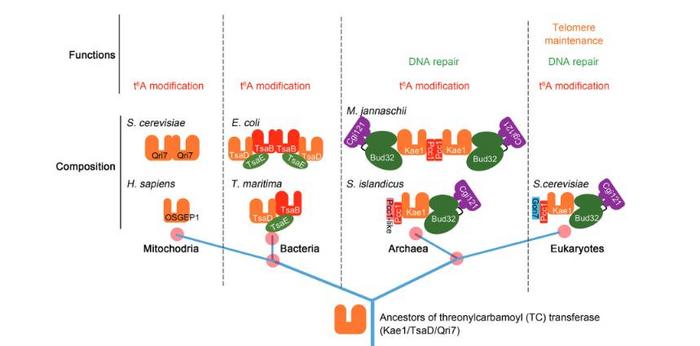
A proposed model for the evolution of TC-transferases and its complexes.

Credit: Beijing Zhongke Journal Publising Co. Ltd.

 KEOPS is composed of Pcc1, Kae1, Bud32, Cgi121, and the eukaryotes-specific fifth subunit Gon7, and functions in N6-threonylcarbamoyl adenosine (t6A) modification of tRNAs, DNA repair, and telomere maintenance, etc. However, the origin of eukaryotic Gon7 subunit and whether archaeal KEOPS functions beyond t6A modification is unclear. Firstly, the researchers found a protein annotated as Pcc1-like co-purified with Pcc1 and Kae1 in the hyperthermophilic archaeon Sulfolobus islandicus REY15A. Interestingly, Pcc1-like is distributed in most archaea, which is possibly a counterpart of eukaryotes Gon7. To verify this hypothesis, they constructed the Pcc1-Kae1 subcomplex in different conditions. The results showed that Pcc1-like disrupts the dimerization of the Kae1:Pcc1 subcomplex, just like the function of Gon7 in eukaryotes. Structure modeling also supports this hypothesis. “Archaea Pcc1-like is the putative functional and structural homolog of Gon7,” the first author Pengju says.

   By introducing a t6A modification system from the thermophilic bacteria Thermotoga miritima into S. islandicus REY15A, the researchers found that it can complement the t6A modification function but not other fundemental functions of the archaeal KEOPS. Combined with the studies of threonylcarbamoyl adenosine (TC) transferases in other organisms’ t6A modification, a model for the evolution of the KEOPS and other t6A modification systems was proposed. “All t6A modification systems may have common ancestors,” the author explained, “and eukaryotic KEOPS shares additional similarity in composition, structure and functions to archaeal KEOPS, which provide the evidence for the the archaeal origin of Eukaryotes theory”.


See the article:

The archaeal KEOPS complex possesses a functional Gon7 homolog and has an essential function independent of the cellular t6A modification level

https://doi.org/10.1002/mlf2.12051


Journal

mLife

DOI

10.1002/mlf2.12051

Article Title

The archaeal KEOPS complex possesses a functional Gon7 homolog and has an essential function independent of the cellular t6A modification level

Article Publication Date

8-Jan-2023

Share13Tweet8Share2ShareShareShare2

Related Posts

Effortless Learning: How the Single-Celled Stentor Masters New Information — Biology

Effortless Learning: How the Single-Celled Stentor Masters New Information

April 29, 2026
UH Professor Advocates Enhanced Prevention and Treatment Strategies to Alleviate Liver Disease Impact — Biology

UH Professor Advocates Enhanced Prevention and Treatment Strategies to Alleviate Liver Disease Impact

April 28, 2026

Impact of Toxic PCBs on Sex-Biased Genes and Brain Development

April 28, 2026

Scientists Uncover Enzyme’s Role in Infertility and Cancer Progression

April 28, 2026

POPULAR NEWS

  • Research Indicates Potential Connection Between Prenatal Medication Exposure and Elevated Autism Risk

    827 shares
    Share 331 Tweet 207
  • New Study Reveals Plants Can Detect the Sound of Rain

    703 shares
    Share 281 Tweet 176
  • Scientists Investigate Possible Connection Between COVID-19 and Increased Lung Cancer Risk

    67 shares
    Share 27 Tweet 17
  • Salmonella Haem Blocks Macrophages, Boosts Infection

    60 shares
    Share 24 Tweet 15

About

We bring you the latest biotechnology news from best research centers and universities around the world. Check our website.

Follow us

Recent News

Tracing the Journey of Antibiotic-Resistant Bacteria: From Poultry Farms to Fresh Produce

SKKU Advances Battery Manufacturing Using Density Dry Electrode Technology, Aims for Foundry Commercialization

UT MD Anderson Launches Center for Cellular Language Intelligence Following $10 Million Gift from Peggy and Carl Sewell

Subscribe to Blog via Email

Enter your email address to subscribe to this blog and receive notifications of new posts by email.

Join 82 other subscribers
  • Contact Us

Bioengineer.org © Copyright 2023 All Rights Reserved.

Welcome Back!

Login to your account below

Forgotten Password?

Retrieve your password

Please enter your username or email address to reset your password.

Log In
No Result
View All Result
  • Homepages
    • Home Page 1
    • Home Page 2
  • News
  • National
  • Business
  • Health
  • Lifestyle
  • Science

Bioengineer.org © Copyright 2023 All Rights Reserved.