Hospitals need to identify and develop interventions to help ICU patients return to work
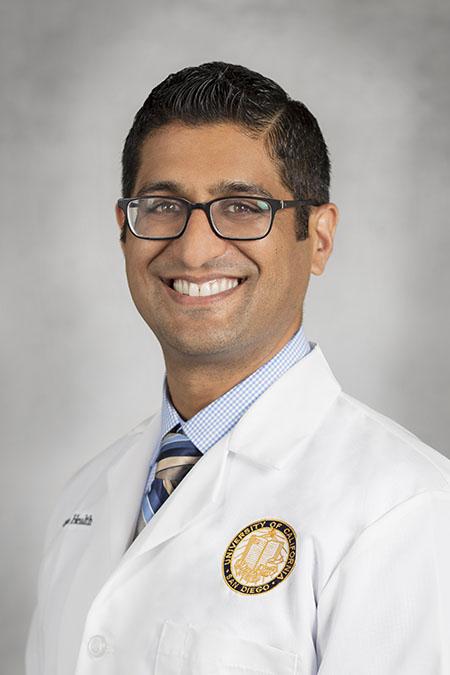
Credit: UC San Diego Health Sciences
In recent years, national attention has been drawn to the plight of patients who have experienced the unintended side effects of prolonged ICU care, such as memory loss, muscle weakness and depression. Now, in the largest review to date, a research team led by University of California San Diego School of Medicine have evaluated the short- and long-term employment impacts to ICU patients, with concerning findings.
Results of the study published in the November online edition of Thorax.
“We already know that more than 50 percent of patients surviving critical illness experience impairments in cognitive, physical, and/or mental health after ICU stays. We now can add delayed return-to-work and joblessness to the potential adverse outcomes,” said first author Biren Kamdar, MD, assistant professor of medicine, UC San Diego School of Medicine. “The good news is that awareness of these consequences is growing, with adoptable approaches to addressing them.”
Kamdar and a team of researchers from UCLA, UCSF, Johns Hopkins University, Intermountain Medical Center and Brigham Young University performed a systematic review and meta-analysis of more than 10,000 previously employed ICU patients to evaluate return-to-work following critical illness. Fifty-two studies were evaluated from sources including PubMed, Embase, PsycINFO, CINAHL, and Cochrane Library.
“We found that two-thirds, two-fifths, and one-third of previously employed ICU survivors are jobless 3, 12 and 60 months following hospital discharge,” said Kamdar. “Impacts ranged from unplanned job changes to complete job loss to early retirement. Survivors frequently required ongoing disability benefits with rates of 20 to 27 percent at one year, and 59 to 89 percent at 76 months.”
Jobless survivors were likely to transition from private to government-provided health care coverage. And, despite return to work, the majority of survivors incurred substantial lost earnings, totaling up to two-thirds of pre-ICU annual income.
Joblessness and delayed return to work, along with cognitive impairments and post-traumatic stress, are among the various problems making up “post intensive care syndrome” or PICS, a constellation of disabling and long-lasting impairments commonly affecting survivors of critical illness. Risk factors for PICS may include sepsis and respiratory failure, which are inherent to critical illness, and delirium and immobility, potentially modifiable conditions in the ICU.
“Survival is not enough. We are seeing that many patients get discharged from the ICU and then experience disabilities that significantly affect their quality of life,” said Kamdar. “We need to shift the paradigm of care in the ICU to include early and effective interventions aimed at helping patients get back to a normal life, including returning to work.”
The systematic review included studies involving outpatient ICU recovery programs aimed at helping patients understand and manage their impairments. Kamdar pointed out that clinical investigations are needed to design, evaluate and optimize vocational rehabilitation programs aimed at helping survivors return to work. A starting point could involve identifying patients’ occupation and anticipating possible post-ICU impairments that could impact their ability to return to work.
“Designing and evaluating novel ICU-based interventions is necessary to give patients a chance of having better long-term outcomes,” said Kamdar. “In coordination with employers, patients may be able to return to their chosen vocations.”
Kamdar noted that initiatives such as THRIVE, launched by the Society of Critical Care Medicine, may help ICU survivors and their families cope with PICS. Kamdar also highlighted the outpatient ICU recovery clinic at UC San Diego Health.
###
Co-authors of this paper include: Rajat Suri from UCLA; Mary Suchyta from Intermountain Healthcare; Kyle Digrande from UC San Diego; Kyla Sherwood from UCSF; Elizabeth Colantuoni, Victor Dinglas and Dale Needham from Johns Hopkins University; and Ramona Hopkins from Brigham Young University.
Media Contact
Jackie Carr
[email protected]
858-249-0456