A groundbreaking systematic review published in NEJM Evidence and coordinated by the D’Or Institute for Research and Education (IDOR) reveals stark disparities in outcomes for adults admitted to intensive care units (ICUs) with community-acquired pneumonia (CAP) across low- and middle-income countries (LMICs). This comprehensive meta-analysis synthesizes data spanning over two decades, underscoring a sobering reality: mortality rates in these settings significantly exceed those reported in high-income nations, shedding light on the critical need for systemic healthcare improvements.
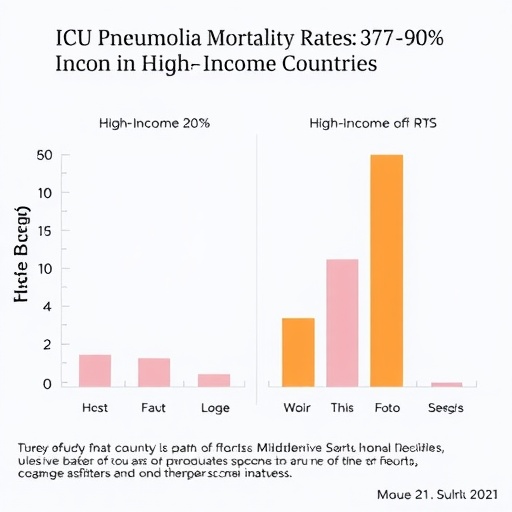
Despite global advances in critical care medicine and pneumonia management, CAP remains a formidable challenge in ICUs within LMICs. The study consolidates findings from 52 individual research studies including nearly 49,000 patients with severe pneumonia, revealing an overall ICU mortality rate of 37.1%. Most alarmingly, this figure escalates to a staggering 59.3% among patients who require respiratory support through mechanical ventilation, a number more than double the mortality reported in high-income countries where ventilated patients have a mortality closer to 26%.
Community-acquired pneumonia stands as one of the predominant reasons for ICU admission worldwide. Yet, the burden of this disease is disproportionately severe in resource-limited settings. The reasons extend beyond patient clinical status, delving into healthcare system deficiencies such as delayed access to care, inadequate ICU infrastructure, lack of standardized treatment protocols, and scarcity of trained critical care personnel. This structural inequity likely drives the elevated mortality in LMICs, pointing to the urgency of addressing systemic gaps alongside clinical improvements.
The meta-analysis follows robust methodological rigor and international standards, being registered in the PROSPERO database. It includes studies published from 2002 to early 2024, focusing on short-term mortality—either during ICU stay or within 30 days post-admission. The geographical scope primarily encompasses middle-income countries, with China and Brazil accounting for the majority of included reports. The absence of eligible studies from low-income countries is particularly striking, highlighting a critical void in scientific data from the most vulnerable regions globally.
Patient demographics analyzed in the review further illuminate the clinical landscape of CAP in these settings. The mean patient age was 65.4 years, and the majority—60.8%—were male. Hypertension, chronic obstructive pulmonary disease (COPD), and diabetes emerged as common comorbidities complicating clinical outcomes. Importantly, both advanced age and the need for mechanical ventilation were robust predictors of mortality, accounting for over half the variation observed across studies. These clinical factors, however, have intensified adverse effects in lower-income contexts due to systemic healthcare limitations.
Mechanical ventilation, a cornerstone in the management of critically ill pneumonia patients, paradoxically encapsulates the disparity in outcomes. While lifesaving in principle, its association with mortality nearly doubled in LMIC ICUs compared to well-resourced centers. This incongruity reflects how technology-dependent interventions demand complementary systems: expertly trained staff, adequate ICU facilities, infection control measures, and timely clinical decision-making—all often inadequate in resource-constrained environments.
Beyond clinical and infrastructural disparities, the review also flags significant data inequities. Although 18 countries contributed to the meta-analysis, the overwhelming majority hailed from middle-income countries, notably China and Brazil. The conspicuous absence of data from low-income countries impedes a holistic understanding of pneumonia’s global impact and may mask even more severe challenges faced in the world’s poorest regions. Such gaps underline the imperative for international collaboration to enhance research capacity and data collection in neglected settings.
Vaccination, a proven preventive measure against pneumonia, is another critical factor conspicuously missing from the existing literature analyzed. The reviewed studies generally lacked systematic information on vaccination status, such as pneumococcal or influenza vaccines. This omission precludes granular analysis of its influence on disease severity and outcomes but underscores a public health opportunity. Expanded vaccination coverage in LMICs could serve as a powerful intervention to reduce CAP incidence and severity, further improving ICU survival rates.
The study’s findings crystallize a mortality gradient that aligns with economic stratification, painting an urgent picture of global health inequities. High-income countries have leveraged advancements in early detection, timely intervention, vaccination programs, and robust ICU infrastructures to achieve lower mortality rates. In contrast, LMICs lag, burdened by systemic resource shortages, inconsistent clinical protocols, and delayed access to intensive care services, all contributing to persistently poor outcomes.
Approximately two decades of intensive care progress have yet to bridge this mortality divide, underscoring that clinical advances alone cannot compensate for broader socioeconomic determinants of health. Addressing this challenge requires multidimensional strategies encompassing healthcare policy reforms, enhanced resource allocation, workforce training, and the adoption of context-adapted clinical guidelines. Strengthening healthcare systems fundamentally is paramount to ameliorate outcomes for severe CAP patients in LMICs.
The authors of the review advocate for dedicated research initiatives focusing on region-specific barriers and enablers to improve CAP care quality. Such studies would inform policy decisions, shape resource distribution, and optimize the implementation of tailored clinical protocols. The synthesis of evidence from multiple countries provides a crucial foundation from which structured improvements can be devised, ultimately advancing equity in critical care delivery worldwide.
In summary, the systematic review illuminates the complex interplay between clinical severity, healthcare infrastructure, and socioeconomic context that governs pneumonia outcomes in intensive care. This extensive analysis amplifies the call for urgent investment in ICU capacity, early access, standardized treatment frameworks, and equitable preventive measures like vaccination. Addressing these interconnected factors is essential to reduce the disproportionately high mortality rates of community-acquired pneumonia in the world’s most vulnerable populations.
As CAP remains a predominant cause of critical illness globally, transforming its management in low- and middle-income countries represents a vital frontier in global health equity. These findings from IDOR and collaborators charter a clear path forward for researchers, clinicians, policymakers, and global health stakeholders committed to mitigating pneumonia’s deadly toll in underserved regions and achieving universally better health outcomes.
Subject of Research: Outcomes of community-acquired pneumonia in intensive care units in low- and middle-income countries.
Article Title: Outcomes of Pneumonia in ICUs in Low- and Middle-Income Countries — A Systematic Review
News Publication Date: 26-May-2026
Web References:
NEJM Evidence DOI 10.1056/EVIDoa2500244
Keywords: Health equity, Medical treatments, Health care delivery, Health care policy, Pneumonia
Tags: community-acquired pneumonia outcomescritical care in resource-limited settingsglobal health inequalities in ICUhealthcare system deficiencies in LMICsICU mortality disparitiesICU pneumonia mortality ratesmechanical ventilation pneumonia mortalitypneumonia in low- and middle-income countriespneumonia management challengespneumonia mortality meta-analysisrespiratory support in pneumonia patientssystematic review on pneumonia mortality