


Swallowing problems after a stroke are far more common than most people realize. Epidemiological studies indicate that more than half of stroke survivors experience dysphagia, and when the gold-standard video fluoroscopic swallowing study is used as the diagnostic tool, prevalence estimates in severe cases climb as high as 81 percent. The condition carries serious consequences: malnutrition, dehydration, stroke-associated pneumonia, elevated healthcare costs, higher mortality, and a sharply reduced quality of life. Now, a systematic review and meta-analysis published in the European Journal of Medical Research has pooled the randomized controlled trial evidence on one increasingly discussed non-drug option, hyperbaric oxygen therapy, and applied a statistical framework designed to ask a harder question than conventional meta-analysis usually does: is the accumulated evidence actually strong enough to believe?
The answer, according to the analysis, is a cautious and qualified yes for some outcomes, and a firm not-yet for others. The review included 14 randomized controlled trials involving 1,114 patients with post-stroke dysphagia, all of them conducted exclusively in China with Asian populations. In every trial, the experimental group received hyperbaric oxygen therapy added to standard dysphagia rehabilitation, while the control group received the rehabilitation alone, a design the authors deliberately enforced to isolate the incremental value of the oxygen treatment rather than attributing the effects of multi-component interventions to hyperbaric oxygen itself. The trials searched eight databases up to 1 May 2026, following PRISMA guidelines, and the protocol was registered in PROSPERO.
The pooled results were statistically significant across every outcome examined. On the Standardized Swallowing Assessment, where lower scores indicate better function, hyperbaric oxygen produced a standardized mean difference of −0.81 (95% CI −1.05 to −0.57, P < 0.00001) across five studies and 450 patients. The Water Swallowing Test, reported in five studies covering 434 patients, improved with a mean difference of −1.27 (95% CI −1.81 to −0.73, P = 0.0001). The video fluoroscopic swallowing study, the instrumental gold standard, showed a mean difference of 1.60 points favoring hyperbaric oxygen (95% CI 0.78–2.42, P = 0.0003) in four studies of 340 patients. The clinical effective rate, defined as either a two-point improvement on a swallowing scale or a return to oral feeding, was higher with hyperbaric oxygen (RR = 1.28, 95% CI 1.14–1.44, P < 0.0001) across three studies of 238 patients.
Secondary outcomes moved in the same direction. Swallowing-related quality of life, measured by the SWAL-QOL questionnaire in three studies of 332 patients, improved with a mean difference of 1.11 (95% CI 0.04–2.18, P = 0.04). The Functional Oral Intake Scale improved with a mean difference of 1.17 (95% CI 0.60–1.74, P < 0.0001) in two studies of 156 patients, and the National Institutes of Health Stroke Scale showed improvement favoring hyperbaric oxygen in two studies of 170 patients, although the authors note the small number of trials precluded reliable estimation of effect size and precision for that outcome.
The most distinctive feature of this review is its use of trial sequential analysis, a method that accounts for the repeated significance testing problem in cumulative meta-analyses. Traditional meta-analyses can produce false-positive findings when events are sparse or when each newly added trial tips the pooled result across a conventional threshold of significance. Trial sequential analysis instead calculates a required information size, the number of patients that would be needed in a well-powered trial, and applies monitoring boundaries that the cumulative evidence must cross before a finding can be considered firm. In this review, the cumulative Z-curves for the Standardized Swallowing Assessment and the Water Swallowing Test crossed both the trial sequential monitoring boundary and the required information size, which the authors interpret as relatively robust signals of efficacy. The curves for the video fluoroscopic swallowing study and the clinical effective rate crossed the monitoring boundary but not the required information size, meaning those findings are promising but still underpowered.
The certainty of the evidence, however, tells a more sobering story. Under the GRADE framework, every outcome was rated between very low and low certainty. Several factors drove the downgrading. No study adequately reported allocation concealment or blinding of participants, personnel, or outcome assessors, and five trials did not even describe how the random sequence was generated. Substantial statistical heterogeneity was observed for the Water Swallowing Test (I² = 74 percent), the video fluoroscopic swallowing study (I² = 48 percent), and SWAL-QOL (I² = 89 percent). All trials came from a single country, and the control group protocols varied in whether acupuncture was included, with five studies using acupuncture in the control arm and ten studies in the remaining comparisons incorporating it, a confound the authors flag as a major limitation on external validity.
That acupuncture confound cuts in an intriguing direction. Subgroup analyses identified the presence or absence of acupuncture in the control group as a source of heterogeneity in the video fluoroscopic swallowing study outcomes, and the effect size was significantly larger in the subgroup receiving acupuncture. Since a previous sequential meta-analysis demonstrated that acupuncture alone has a significant effect on post-stroke dysphagia, the authors suggest that combining hyperbaric oxygen with acupuncture may yield better results, a hypothesis they frame as a promising direction for future research rather than an established finding. Sensitivity analyses also traced the heterogeneity in the Standardized Swallowing Assessment result to a single study, apparently attributable to baseline medication use in its control group; removing that study reduced heterogeneity to zero.
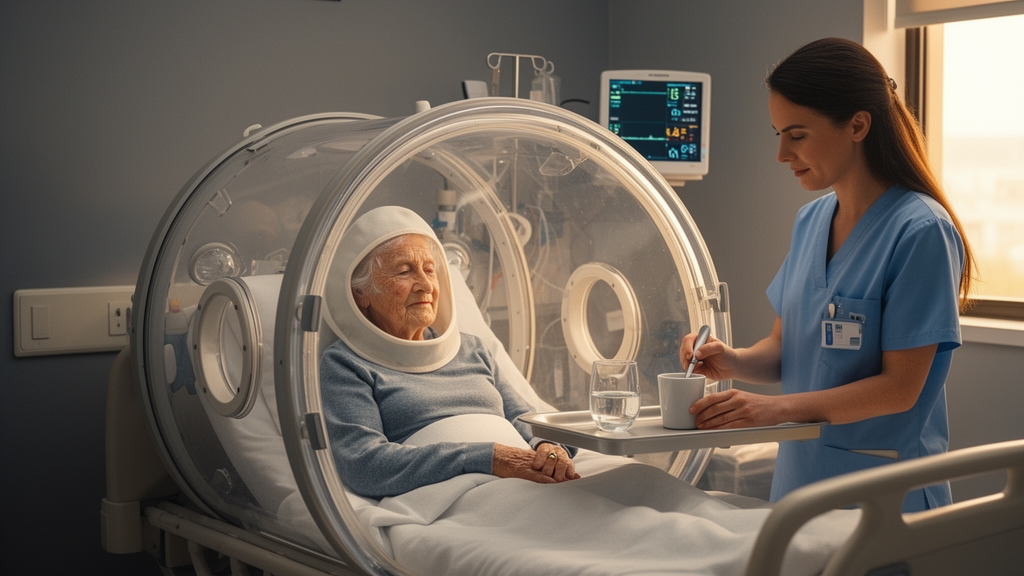
The biological rationale the authors offer is grounded in oxygen physiology. Hyperbaric oxygen therapy requires patients to breathe pure oxygen inside a pressurized chamber, and clinical studies cited in the review report that inhaling pure oxygen at 2.5 atmospheres absolute raises arterial oxygen partial pressure from 13 kilopascals at sea level to 235 kilopascals, with physically dissolved oxygen increasing roughly seventeen-fold. The authors hypothesize that this supersaturated oxygen can penetrate the ischemic penumbra, rescue struggling nerve cells, and support the recovery of the cortical and brainstem swallowing centers. Animal work lends some plausibility: in a rat middle cerebral artery occlusion model, hyperbaric oxygen therapy lowered myeloperoxidase expression in the ischemic penumbra, suggesting a neuroprotective anti-inflammatory effect. These remain mechanistic hypotheses, however, not demonstrated pathways in stroke patients with dysphagia.
The practical parameters of the therapy varied considerably across the included trials. Chamber pressures ranged from 0.2 to 0.23 megapascals in most studies, with a single trial using 0.1 megapascals. Session counts ranged from 5 to 30 days, with 10-day courses most common, and total treatment periods lasted four weeks in all but one study, which lasted six. The authors note that this incomplete reporting of intervention parameters, along with unreported disease stage, lesion location, and rehabilitation intensity, precludes any conclusion about the optimal timing, dosing, or patient selection for hyperbaric oxygen in this population.
The bottom line drawn by the authors is deliberately restrained. Adjunctive hyperbaric oxygen may improve swallowing function and related outcomes in post-stroke dysphagia, and for two scale-based outcomes the sequential analysis suggests the evidence has reached a sufficient information size. But the evidence from the instrumental gold-standard assessment and from patient-centered quality-of-life measures has not met that threshold, all findings carry low to very low GRADE certainty, and hyperbaric oxygen remains absent from the European Stroke Organization guidelines for post-stroke dysphagia. The authors conclude that the current data are insufficient to support routine clinical recommendations and call for large, international, multicenter randomized trials using standardized rehabilitation platforms, with hyperbaric oxygen administered as the sole difference between arms, before the therapy can be endorsed as standard care for stroke survivors struggling to swallow.
Subject of Research: Hyperbaric oxygen therapy as an adjunctive treatment for post-stroke dysphagia
Article Title: Effectiveness of hyperbaric oxygenation therapy in post-stroke dysphagia: a systematic review and meta-analysis with trial sequential analysis of randomized controlled trials
Article References: Lin, X., Wang, L., Wu, M., Chen, Q., Li, B., Niu, S., & Zhu, L. (2026). Effectiveness of hyperbaric oxygenation therapy in post-stroke dysphagia: a systematic review and meta-analysis with trial sequential analysis of randomized controlled trials. European Journal of Medical Research, 31(1), Article 1374. https://doi.org/10.1186/s40001-026-04910-y
Image Credits: AI Generated
DOI: 10.1186/s40001-026-04910-y
Keywords: hyperbaric oxygen therapy, post-stroke dysphagia, meta-analysis, trial sequential analysis, randomized controlled trials, swallowing function, stroke rehabilitation, GRADE certainty, systematic review, swallowing scales, Effectiveness, hyperbaric
News Source: Cassandra Pierce. (October 30, 2026). Hyperbaric Oxygen Shows Promise for Post-Stroke Swallowing, Evidence Still Weak. Scienmag.



