• HOME
  • NEWS
  • EXPLORE
    • CAREER
      • Companies
      • Jobs
    • EVENTS
    • iGEM
      • News
      • Team
    • PHOTOS
    • VIDEO
    • WIKI
  • BLOG
  • COMMUNITY
    • FACEBOOK
    • INSTAGRAM
    • TWITTER
Monday, October 5, 2026
BIOENGINEER.ORG
No Result
View All Result
  • Login
  • HOME
  • NEWS
  • EXPLORE
    • CAREER
      • Companies
      • Jobs
        • Lecturer
        • PhD Studentship
        • Postdoc
        • Research Assistant
    • EVENTS
    • iGEM
      • News
      • Team
    • PHOTOS
    • VIDEO
    • WIKI
  • BLOG
  • COMMUNITY
    • FACEBOOK
    • INSTAGRAM
    • TWITTER
No Result
View All Result
Bioengineer.org
No Result
View All Result
Home NEWS Science News

Hydrogen in your pocket? New plastic for carrying and storing hydrogen

Bioengineer by Bioengineer
November 28, 2016
in Science News
Reading Time: 2 mins read
0
Share on FacebookShare on TwitterShare on LinkedinShare on RedditShare on Telegram
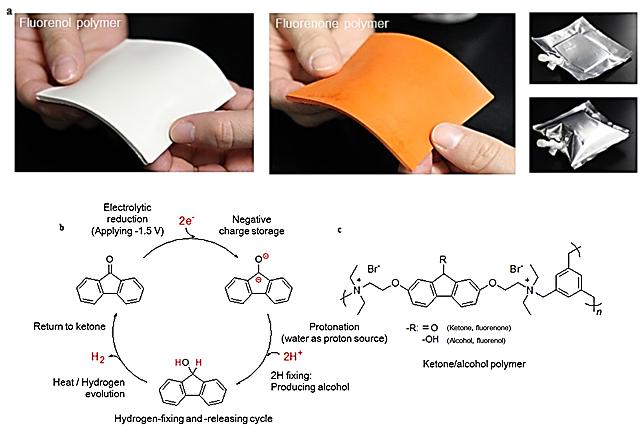
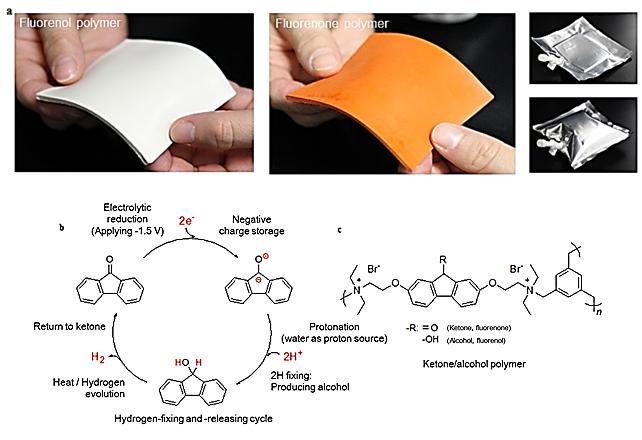
IMAGE

Credit: Waseda University

A Waseda University (Tokyo) research group has developed a polymer which can store hydrogen in a light, compact and flexible sheet, and is safe to touch even when filled with hydrogen gas.

Although research and development on technology allowing hydrogen to become a major energy source have been going on for many years, the conventional methods of storing and carrying hydrogen were accompanied by safety risks such as explosions. Recently, hydrogen-absorbing organic compounds have been studied as storage materials, for their ability to stably store and release hydrogen through chemical bonding. However, these compounds require vessels or tanks maintained at high pressure and/or temperature and often encounter difficulty in releasing the hydrogen gas. Widespread commercialization of hydrogen as an energy source requires a safer and more efficient system for storing and carrying it.

The research group, led by Professors Hiroyuki Nishide and Kenichi Oyaizu of the Department of Applied Chemistry, developed a ketone (fluorenone) polymer, which can be produced as a thin sheet, and can fix hydrogen via simple electrolytic hydrogenation in water at room temperature. Furthermore, the fluorenol polymer can release hydrogen when heated to 80 degrees Celsius with an aqueous iridium catalyst. The group proved that under mild conditions the cycle of fixing and releasing hydrogen can be repeated without significant deterioration.

The advantages of the ketone/alcohol polymer include easy handling, moldability, robustness, non-flammability and low toxicity, pointing the way to the development of a light, thin plastic container that can be carried in your pocket. The new material is also expected to contribute to the creation of distributed energy systems, especially in remote areas.

The research results were published in the Nature Communications on September 30.

###

Publication

Title: A ketone/alcohol polymer for cycle of electrolytic hydrogen-fixing with water and releasing under mild conditions
Authors: Ryo Kato, Keisuke Yoshimasa, Tatsuya Egashira, Takahiro Oya, Kenichi Oyaizu & Hiroyuki Nishide; Department of Applied Chemistry, Waseda University

Waseda University News

Media Contact

Marshall Adams
[email protected]
@waseda_univ

http://www.waseda.jp/top/index-e.html

############

Story Source: Materials provided by Scienmag

Share12Tweet8Share2ShareShareShare2

Related Posts

Pomegranate Seeds, Long Thrown Away, Yield Protein Fractions With Surprising Food Power

Pomegranate Seeds, Long Thrown Away, Yield Protein Fractions With Surprising Food Power

October 5, 2026
Two-Stage AI System Tames Long Documents With Smarter Summaries

Two-Stage AI System Tames Long Documents With Smarter Summaries

October 5, 2026

Obesity Awareness Tracks Family and Work Life, Not Body Measurements

October 5, 2026

Mitochondrial Assembly Factor NDUFAF2 Emerges as Driver of Deadly Aortic Aneurysms

October 5, 2026
Please login to join discussion

POPULAR NEWS

  • Alloys That Shrink Their Own Grains: New PIX Mechanism Refines Metals With Heat Alone

    Alloys That Shrink Their Own Grains: New PIX Mechanism Refines Metals With Heat Alone

    29 shares
    Share 12 Tweet 7
  • Endurance Exercise Reshapes the Liver in Males and Females Through Distinct Molecular Routes

    29 shares
    Share 12 Tweet 7
  • Single Transcription Factor PU.1 Rapidly Converts Fibroblasts into Macrophage-Lineage Cells

    29 shares
    Share 12 Tweet 7
  • New Scale Measures How Ready Nurse Educators Really Are for the AI Era

    29 shares
    Share 12 Tweet 7

About

We bring you the latest biotechnology news from best research centers and universities around the world. Check our website.

Follow us

Recent News

Alloys That Shrink Their Own Grains: New PIX Mechanism Refines Metals With Heat Alone

Endurance Exercise Reshapes the Liver in Males and Females Through Distinct Molecular Routes

Single Transcription Factor PU.1 Rapidly Converts Fibroblasts into Macrophage-Lineage Cells

Subscribe to Blog via Email

Success! An email was just sent to confirm your subscription. Please find the email now and click 'Confirm' to start subscribing.

Join 85 other subscribers
  • Contact Us

Bioengineer.org © Copyright 2023 All Rights Reserved.

Welcome Back!

Login to your account below

Forgotten Password?

Retrieve your password

Please enter your username or email address to reset your password.

Log In
No Result
View All Result
  • Homepages
    • Home Page 1
    • Home Page 2
  • News
  • National
  • Business
  • Health
  • Lifestyle
  • Science

Bioengineer.org © Copyright 2023 All Rights Reserved.