• HOME
  • NEWS
  • EXPLORE
    • CAREER
      • Companies
      • Jobs
    • EVENTS
    • iGEM
      • News
      • Team
    • PHOTOS
    • VIDEO
    • WIKI
  • BLOG
  • COMMUNITY
    • FACEBOOK
    • INSTAGRAM
    • TWITTER
Saturday, July 4, 2026
BIOENGINEER.ORG
No Result
View All Result
  • Login
  • HOME
  • NEWS
  • EXPLORE
    • CAREER
      • Companies
      • Jobs
        • Lecturer
        • PhD Studentship
        • Postdoc
        • Research Assistant
    • EVENTS
    • iGEM
      • News
      • Team
    • PHOTOS
    • VIDEO
    • WIKI
  • BLOG
  • COMMUNITY
    • FACEBOOK
    • INSTAGRAM
    • TWITTER
  • HOME
  • NEWS
  • EXPLORE
    • CAREER
      • Companies
      • Jobs
        • Lecturer
        • PhD Studentship
        • Postdoc
        • Research Assistant
    • EVENTS
    • iGEM
      • News
      • Team
    • PHOTOS
    • VIDEO
    • WIKI
  • BLOG
  • COMMUNITY
    • FACEBOOK
    • INSTAGRAM
    • TWITTER
No Result
View All Result
Bioengineer.org
No Result
View All Result
Home NEWS Science News Chemistry

Hybrid transistor improves next-generation displays

Bioengineer by Bioengineer
February 11, 2020
in Chemistry
Reading Time: 2 mins read
0
IMAGE
Share on FacebookShare on TwitterShare on LinkedinShare on RedditShare on Telegram

IMAGE

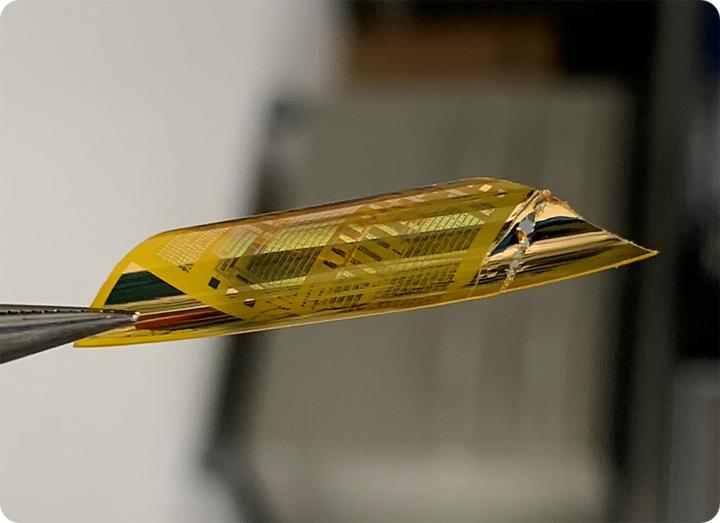
Credit: © 2019 KAUST


An innovative manufacturing technique developed by KAUST researchers has led to the development of hybrid organic transistors for use in next-generation electronic displays and large-area electronics.

Thin-film transistors (TFTs) made from metal oxides have useful properties, including optical transparency and high charge-carrying capacity, and they are increasingly being used in organic light-emitting diode displays.

Currently, most TFTs are made using physical vapor deposition methods, but solution-based printing could hold promise for a simpler and more cost-effective approach. However, producing metal oxide TFTs with high carrier mobility and operating stability has proved challenging.

Led by Thomas Anthopoulos and colleagues from the KAUST Solar Center, an international team of researchers from the United Kingdom, China and Greece has made a hybrid TFT from solution-processed layers of polystyrene sandwiched between ultrathin sheets of indium oxide and zinc oxide nanoparticles.

“Much to our surprise, we discovered that the electron mobility of this hybrid TFT was very high,” explains Anthopoulos. “But more importantly, we found that the ability of the device to sustain electrical bias for a long period of continuous operation, without changing its operating characteristics, has improved dramatically.”

Previous work by Anthopoulos and colleagues had shown that TFTs made from two or more metal oxides can generate sheets of mobile electrons at the interface of the metal oxide layers. These electrons are free to move across the device, increasing its charge carrying capacity. However, structural defects present in the polycrystalline layers that form the interfaces produce election traps, altering the electrical properties of the device.

The researchers found that first inserting a polystyrene layer between the metal oxide layers and then applying an ultraviolet-ozone treatment to the layer caused the polystyrene to decompose into smaller molecular species that reacted with the oxide layers, strengthening the bonds between nanoparticles and removing some of the electron traps.

“The key to the success of our design is the incorporation of an ozone-treated polystyrene interlayer, which passivates the electron traps present on the surface/interface of the metal oxides and increases not only the electron mobility of the device but also its bias-stress stability,” says Anthopoulos.

The work presents a simple, cost-effective and scalable method for fabricating TFTs for application in next-generation displays and a range of other large-area electronics.

“Next, we want to see if we can exploit the same electron trap passivation technique for different metal oxide semiconductors or other combinations of materials. I’m confident that we will identify even better-performing materials,” says Anthopoulos.

###

Media Contact
Carolyn Unck
[email protected]

Original Source

https://discovery.kaust.edu.sa/en/article/925/hybrid-transistor-improves-next-generation-displays

Related Journal Article

http://dx.doi.org/10.1038/s41928-019-0342-y

Tags: Computer ScienceElectrical Engineering/ElectronicsMaterialsTechnology/Engineering/Computer Science
Share12Tweet8Share2ShareShareShare2

Related Posts

Graz University of Technology Deciphers the Structural Secrets of MOF Thin Films — Chemistry

Graz University of Technology Deciphers the Structural Secrets of MOF Thin Films

July 2, 2026
Breaking Thermodynamic Limits: Wavelength-Driven Catalysis Advances Ammonia Synthesis — Chemistry

Breaking Thermodynamic Limits: Wavelength-Driven Catalysis Advances Ammonia Synthesis

July 2, 2026

From Quantum Mechanics to AI-Powered Materials Discovery: MARVEL Marks 12 Years of Transforming Computational Science

July 2, 2026

Djire Recognized with National Award for Outstanding Contributions in Research and Teaching

July 2, 2026
Please login to join discussion

POPULAR NEWS

  • Detection of EDCs in Breast Milk and Infant Urine Up to Six Months Highlights Early Exposure Risks

    77 shares
    Share 31 Tweet 19
  • Saying Goodbye to PGY-6: Pediatric Fellowship Realities

    103 shares
    Share 41 Tweet 26
  • New Drug Candidate Developed at McMaster Shows Potential for Treating Brain Cancer

    58 shares
    Share 23 Tweet 15
  • KTU Researchers Explore Ultrasound’s Role in Enhancing Blood Flow Beyond Diagnostics

    53 shares
    Share 21 Tweet 13

About

BIOENGINEER.ORG

We bring you the latest biotechnology news from best research centers and universities around the world. Check our website.

Follow us

Recent News

Steatosis Drives Liver Metastasis Diversity in CRC

Unlocking the Mysteries of Alzheimer’s Disease

Pensoft Introduces New Peer-Reviewed Journal of Regeneration to Advance Restorative Biology Across Species

Subscribe to Blog via Email

Enter your email address to subscribe to this blog and receive notifications of new posts by email.

Join 83 other subscribers
  • Contact Us

Bioengineer.org © Copyright 2023 All Rights Reserved.

Welcome Back!

Login to your account below

Forgotten Password?

Retrieve your password

Please enter your username or email address to reset your password.

Log In
No Result
View All Result
  • Homepages
    • Home Page 1
    • Home Page 2
  • News
  • National
  • Business
  • Health
  • Lifestyle
  • Science

Bioengineer.org © Copyright 2023 All Rights Reserved.