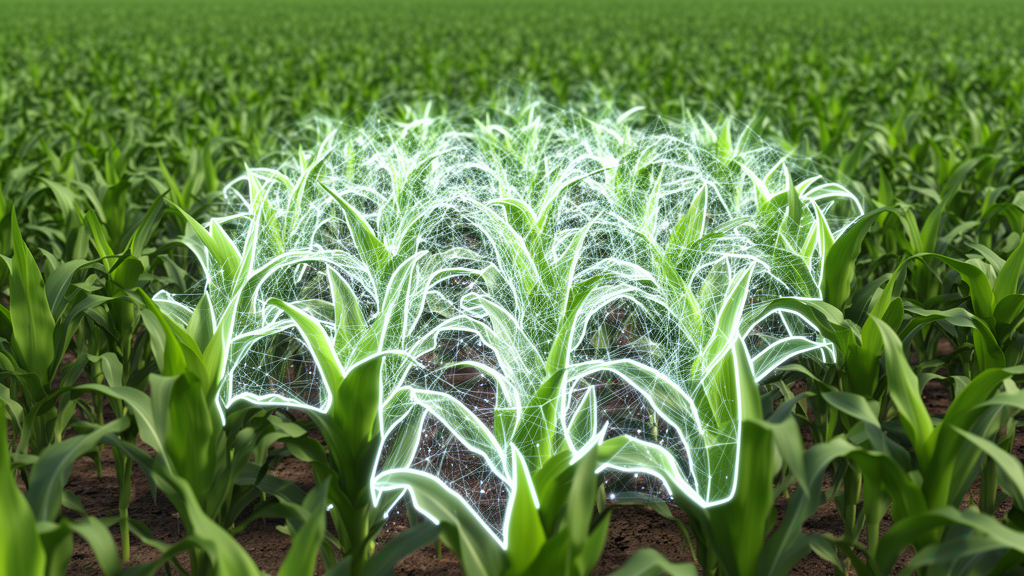
Researchers have developed a hybrid optimization algorithm that improves how computers isolate green maize seedlings from cluttered field photographs. The method, described in a study published in Cluster Computing, combines particle swarm optimization with a human evolutionary optimization algorithm to produce a technique the authors call HPSO-HEOA. It is designed to address two persistent problems in field maize seedling image segmentation: uneven lighting and complex backgrounds.
The core task is multilevel thresholding, a segmentation approach that splits an image’s pixel intensity values at several cutoff points rather than a single one. The team made three modifications to the underlying human evolutionary optimization algorithm. First, a hybrid initialization strategy seeds the population of candidate solutions. Second, a velocity update mechanism borrowed from particle swarm optimization is introduced. Third, the algorithm adds update mechanisms for both individual-best and global-best solutions.
To judge candidate segmentations, the researchers used Kapur entropy as the fitness function. The algorithm was paired with an asymmetric segmentation strategy labeled R2-G8-B2, which assigns different numbers of thresholds to different color channels. The green channel receives eight thresholds to refine the green layers, while the red and blue channels receive only two each, compressing background information. According to the authors, this asymmetry significantly enhances the prominence of the green subject in field images.
Before applying the method to crops, the team benchmarked it against standard test problems. Across 33 benchmark functions from the IEEE CEC suite, HPSO-HEOA showed stronger global and local optimization capability, along with better convergence accuracy and stability, than comparison algorithms including the base HEOA and the grey wolf optimizer. The authors also report a tuning result for population size: when the population parameter N was set to 50, the algorithm achieved a balance between optimization efficiency and performance.
The segmentation experiments used maize seedling images captured in field conditions. As the number of thresholds increased from 2 to 10, three standard image-quality metrics improved substantially: FSIM, SSIM, and PSNR. At a threshold count of 8, the method reached an average FSIM of 0.9925, an SSIM of 0.9624, and a PSNR of 23.938, which the authors describe as balancing segmentation quality against efficiency.
The asymmetric strategy’s channel allocation is central to the reported result. By devoting most of the threshold budget to the green channel, the method refines the layers of plant material where the signal of interest lies, while the low thresholds on the red and blue channels reduce the detail devoted to soil and other background elements. The authors state that this significantly enhances the prominence of the green subject relative to its surroundings.
The study’s reported results are specific to its experimental setup: the benchmark comparisons cover the 33 IEEE CEC functions tested, and the image metrics come from the maize seedling images the authors evaluated, with the headline figures measured at eight thresholds. The work is presented as a methodological contribution to multilevel thresholding rather than a field deployment, and its performance claims rest on the experiments described in the paper.
Within that scope, the combination of a hybrid optimizer, Kapur entropy fitness, and channel-asymmetric thresholds offers a documented approach for green-enhancement segmentation under the uneven lighting and complex backgrounds that characterize real field imagery. The authors report that the method provides a superior image foundation for the precise identification and analysis of maize seedlings in the field.
Subject of Research: Hybrid metaheuristic optimization for multilevel thresholding segmentation of field maize seedling images
Article Title: A new hybrid PSO-HEOA for green-enhancement segmentation of field maize seedling images using multilevel thresholding
Article References: Wang, Q., Zhou, P., Zhan, M., Yi, K., Huang, X., Jiang, C., & Cao, B. (2026). A new hybrid PSO-HEOA for green-enhancement segmentation of field maize seedling images using multilevel thresholding. Cluster Computing, 29(15), Article 887. https://doi.org/10.1007/s10586-026-06675-9
Image Credits: AI Generated
DOI: 10.1007/s10586-026-06675-9
Keywords: maize seedlings, image segmentation, multilevel thresholding, particle swarm optimization, human evolutionary optimization algorithm, Kapur entropy, hybrid metaheuristics, IEEE CEC benchmarks, FSIM, SSIM, PSNR, green channel enhancement
News Source: Alan Morgan. (October 24, 2026). Hybrid swarm algorithm sharpens green segmentation of field maize seedling images. Scienmag.