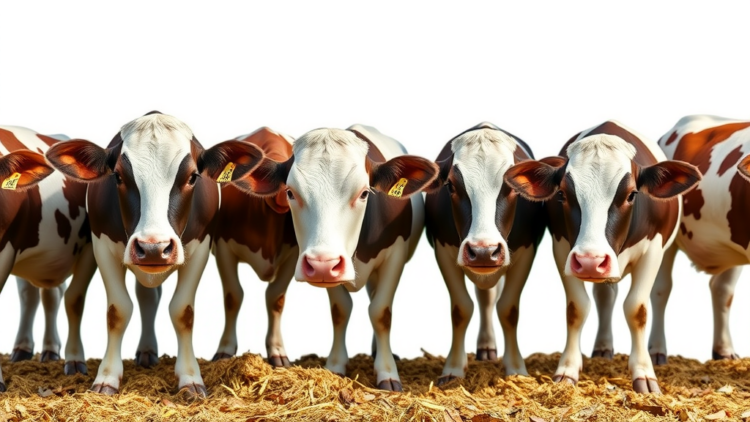
Milk is one of the most climate-sensitive commodities on Earth. Global production hovers between roughly 940 and 966 million tons a year, and even small dips ripple through prices, processing capacity, and food security. Now, researchers report that a carefully engineered hybrid artificial intelligence model can forecast how much milk an individual cow will produce on a given day — accounting for the lingering, delayed effects of heat and humidity — with markedly better accuracy than any single modeling approach previously applied to the same data.
The study, conducted by Arifa Sultana, Kaisa M. Linderborg, and Jukka Heikkonen and published in the Journal of Agriculture and Food Research, tackles a stubborn biological problem: heat stress does not hit dairy cows instantly. Reduced feed intake, hormonal shifts, and metabolic adjustments typically surface over several days, meaning simple correlations between a hot afternoon and a weaker milking session miss most of the damage. The team’s answer is a two-stage architecture that pairs a nonlinear autoregressive model with exogenous inputs (NARX) with XGBoost, a gradient-boosting algorithm, in a residual-stacking arrangement.
The framework works by dividing the forecasting problem in two. NARX, whose feedback structure explicitly models delayed physiological responses, captures the general lactation curve and the lagged influence of weather variables such as temperature, humidity, wind speed, and solar radiation. XGBoost then steps in to learn the residuals — the systematic errors the temporal model leaves behind — which often reflect abrupt climatic swings. The researchers chose NARX over ARIMA-type models because it avoids strict stationarity assumptions, and over long short-term memory (LSTM) networks because it does not demand massive training datasets.
The evidence comes from an open-access dataset collected at the Austral Agricultural Experimental Station near Valdivia in southern Chile, originally gathered by Arias and colleagues. It spans three summer seasons — 2012–2013, 2015–2016, and 2016–2017 — covering 330 Holstein Friesian cows on a 90-hectare farm, with daily milk records aligned to hourly weather-station readings of temperature, relative humidity, wind speed, and solar radiation. The team enriched the raw data with three-day lagged weather variables, rolling averages, and interaction terms such as temperature multiplied by days in milk, encoding the biological insight that early-lactation cows are more thermally vulnerable than cows late in their cycle.
Validation was deliberately stringent. Instead of random splits, the researchers used five-fold cross-validation grouped by cow identity, so no animal appeared in both training and test sets — a safeguard against the model simply memorizing individuals. They also ran temporal holdout tests, training on earlier seasons and forecasting entirely unseen future ones. The NARX–XGBoost hybrid achieved a coefficient of determination (R²) of 0.839 and a mean absolute percentage error of 8.86%, cutting root mean squared error by 24.1% compared with the strongest naive baseline, which simply predicted that each cow would produce the same volume as the previous day. Weather variables alone, by contrast, explained almost nothing (R² = 0.071), underscoring that a cow’s own production history is the backbone of any useful forecast.
Statistical testing reinforced the result. A Friedman test across all six hybrid configurations showed significant overall differences in cow-level error, and Holm-corrected pairwise Wilcoxon comparisons confirmed that NARX–XGBoost significantly outperformed every rival, including hybrids combining a linear mixed model with random forest, XGBoost, or LSTM, and NARX paired with a multilayer perceptron or LSTM. Interestingly, the LSTM variant underperformed because the lagged NARX inputs already supplied temporal memory, creating redundant internal representations and unstable training. Complete-season transfer tests proved remarkably consistent, with R² values of 0.7735 and 0.7743 for the 2015–2016 and 2016–2017 holdouts respectively.
Perhaps the most consequential finding came from the interpretability analysis. Using SHAP (Shapley Additive Explanations), the team examined which environmental drivers actually moved the model’s predictions. Relative humidity dominated, a logical outcome in southern Chile’s humid climate, where moisture-laden air cripples the evaporative cooling that cows depend on. Wind speed and ambient temperature contributed moderately, and the analysis revealed an interaction: temperature’s effect on predicted yield grew more pronounced at higher temperature–humidity index values, while stronger winds appeared to soften the negative impact of humid heat.
Notably, the composite thermal indices that anchored earlier descriptive work — the adjusted temperature–humidity index and the Comprehensive Climate Index — turned out to be partly redundant, because the hybrid model could learn climatic interactions directly from raw variables. The earlier study on this same dataset, which relied on those indices and simple regression, explained less than 5% of milk yield variability; the new framework captures more than sixteen times that share of variance by embracing nonlinearity, lagged effects, and cow-level dynamics. A three-dimensional response surface confirmed that heat stress suppresses yield most severely when cows are deep into lactation, quantifying a pattern the original Chilean study had described only qualitatively.
The researchers are careful about the limits. The dataset comes from a single farm, one weather station, and a temperate-humid climate; barn ventilation, shade, pasture exposure, and nighttime recovery were not captured, and heat stress was inferred rather than measured physiologically. Feed composition, health records, and genetics were also outside the model’s scope. External validation on independent herds — particularly in tropical production systems — remains a prerequisite before any operational rollout, and the error reductions reported here should not be read as demonstrated gains in farm productivity.
Still, the implications are significant. Because the pipeline runs on ordinary weather-station data and daily milking records rather than expensive high-resolution sensors, it could be adapted to small and mid-sized farms that lack the infrastructure for deep-learning approaches. The authors suggest that lightweight versions could eventually run on edge devices for real-time monitoring, and that future work may explore transformer-based or physics-informed architectures. If the model survives external testing, a predicted daily milk figure accurate to within roughly a liter and a half per cow could give farm managers the lead time they need to adjust feeding, cooling, and intervention schedules before heat stress silently erodes the bottom line.
Subject of Research: Development and comparison of hybrid machine learning models for weather-influenced dairy milk yield prediction
Article Title: A comparative study of hybrid models for weather-influenced dairy milk yield prediction
Article References: Sultana, A., Linderborg, K. M., & Heikkonen, J. (2026). A comparative study of hybrid models for weather-influenced dairy milk yield prediction. Journal of Agriculture and Food Research, 31, Article 103276. https://doi.org/10.1016/j.jafr.2026.103276
Image Credits: AI Generated
DOI: 10.1016/j.jafr.2026.103276
Keywords: dairy farming, milk yield prediction, heat stress, machine learning, NARX, XGBoost, SHAP interpretability, temperature-humidity index, time series forecasting, Holstein Friesian, climate variability, precision livestock farming
Cite Scienmag News
APA MLA Chicago
Alan Morgan. (September 22, 2026). Hybrid AI Model Predicts Heat-Stressed Dairy Cows’ Milk Yields With New Precision. Scienmag. https://scienmag.com/hybrid-ai-model-predicts-heat-stressed-dairy-cows-milk-yields-with-new-precision/
Alan Morgan. “Hybrid AI Model Predicts Heat-Stressed Dairy Cows’ Milk Yields With New Precision.” Scienmag, 22 September 2026, https://scienmag.com/hybrid-ai-model-predicts-heat-stressed-dairy-cows-milk-yields-with-new-precision/. Accessed 22 September 2026.
Alan Morgan. “Hybrid AI Model Predicts Heat-Stressed Dairy Cows’ Milk Yields With New Precision.” Scienmag. September 22, 2026. https://scienmag.com/hybrid-ai-model-predicts-heat-stressed-dairy-cows-milk-yields-with-new-precision/
Copy citation Download RIS
Tags: advanced forecasting methods for milk yieldbiological response delays in dairy cowsclimate resilience in dairy industryclimate variabilityclimate-sensitive dairy productiondairy farmingheat stressheat stress delayed effects on milk outputheat stress impact on milk yieldHolstein Friesianhybrid AI modeling for dairy cowsMachine learningmachine learning for livestock productivitymilk yield predictionmodeling heat and humidity effects on dairyNARXNARX and XGBoost in agricultureprecision dairy farmingPrecision Livestock Farmingresidual stacking AI models for milk predictionSHAP interpretabilitytemperature-humidity indextime-series forecastingXGBoost