Fruit flies provide an effective platform for screening new obesity genes, and fat flies implicate a neuronal signaling pathway in weight gain, according to a new study publishing November 4th in the open-access journal PLOS Biology by Sadaf Farooqi and Andrea Brand of the University of Cambridge, UK, and colleagues.
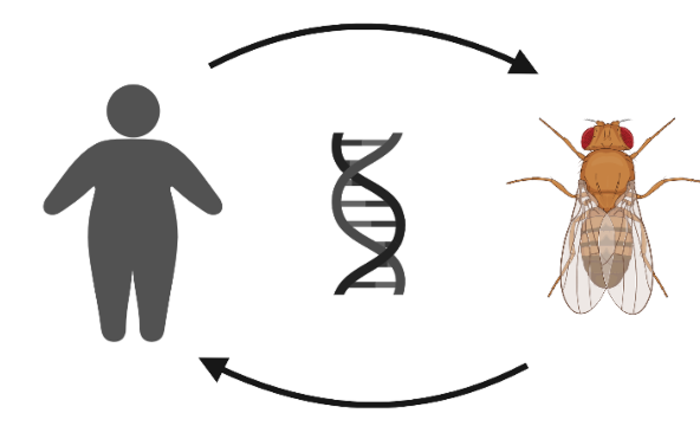
Credit: Neha Agrawal and Andrea H. Brand, CC BY 4.0 (https://creativecommons.org/licenses/by/4.0/)
Fruit flies provide an effective platform for screening new obesity genes, and fat flies implicate a neuronal signaling pathway in weight gain, according to a new study publishing November 4th in the open-access journal PLOS Biology by Sadaf Farooqi and Andrea Brand of the University of Cambridge, UK, and colleagues.
Identification of genes that contribute to obesity has been challenging for several reasons, including the fact that weight is an organism-level characteristic that is not well modeled in cell culture. Animal models provide a useful platform for exploring the effects of genes on weight; for example, the role of the leptin signaling system in obesity was first established using mice. But genetic research in mice takes time and is expensive.
Experiments in fruit flies, by contrast, are fast and relatively cheap, meaning that many genes can be screened simultaneously for their effects. Like humans, flies gain weight and develop heart problems when raised on high-fat or high-sugar diets. Many genes known to affect fat levels in flies have evolutionary counterparts (“orthologues”) in humans, increasing the likelihood that results in flies would be meaningful for understanding human obesity.
To search for obesity genes, the authors began with a large dataset of gene sequences from people with early-onset severe obesity, including many consanguineous families, whose highly similar genomes made searching for potential obesity genes easier. They focused on small genetic changes that were present in two gene copies in affected individuals, and also extremely rare in the general population. They then used a technique called RNA interference (RNAi) to reduce the activity of each gene in turn and studied the effect on levels of triacylglyceride, the major fat storage molecule in flies.
Triacyclglyceride increased significantly after reducing the activity of four genes, including one called “dachsous,” which had not been previously linked to human obesity. This gene is part of an important signaling pathway called “Hippo,” and the authors found that knocking down different links in the pathway also dramatically altered triacylglyceride levels. When that reduced gene activity was confined to neurons, triacyclgycerides increased significantly, indicating that the central nervous system was controlling adiposity.
In humans, the authors found that rare variants in genes encoding two other members of the Hippo pathway, called FAT4 and TAOK2, were also associated with obesity, albeit not in every database.
“Studies of obese individuals have the potential to identify genes that, when mutated, might lead to human obesity,” Dr. Brand says. “Establishing a functional relationship between these candidate genes and obesity is challenging, however. We were able to assess the function of candidate genes in the humble fruit fly and not only identified four novel obesity genes, but also predicted a fifth, in which rare variants were subsequently found in obese individuals.”
“Our study serves as a proof of principle that Drosophila functional screens are an efficient and effective way to assess the likely pathogenicity of rare variants associated with human obesity,” Dr. Brand adds. “This has allowed us to identify new and potentially important targets for development of therapies, and gives us new insights for finding further obesity genes.”
#####
In your coverage, please use these URLs to provide access to the freely available article in PLOS Biology: http://journals.plos.org/plosbiology/article?id=10.1371/journal.pbio.3001255
Citation: Agrawal N, Lawler K, Davidson CM, Keogh JM, Legg R, INTERVAL, et al. (2021) Predicting novel candidate human obesity genes and their site of action by systematic functional screening in Drosophila. PLoS Biol 19(11): e3001255. https://doi.org/10.1371/journal.pbio.3001255
Author Countries: United Kingdom
Funding: This work was funded by the Royal Society Darwin Trust Research Professorship and Wellcome Trust Senior Investigator Award (103792) to AHB. AHB acknowledges core funding to the Gurdon Institute from the Wellcome Trust (092096) and CRUK (C6946/A14492). ISF was supported by Wellcome (207462/Z/17/Z), the NIHR Cambridge Biomedical Research Centre, a NIHR Senior Investigator Award and the Bernard Wolfe Health Neuroscience Endowment. The IMS Translational Research Facility is funded by Wellcome (208363/Z/17/Z). DNA extraction and genotyping of the INTERVAL cohort was co-funded by the National Institute for Health Research (NIHR), the NIHR BioResource (http://bioresource.nihr.ac.uk/) and the NIHR [Cambridge Biomedical Research Centre at the Cambridge University Hospitals NHS Foundation Trust]. Sequencing was supported by the Wellcome Trust (206194). The academic coordinating centre for INTERVAL was supported by core funding from: NIHR Blood and Transplant Research Unit in Donor Health and Genomics (NIHR BTRU-2014-10024), UK Medical Research Council (MR/L003120/1), British Heart Foundation (SP/09/002; RG/13/13/30194; RG/18/13/33946) and the NIHR [Cambridge Biomedical Research Centre at the Cambridge University Hospitals NHS Foundation Trust. Genes & Health is core-funded by Wellcome (WT102627, WT210561), the Medical Research Council (UK) (M009017), Higher Education Funding Council for England Catalyst, Barts Charity (845/1796), Health Data Research UK (for London substantive site), and research delivery support from the NHS National Institute for Health Research Clinical Research Network (North Thames). The funders had no role in study design, data collection and analysis, decision to publish, or preparation of the manuscript.
Journal
PLoS Biology
DOI
10.1371/journal.pbio.3001255
Method of Research
Experimental study
Subject of Research
Animals
COI Statement
The authors have declared that no competing interests exist.