• HOME
  • NEWS
  • EXPLORE
    • CAREER
      • Companies
      • Jobs
    • EVENTS
    • iGEM
      • News
      • Team
    • PHOTOS
    • VIDEO
    • WIKI
  • BLOG
  • COMMUNITY
    • FACEBOOK
    • INSTAGRAM
    • TWITTER
Saturday, June 27, 2026
BIOENGINEER.ORG
No Result
View All Result
  • Login
  • HOME
  • NEWS
  • EXPLORE
    • CAREER
      • Companies
      • Jobs
        • Lecturer
        • PhD Studentship
        • Postdoc
        • Research Assistant
    • EVENTS
    • iGEM
      • News
      • Team
    • PHOTOS
    • VIDEO
    • WIKI
  • BLOG
  • COMMUNITY
    • FACEBOOK
    • INSTAGRAM
    • TWITTER
  • HOME
  • NEWS
  • EXPLORE
    • CAREER
      • Companies
      • Jobs
        • Lecturer
        • PhD Studentship
        • Postdoc
        • Research Assistant
    • EVENTS
    • iGEM
      • News
      • Team
    • PHOTOS
    • VIDEO
    • WIKI
  • BLOG
  • COMMUNITY
    • FACEBOOK
    • INSTAGRAM
    • TWITTER
No Result
View All Result
Bioengineer.org
No Result
View All Result
Home NEWS Science News Chemistry

Hungry galaxies grow fat on the flesh of their neighbours

Bioengineer by Bioengineer
April 22, 2020
in Chemistry
Reading Time: 2 mins read
0
IMAGE
Share on FacebookShare on TwitterShare on LinkedinShare on RedditShare on Telegram

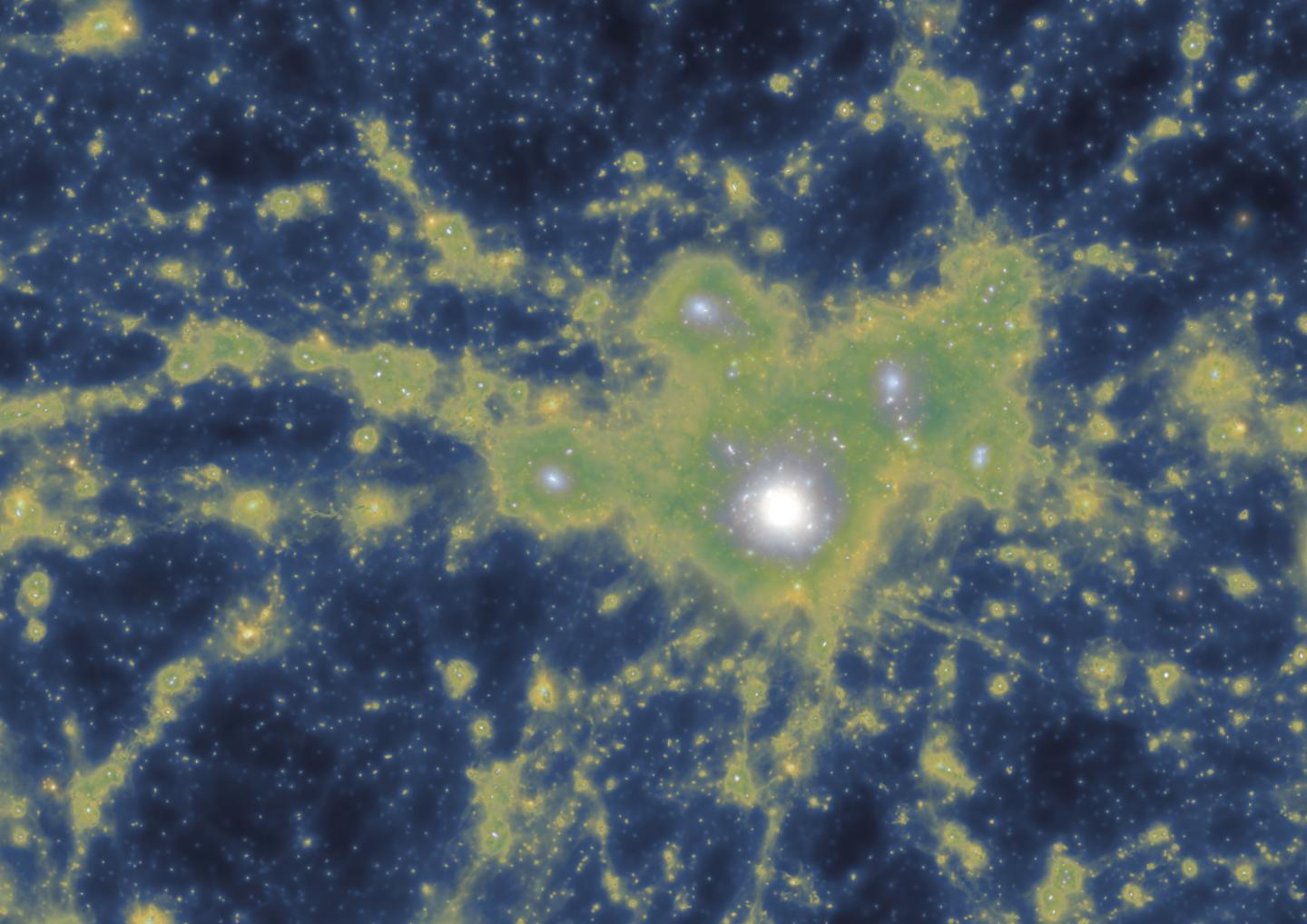
Modelling shows big galaxies get bigger by merging with smaller ones
IMAGE

Credit: Gupta et al/ASTRO 3D/ IllustrisTNG collaboration.

Galaxies grow large by eating their smaller neighbours, new research reveals.

Exactly how massive galaxies attain their size is poorly understood, not least because they swell over billions of years. But now a combination of observation and modelling from researchers led by Dr Anshu Gupta from Australia’s ARC Centre of Excellence for All Sky Astrophysics in 3 Dimensions (ASTRO 3D) has provided a vital clue.

In a paper published in the Astrophysical Journal, the scientists combine data from an Australian project called the Multi-Object Spectroscopic Emission Line (MOSEL) survey with a cosmological modelling program running on some of the world’s largest supercomputers in order to glimpse the forces that create these ancient galactic monsters.

By analysing how gases within galaxies move, Dr Gupta said, it is possible to discover the proportion of stars made internally – and the proportion effectively cannibalised from elsewhere.

“We found that in old massive galaxies – those around 10 billion light years away from us – things move around in lots of different directions,” she said.

“That strongly suggests that many of the stars within them have been acquired from outside. In other words, the big galaxies have been eating the smaller ones.”

Because light takes time to travel through the universe, galaxies further away from the Milky Way are seen at an earlier point in their existence. Dr Gupta’s team found that observation and modelling of these very distant galaxies revealed much less variation in their internal movements.

“We then had to work out why ‘older’, closer big galaxies were so much more disordered than the ‘younger’, more distant ones,” said second author ASTRO 3D’s Dr Kim-Vy Tran, who like Dr Gupta, is based at the UNSW Sydney.

“The most likely explanation is that in the intervening billions of years the surviving galaxies have grown fat and disorderly through incorporating smaller ones. I think of it as big galaxies having a constant case of the cosmic munchies.”

The research team – which included scientists from other Australian universities plus institutions in the US, Canada, Mexico, Belgium and the Netherlands – ran their modelling on a specially designed set of simulations known as IllustrisTNG.

This is a multi-year, international project that aims to build a series of large cosmological models of how galaxies form. The program is so big that it has to run simultaneously on several of world’s most powerful supercomputers.

“The modelling showed that younger galaxies have had less time to merge with other ones,” said Dr Gupta.

“This gives a strong clue to what happens during an important stage of their evolution.”

###

Media Contact
Andrew Masterson
[email protected]

Related Journal Article

http://dx.doi.org/10.3847/1538-4357/ab7b6d

Tags: AstronomyAstrophysicsSpace/Planetary ScienceStars/The Sun
Share12Tweet8Share2ShareShareShare2

Related Posts

AI and Physics Collaborate to Design Advanced Hydrogen Storage Materials

June 25, 2026

International Team Including Dresden Scientists Develops Novel Designer Proteins for Advanced Study of Living Tissue

June 25, 2026

New Study Uncovers Key Factors Driving Water Chemistry in Nanoscale Environments

June 25, 2026

Plasma Technology Extends Catalyst Lifespan in Hydrogen Production

June 24, 2026
Please login to join discussion

POPULAR NEWS

  • Saying Goodbye to PGY-6: Pediatric Fellowship Realities

    103 shares
    Share 41 Tweet 26
  • Multi-Hospital Study Reveals Long Covid Burden Is Twice as High as Current Estimates

    92 shares
    Share 36 Tweet 23
  • Detection of EDCs in Breast Milk and Infant Urine Up to Six Months Highlights Early Exposure Risks

    77 shares
    Share 31 Tweet 19
  • New Drug Candidate Developed at McMaster Shows Potential for Treating Brain Cancer

    58 shares
    Share 23 Tweet 15

About

We bring you the latest biotechnology news from best research centers and universities around the world. Check our website.

Follow us

Recent News

Tracking Lanthanide-Labeled Microplastics in Plants

POSTECH Researchers Slash Cost of Reconstituted Cell-Free Systems by 95%

AI and Physics Collaborate to Design Advanced Hydrogen Storage Materials

Subscribe to Blog via Email

Success! An email was just sent to confirm your subscription. Please find the email now and click 'Confirm' to start subscribing.

Join 82 other subscribers
  • Contact Us

Bioengineer.org © Copyright 2023 All Rights Reserved.

Welcome Back!

Login to your account below

Forgotten Password?

Retrieve your password

Please enter your username or email address to reset your password.

Log In
No Result
View All Result
  • Homepages
    • Home Page 1
    • Home Page 2
  • News
  • National
  • Business
  • Health
  • Lifestyle
  • Science

Bioengineer.org © Copyright 2023 All Rights Reserved.