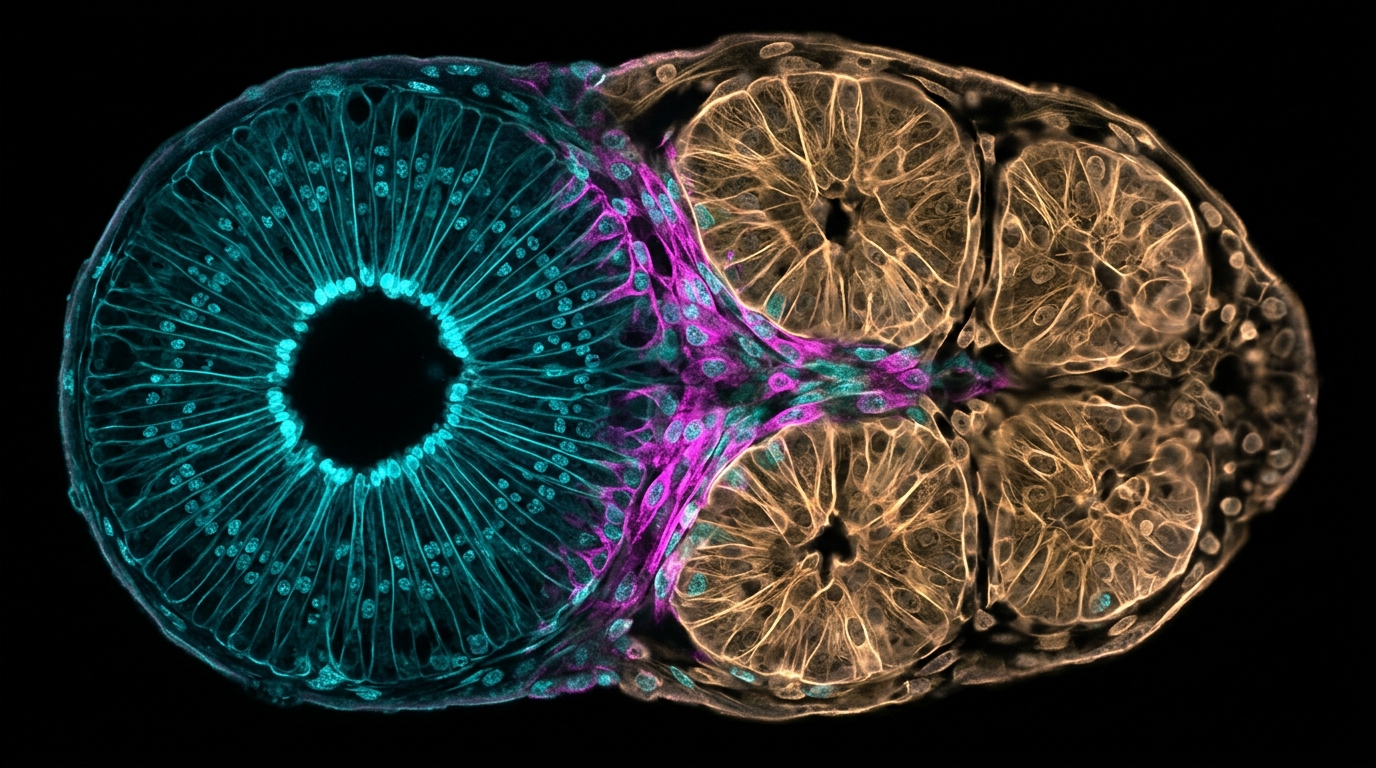
A newly developed human organoid system captures the co-development of neural and cartilage-like domains with progressive axial patterning, providing an experimental platform to study early body-axis formation. Reporting their findings, the researchers established this model using neuromesodermal progenitors derived from human pluripotent stem cells. The authors note that human trunk formation fundamentally relies on the coordinated development of neural and mesodermal tissues, but understanding how these distinct lineages interact and diversify has historically been limited by the absence of effective experimental models of early human axial development.
To investigate the cellular interactions and lineage divergence within the developing tissues, the research team carried out single-cell transcriptomic analysis on the organoids. This sequencing revealed dynamic lineage bifurcation occurring during the developmental progression of the model. Furthermore, the transcriptomic profile identified a distinct, highly proliferative progenitor population characterized by the expression of the hyaluronan-mediated motility receptor, designated as HMMR-positive cells, which differ markedly from canonical neuromesodermal progenitors.
The researchers subsequently conducted functional assays to characterize the cellular properties and developmental potential of this newly identified population. These laboratory experiments demonstrated that HMMR-positive cells can be prospectively isolated from the culture and serially expanded over time. When cultured under defined experimental conditions, these isolated progenitors successfully differentiated into both neural and mesenchymal derivatives, confirming their multipotency.
To verify the differentiation capacity of individual cells within the population, the investigators assessed the lineage outputs at the clonal level. These clonal assays confirmed that single HMMR-positive cells retain the intrinsic capacity to generate both neural and mesenchymal cell types. Consequently, the authors defined these cells as bipotent transitional progenitors that occupy a distinct developmental position between the canonical neuromesodermal progenitor state and subsequent neural and mesenchymal lineage diversification.
By bridging canonical progenitors and downstream diversified lineages, the identification of these bipotent transitional cells clarifies how neural and mesodermal cell fates emerge during early development. The authors conclude that their spine-spinal cord organoid model provides an accessible human cellular platform for directly investigating coordinated neural and mesenchymal tissue development during trunk formation.
Subject of Research: Human spine-spinal cord organoids and transitional progenitors in trunk development
Article Title: A spine–spinal cord organoid model captures bipotent transitional progenitors bridging neural and mesodermal lineages
Article References: Li, D., Ma, Y., Huang, W., Wang, B., Wei, L., Dong, Z., Xiong, C., Li, Y., Zhao, Q., Ye, W., Zhang, R., Huang, L., Rong, L., Xiang, A. P., & Li, W. (2026). A spine–spinal cord organoid model captures bipotent transitional progenitors bridging neural and mesodermal lineages. Cell Death Discovery. https://doi.org/10.1038/s41420-026-03365-8
Image Credits: AI Generated
DOI: 10.1038/s41420-026-03365-8
Keywords: spine-spinal cord organoid, neuromesodermal progenitors, human pluripotent stem cells, trunk formation, body-axis development, HMMR, hyaluronan-mediated motility receptor, bipotent transitional progenitors, neural lineage, mesodermal lineage, mesenchymal derivatives, single-cell transcriptomics, lineage bifurcation, axial patterning, clonal analysis, cartilage-like domains, developmental biology
News Source: Cassandra Pierce. (November 17, 2026). Human Spine Organoid Model Identifies Transitional Progenitors Bridging Neural and Mesodermal Lineages. Scienmag.