


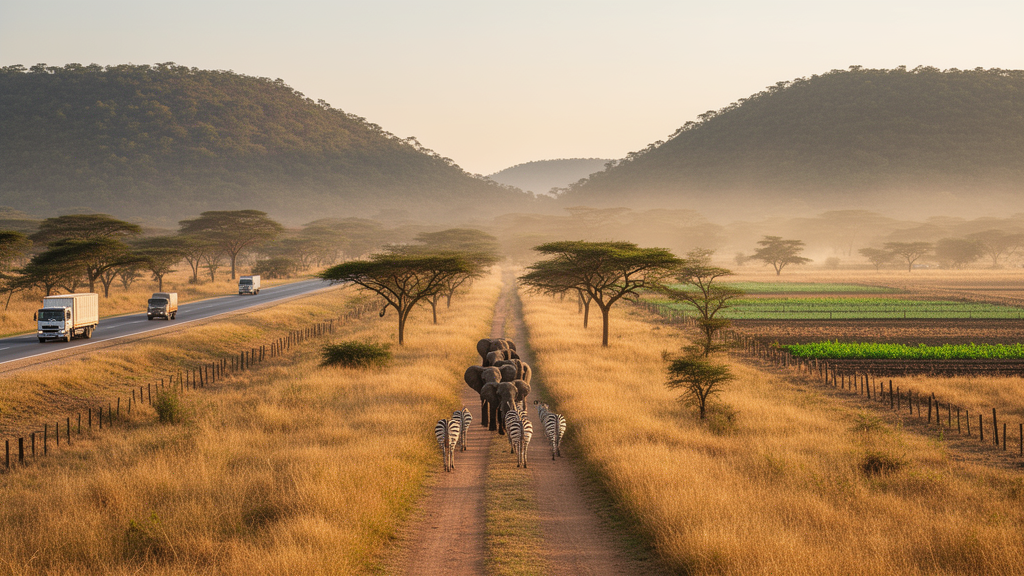
A new study of the Igando-Igawa Wildlife Corridor in Tanzania reports that human activities are measurably reducing wildlife abundance in a habitat link that connects Mpanga Kipengere Game Reserve with Ruaha National Park. The research, published in BMC Zoology, combined household surveys with field transect counts to assess how agriculture, settlement expansion, livestock grazing and charcoal production are affecting the corridor’s ecological function.
The survey team, led by Joas J. Makwati and colleagues, interviewed 304 households and supplemented this with focus group discussions and key informant interviews. Respondents identified human population growth, cited by 97 percent of participants, as the primary driver of habitat loss, followed by agriculture at 94.4 percent and settlement expansion at 93.4 percent. These socio-economic pressures were analysed using both descriptive and inferential statistics to characterise the drivers of land-use change in the corridor.
To gauge wildlife presence, the researchers walked ten transects, each two kilometres long, recording indirect signs of animals rather than direct sightings. These signs included tracks, dung and vocal cues. Across the surveys they documented 57 wildlife signs in total. Elephants accounted for the largest share of recorded signs at 43.9 percent, followed by greater kudu at 15.8 percent, duiker at 12.3 percent and hyena at 12.3 percent.
Species diversity in the corridor was quantified using Simpson’s Diversity Index, which yielded a value of 0.76. According to the authors, this figure indicates notable species heterogeneity, meaning the recorded signs represented a reasonably varied set of species rather than dominance by a single one.
The study’s central statistical comparison used Welch’s t-test to contrast wildlife occurrence between disturbed and undisturbed habitats. The result was significant: wildlife abundance was lower in disturbed habitats than in undisturbed ones, with a test statistic of 3.84 and a p-value of 0.001. The authors interpret this as evidence of the negative impact of anthropogenic activities on ecological connectivity within the corridor.
Despite these pressures, the study concludes that the corridor remains ecologically functional. Wildlife signs were still recorded across the surveyed transects, and the diversity index suggests multiple species continue to use the area. The researchers frame this as a reason for timely intervention rather than grounds for complacency, noting that escalating pressures threaten the corridor’s ecological functions and the long-term viability of wildlife populations.
On the basis of their findings, the authors recommend conservation strategies that balance local livelihoods with biodiversity conservation while maintaining the overall health of the landscape ecosystem. The recommendation reflects the study’s dual focus: the household survey data were collected specifically to identify the socio-economic drivers behind land-use change, acknowledging that corridor survival depends on the communities living around it.
The study is an open-access article published on 9 October 2026, and the version shared at publication is an accepted manuscript released early for faster access, subject to further edits before the final Version of Record. Within those limits, the study provides quantified evidence that the intensity of human land use in the Igando-Igawa corridor is associated with lower wildlife abundance, and that the connectivity between Mpanga Kipengere Game Reserve and Ruaha National Park persists but is under pressure from the surrounding human population, farms and settlements.
Subject of Research: Human pressures on wildlife habitat connectivity in the Igando-Igawa Wildlife Corridor, Tanzania
Article Title: Human pressures and habitat connectivity loss threaten wildlife survival: evidence from the Igando-Igawa Wildlife Corridor, Tanzania
Article References: Makwati, J. J., Temu, S. E., Mwanukuzi, P. K., & Ndangalasi, H. J. (2026). Human pressures and habitat connectivity loss threaten wildlife survival: evidence from the Igando-Igawa Wildlife Corridor, Tanzania. BMC Zoology. https://doi.org/10.1186/s40850-026-00290-2
Image Credits: AI Generated
DOI: 10.1186/s40850-026-00290-2
Keywords: wildlife corridors, Tanzania, habitat connectivity, human-wildlife conflict, Simpson's Diversity Index, elephants, Mpanga Kipengere Game Reserve, Ruaha National Park, land-use change, BMC Zoology, Human, pressures
News Source: Margaret Porter. (October 29, 2026). Human pressures erode wildlife connectivity in a Tanzanian corridor, survey finds. Scienmag.



