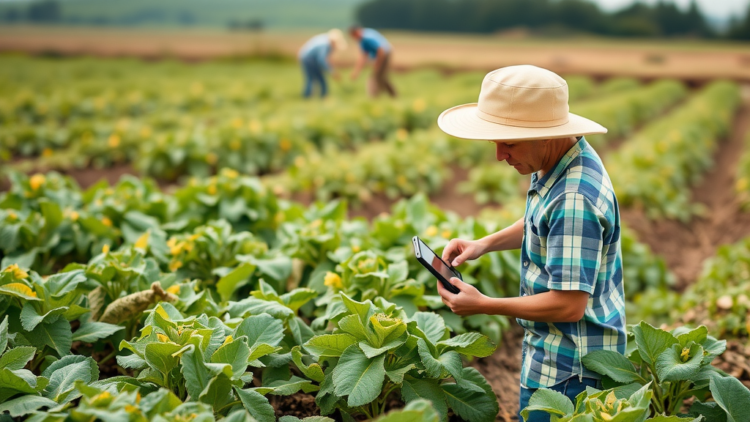
Despite a decade of breathless headlines about artificial intelligence, agricultural robots, and fully autonomous farms, the berries, avocados, oranges, and tomatoes stacked in market stalls around the world are still harvested, in the overwhelming majority of cases, by human hands. A new perspective published in the journal Smart Agricultural Technology argues that this is not merely a curiosity of the fruit and vegetable sector but the visible symptom of a deeper failure: the technologies of Agriculture 4.0 have promised transformation, yet their adoption remains limited, uneven, and well below what their technical capabilities would suggest. The paper, authored by Yael Salzer, traces the problem to a fundamental mismatch between how agricultural technologies are designed and how farms actually work, and proposes a remedy drawn from an unexpected corner of engineering—human factors and ergonomics, the discipline that builds technology around people rather than expecting people to bend around technology.
The stakes could hardly be higher. The world’s population stood at 8.2 billion in 2024 and is projected to peak at roughly 10.3 billion around 2080, making food security a defining challenge of the century, enshrined in the United Nations’ Sustainable Development Goal 2 for zero hunger. Agricultural land use has already expanded from 3.7 billion hectares in 1950 to 4.83 billion hectares in 2023, covering about 32 percent of Earth’s land surface, while the share of the global labor force employed in agriculture has fallen from 44 percent in 1991 to 27 percent in 2019. The result is a sector asked to grow more food with fewer farmers, on finite land, under mounting environmental constraints. In developed nations, workforces are aging and potential entrants are declining; the shortage of agricultural labor in OECD countries pushed U.S. labor costs up by 17 percent in 2023, and the COVID-19 pandemic exposed how fragile the reliance on migrant seasonal workers truly is when borders close.
Paradoxically, productivity keeps rising. Between 2001 and 2015, global gross agricultural output per worker grew at an average annual rate of 3.77 percent, driven by technological innovation and improved practices spanning fertilizers, seeds, irrigation, and machinery. The OECD-FAO outlook projects that world agricultural production will expand by roughly 14 percent between 2025 and 2034, with middle-income countries leading the charge. This trajectory has historically tracked the industrial revolutions. Agriculture 1.0 relied on manual labor with rudimentary tools; the machinery of Industry 1.0 and the oil-powered mechanization of Industry 2.0 brought engine-driven equipment across the entire production process; and Industry 3.0’s embedded systems and software enabled precision agriculture. The current era, Agriculture 4.0, converges artificial intelligence, machine learning, digital twins, edge computing, the Internet of Things, robotics, and smart and nanosensors into systems that collect, transmit, and analyze data at a speed and scale no human can match, generating actionable instructions for irrigation, fertilization, sowing schedules, and crop management.
On paper, the promise is extraordinary. Drones both sense the field and intervene in it, spraying water and pesticides with precision guided by real-time environmental data. Wearable sensors track animal health and reproductive cycles. Cyber-physical systems enhanced with AI can perform targeted interventions autonomously, and agricultural research has historically delivered average social returns exceeding 40 percent annually in developing countries. Yet the deployment record tells a different story. Of the world’s 608 million farms, 84 percent are smaller than two hectares, while the largest 1 percent control more than 70 percent of global agricultural land. Advanced applications such as variable-rate technologies, drones, and robotic systems show adoption rates generally ranging from just 4 to 22 percent, varying widely by region and crop. In low- and middle-income countries, drones and robots are rarely adopted at all—although, tellingly, farmers in both rich and poor countries consistently express strong interest and positive attitudes toward these technologies.
The barriers are well documented: uncertainty about cost-effectiveness, substantial upfront infrastructure and maintenance investments, misalignment with existing workflows and equipment, knowledge gaps tied to an aging workforce—the average farm manager worldwide is over 55 years old—and concerns about data security and usability. Robotic harvesting illustrates the problem acutely. Agricultural robots must operate in unstructured environments with variable light, weather, and terrain, interacting with irregular plants, perishable produce, and unpredictable livestock. No robotic harvesting solution has yet been commercially adopted for tree fruit crops, which researchers attribute to inadequate performance compared with human workers, limited adaptability to diverse orchards, and high financial risk from uncertain returns. While farmers remain unconvinced, agri-tech companies themselves often lack adequate knowledge of farm business models, leaving a two-sided information vacuum that neither marketing nor engineering has filled.
This is where the paper’s central argument enters. The European Commission’s Industry 5.0 framework—built on human-centricity, sustainability, and resilience—offers a policy vision, but it does not specify how to achieve it. Salzer contends that Human Factors and Ergonomics, or HF/E, provides precisely the methods needed to operationalize that vision and, more urgently, to close the adoption gap. The discipline has simply never turned its attention to farming. An analysis of the Human Factors and Ergonomics Society’s annual meetings from 2015 to 2025 found that of 5,047 individual presentation titles, only nine—roughly 0.17 percent—were agriculture-related. The society’s flagship journal, Human Factors, published 1,067 papers over the past decade with only nine addressing agricultural contexts. Conversely, of 2,240 articles in the leading journal Biosystems Engineering between 2015 and 2025, just 32 incorporated HF/E concepts, and most of those addressed narrow physical safety issues like machinery rollover rather than cognitive ergonomics or sociotechnical design.
The paper maps a practical toolkit across the technology lifecycle. To understand the work domain, developers can use knowledge elicitation, direct observation, and Hierarchical Task Analysis—decomposing tasks such as pesticide application into subtasks to reveal what farmers perceive, decide, and know tacitly, as demonstrated in vineyard safety research. Anthropometric review ensures tools fit diverse user populations, adapting hand tools to local body-measurement data to reduce strain. In the design phase, participatory methods—contextual inquiry, focus groups, co-design workshops with sketches and low-fidelity prototypes—involve farmers as collaborators before resources are committed, an approach used successfully in developing an E. coli risk decision-support system with regulators, industry, academics, and farmers at the table. For AI integration, the paper stresses that agricultural expertise is fundamentally tacit, built on seasons of observation, and that explainable AI must make sense to farmers in a way that fits how they naturally think, not merely to the researchers who built the models. Sociotechnical frameworks examining people, tasks, tools, environments, and organizations help anticipate implementation conflicts before deployment.
Evaluation and adoption round out the framework. Usability testing and heuristic evaluation, drawing on methods proven in aerospace and healthcare, assess whether systems fit real workflows, while simulation with digital human models can expose usability problems before full-scale deployment. Cognitive Work Analysis, applied early in design, informed a pioneering robotic Medjool date thinning system, where abstraction hierarchies and event sequence diagrams refined human-robot coordination requirements. Time and motion studies combined with economic modeling have helped apple growers decide whether mechanical harvest platforms are worth buying and how to deploy them. On the adoption side, training needs analyses, knowledge-sharing platforms, and the UTAUT framework—which identifies performance expectancy, effort expectancy, social influence, and facilitating conditions as drivers of acceptance—address the human dimension of uptake, particularly for older farmers who dominate the workforce. A newly proposed Technology Acceptance Level metric aims to measure whether deployed systems achieve routine, trusted use.
The author is careful about limits. HF/E methods cannot guarantee that a technology is worth the investment, resolve credit access, build infrastructure, or fix unclear regulations; they are one contributing factor among several in a broader adoption challenge, and the proposition that they narrow the Agriculture 4.0 gap has yet to be empirically substantiated. Nor is scalability trivial: farming is intensely heterogeneous, and technologies demanding heavy customization pose economic risks for developers targeting smallholders and niche crops. As one cited analysis cautions, technology shaping better futures will not have a future if it stays concentrated in the northern hemisphere. Yet the concluding message is unambiguous: transitioning from technology-driven to human-centered innovation aligns with the experiential nature of agricultural work, and the systematic application of human factors methods—while not sufficient—is necessary to finally realize what Agriculture 4.0 promised, through the human-centric lens of Agriculture 5.0. Whether the next generation of farm machines is built with farmers, rather than merely for them, may determine the sustainability and equity of the food systems on which billions depend.
Subject of Research: Applying human factors and ergonomics methods to overcome low adoption of Industry 4.0 technologies in agriculture and advance toward human-centric Agriculture 5.0
Article Title: Can industry 5.0’s human-centric approach fulfill industry 4.0’s unrealized promise to agriculture?
Article References: Salzer, Y. (2026). Can industry 5.0’s human-centric approach fulfill industry 4.0’s unrealized promise to agriculture?. Smart Agricultural Technology, 15, Article 102551. https://doi.org/10.1016/j.atech.2026.102551
Image Credits: AI Generated
DOI: 10.1016/j.atech.2026.102551
Keywords: Agriculture 5.0, Industry 4.0, human factors and ergonomics, smart farming, agricultural technology adoption, agricultural robotics, explainable AI, precision agriculture, human-centered design, food security, farm labor shortage, sociotechnical systems
Cite Scienmag News
APA MLA Chicago
Alan Morgan. (September 12, 2026). Human-Centered Design May Close Agriculture’s Stubborn Technology Adoption Gap. Scienmag. https://scienmag.com/human-centered-design-may-close-agricultures-stubborn-technology-adoption-gap/
Alan Morgan. “Human-Centered Design May Close Agriculture’s Stubborn Technology Adoption Gap.” Scienmag, 12 September 2026, https://scienmag.com/human-centered-design-may-close-agricultures-stubborn-technology-adoption-gap/. Accessed 12 September 2026.
Alan Morgan. “Human-Centered Design May Close Agriculture’s Stubborn Technology Adoption Gap.” Scienmag. September 12, 2026. https://scienmag.com/human-centered-design-may-close-agricultures-stubborn-technology-adoption-gap/
Copy citation Download RIS
Tags: agricultural roboticsagricultural technology adoptionAgriculture 4.0 challengesAgriculture 5.0automation vs. manual labor in agriculturebarriers to agricultural innovationbridging the technology adoption gap in farmingdesigning user-friendly agricultural robotsergonomics in farming equipmentexplainable AIfarm labor shortageFood securityhuman factors and ergonomicshuman factors in agricultural technologyhuman-centered designHuman-centered design in agricultureimpact of human-centered design on agricultural productivityimproving agricultural technology usabilityIndustry 4.0precision agricultureSmart farmingsociotechnical systemssustainable food security solutionstechnology adoption in farming