• HOME
  • NEWS
  • EXPLORE
    • CAREER
      • Companies
      • Jobs
    • EVENTS
    • iGEM
      • News
      • Team
    • PHOTOS
    • VIDEO
    • WIKI
  • BLOG
  • COMMUNITY
    • FACEBOOK
    • INSTAGRAM
    • TWITTER
Sunday, May 17, 2026
BIOENGINEER.ORG
No Result
View All Result
  • Login
  • HOME
  • NEWS
  • EXPLORE
    • CAREER
      • Companies
      • Jobs
        • Lecturer
        • PhD Studentship
        • Postdoc
        • Research Assistant
    • EVENTS
    • iGEM
      • News
      • Team
    • PHOTOS
    • VIDEO
    • WIKI
  • BLOG
  • COMMUNITY
    • FACEBOOK
    • INSTAGRAM
    • TWITTER
  • HOME
  • NEWS
  • EXPLORE
    • CAREER
      • Companies
      • Jobs
        • Lecturer
        • PhD Studentship
        • Postdoc
        • Research Assistant
    • EVENTS
    • iGEM
      • News
      • Team
    • PHOTOS
    • VIDEO
    • WIKI
  • BLOG
  • COMMUNITY
    • FACEBOOK
    • INSTAGRAM
    • TWITTER
No Result
View All Result
Bioengineer.org
No Result
View All Result
Home NEWS Science News

Hubble ‘traps’ a vermin galaxy

Bioengineer by Bioengineer
June 2, 2017
in Science News
Reading Time: 2 mins read
0
Share on FacebookShare on TwitterShare on LinkedinShare on RedditShare on Telegram
IMAGE

Credit: Credit: ESA/Hubble & NASA

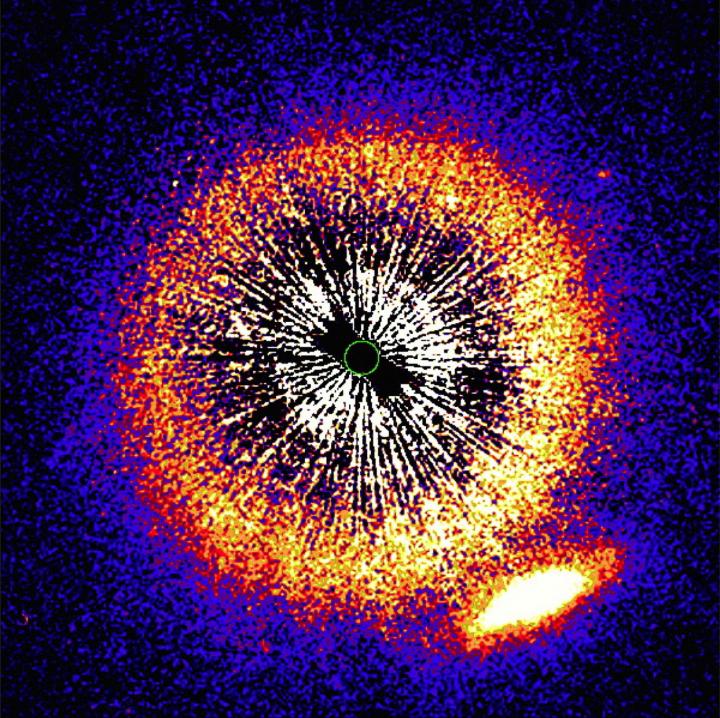
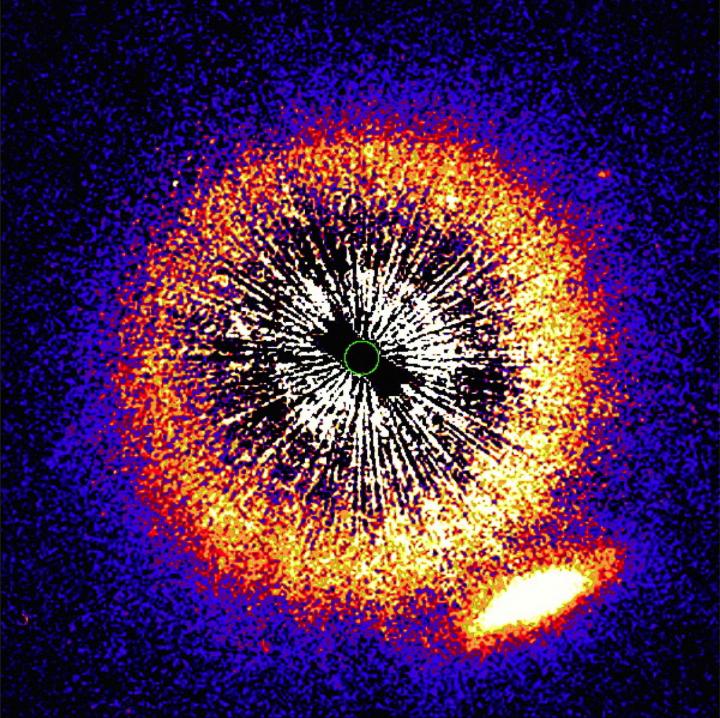
The NASA/ESA Hubble Space Telescope is famous for its jaw-dropping snapshots of the cosmos. At first glance this Picture of the Week appears to be quite the opposite, showing just a blur of jagged spikes, speckled noise, and weird, clashing colors — but once you know what you are looking at, images like this one are no less breathtaking.

This shows a distant galaxy — visible as the smudge to the lower right — as it begins to align with and pass behind a star sitting nearer to us within the Milky Way. This is an event known as a transit. The star is called HD 107146, and it sits at the center of the frame. Its light has been blocked in this image to make its immediate surroundings and the faint galaxy visible — the position of the star is marked with a green circle.

The concentric orange circle surrounding HD 107146 is a circumstellar disk — a disk of debris orbiting the star. In the case of HD 107146 we see the disk face-on. As this star very much resembles our sun, it is an interesting scientific target to study: its circumstellar disk could be analogous to the asteroids in our Solar System and the Kuiper belt.

A detailed study of this system is possible because of the much more distant galaxy — nicknamed the "Vermin Galaxy" by some to reflect their annoyance at its presence — as the star passes in front of it. The unusual pairing was first observed in 2004 by Hubble's Advanced Camera for Surveys, and again in 2011 by Hubble's Space Telescope Imaging Spectrograph. The latter image is shown here, as the Vermin Galaxy began its transit behind HD 107146. The galaxy will not be fully obscured until around 2020, but interesting science can be done even while the galaxy is only partly obscured. Light from the galaxy will pass through the star's debris disks before reaching our telescopes, allowing us to study the properties of the light and how it changes, and thus infer the characteristics of the disk itself.

###

Media Contact

Rob Gutro
[email protected]
@NASAGoddard

http://www.nasa.gov/goddard

############

Story Source: Materials provided by Scienmag

Share12Tweet8Share2ShareShareShare2

Related Posts

New Study Reveals the Massive Economic Impact of Tuberculosis

May 17, 2026

Age Discrimination Affects Healthcare Use in India

May 17, 2026

Lavandula-Zn(II) Hybrid Shields Steel from Corrosion

May 17, 2026

Targeted Radiotherapy Extends Control of Early-Stage Breast Cancer Spread

May 17, 2026
Please login to join discussion

POPULAR NEWS

  • Research Indicates Potential Connection Between Prenatal Medication Exposure and Elevated Autism Risk

    844 shares
    Share 338 Tweet 211
  • New Study Reveals Plants Can Detect the Sound of Rain

    730 shares
    Share 291 Tweet 182
  • Salmonella Haem Blocks Macrophages, Boosts Infection

    62 shares
    Share 25 Tweet 16
  • Breastmilk Balances E. coli and Beneficial Bacteria in Infant Gut Microbiomes

    58 shares
    Share 23 Tweet 15

About

We bring you the latest biotechnology news from best research centers and universities around the world. Check our website.

Follow us

Recent News

New Study Reveals the Massive Economic Impact of Tuberculosis

Age Discrimination Affects Healthcare Use in India

Lavandula-Zn(II) Hybrid Shields Steel from Corrosion

Subscribe to Blog via Email

Enter your email address to subscribe to this blog and receive notifications of new posts by email.

Join 82 other subscribers
  • Contact Us

Bioengineer.org © Copyright 2023 All Rights Reserved.

Welcome Back!

Login to your account below

Forgotten Password?

Retrieve your password

Please enter your username or email address to reset your password.

Log In
No Result
View All Result
  • Homepages
    • Home Page 1
    • Home Page 2
  • News
  • National
  • Business
  • Health
  • Lifestyle
  • Science

Bioengineer.org © Copyright 2023 All Rights Reserved.