• HOME
  • NEWS
  • EXPLORE
    • CAREER
      • Companies
      • Jobs
    • EVENTS
    • iGEM
      • News
      • Team
    • PHOTOS
    • VIDEO
    • WIKI
  • BLOG
  • COMMUNITY
    • FACEBOOK
    • INSTAGRAM
    • TWITTER
Sunday, May 10, 2026
BIOENGINEER.ORG
No Result
View All Result
  • Login
  • HOME
  • NEWS
  • EXPLORE
    • CAREER
      • Companies
      • Jobs
        • Lecturer
        • PhD Studentship
        • Postdoc
        • Research Assistant
    • EVENTS
    • iGEM
      • News
      • Team
    • PHOTOS
    • VIDEO
    • WIKI
  • BLOG
  • COMMUNITY
    • FACEBOOK
    • INSTAGRAM
    • TWITTER
  • HOME
  • NEWS
  • EXPLORE
    • CAREER
      • Companies
      • Jobs
        • Lecturer
        • PhD Studentship
        • Postdoc
        • Research Assistant
    • EVENTS
    • iGEM
      • News
      • Team
    • PHOTOS
    • VIDEO
    • WIKI
  • BLOG
  • COMMUNITY
    • FACEBOOK
    • INSTAGRAM
    • TWITTER
No Result
View All Result
Bioengineer.org
No Result
View All Result
Home NEWS Science News Chemistry

Hubble spies curious galaxy moving a little closer

Bioengineer by Bioengineer
May 24, 2019
in Chemistry
Reading Time: 2 mins read
0
IMAGE
Share on FacebookShare on TwitterShare on LinkedinShare on RedditShare on Telegram

IMAGE

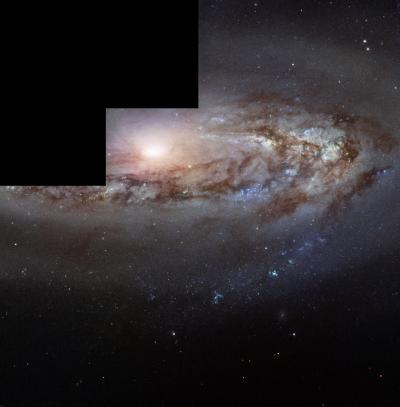
Credit: ESA/Hubble & NASA, W. Sargent et al.

This Hubble image stars Messier 90, a beautiful spiral galaxy located roughly 60 million light-years from the Milky Way in the constellation of Virgo (the Virgin). The galaxy is part of the Virgo Cluster, a gathering of galaxies that is over 1,200 strong.

This image combines infrared, ultraviolet and visible light gathered by the Wide Field and Planetary Camera 2 on the NASA/ESA Hubble Space Telescope. This camera was operational between 1994 and 2010, producing images with an unusual staircase-like shape as seen here. This is because the camera was made up of four light detectors with overlapping fields of view, one of which gave a higher magnification than the other three. When the four images are combined together in one picture, the high-magnification image needs to be reduced in size in order for the image to align properly. This produces an image with a layout that looks like steps.

Messier 90 is remarkable; it is one of the few galaxies seen to be traveling toward the Milky Way, not away from it. The galaxy’s light reveals this incoming motion in a phenomenon known as blueshift. In simple terms, the galaxy is compressing the wavelength of its light as it moves towards us, like a slinky being squashed when you push on one end. This increases the frequency of the light and shifts it towards the blue end of the spectrum. As our universe is expanding, almost all of the galaxies we see in the universe are moving away from us, and we therefore see their light more towards the red end of the spectrum, known as redshift. Messier 90, however, appears to be a rare exception.

Astronomers think that this blueshift is likely caused by the cluster’s colossal mass accelerating its members to high velocities on bizarre and peculiar orbits, sending them whirling around on odd paths that take them both towards and away from us over time. While the cluster itself is moving away from us, some of its constituent galaxies, such as Messier 90, are moving faster than the cluster as a whole, making it so that, from Earth, we see the galaxy heading towards us. However, some are also moving in the opposite direction within the cluster, and thus seem to be streaking away from us at very high velocity.

###

Messier 90 is featured in Hubble’s Messier catalog, which includes some of the most fascinating objects that can be observed from Earth’s Northern Hemisphere. See the NASA-processed image and other Messier objects at: https://www.nasa.gov/content/goddard/hubble-s-messier-catalog.

Media Contact
Claire Andreoli
[email protected]

Tags: AstronomyAstrophysicsSatellite Missions/ShuttlesSpace/Planetary ScienceStars/The Sun
Share13Tweet8Share2ShareShareShare2

Related Posts

Miniature Sensor Uses Light to Detect Touch — Chemistry

Miniature Sensor Uses Light to Detect Touch

May 8, 2026
Iron Minerals Determine Whether Dissolved Organic Matter Fuels Microbes or Becomes Long-Term Carbon Storage — Chemistry

Iron Minerals Determine Whether Dissolved Organic Matter Fuels Microbes or Becomes Long-Term Carbon Storage

May 8, 2026

Kate Evans Appointed Associate Lab Director for Biological and Environmental Systems Science at ORNL

May 8, 2026

Advancing Multiscale Modeling and Overcoming Operational Challenges in Autothermal COâ‚‚-to-Methanol Reactors

May 8, 2026
Please login to join discussion

POPULAR NEWS

  • Research Indicates Potential Connection Between Prenatal Medication Exposure and Elevated Autism Risk

    840 shares
    Share 336 Tweet 210
  • New Study Reveals Plants Can Detect the Sound of Rain

    727 shares
    Share 290 Tweet 181
  • Scientists Investigate Possible Connection Between COVID-19 and Increased Lung Cancer Risk

    68 shares
    Share 27 Tweet 17
  • Salmonella Haem Blocks Macrophages, Boosts Infection

    61 shares
    Share 24 Tweet 15

About

We bring you the latest biotechnology news from best research centers and universities around the world. Check our website.

Follow us

Recent News

Evaluating Digoxin Use in Patients with Symptomatic Rheumatic Heart Disease

Evaluating the Effectiveness and Safety of Digitalis Glycosides in Treating Heart Failure

Urdu Fall Risk Questionnaire Adapted for Elderly

Subscribe to Blog via Email

Success! An email was just sent to confirm your subscription. Please find the email now and click 'Confirm' to start subscribing.

Join 82 other subscribers
  • Contact Us

Bioengineer.org © Copyright 2023 All Rights Reserved.

Welcome Back!

Login to your account below

Forgotten Password?

Retrieve your password

Please enter your username or email address to reset your password.

Log In
No Result
View All Result
  • Homepages
    • Home Page 1
    • Home Page 2
  • News
  • National
  • Business
  • Health
  • Lifestyle
  • Science

Bioengineer.org © Copyright 2023 All Rights Reserved.