• HOME
  • NEWS
  • EXPLORE
    • CAREER
      • Companies
      • Jobs
    • EVENTS
    • iGEM
      • News
      • Team
    • PHOTOS
    • VIDEO
    • WIKI
  • BLOG
  • COMMUNITY
    • FACEBOOK
    • INSTAGRAM
    • TWITTER
Monday, May 11, 2026
BIOENGINEER.ORG
No Result
View All Result
  • Login
  • HOME
  • NEWS
  • EXPLORE
    • CAREER
      • Companies
      • Jobs
        • Lecturer
        • PhD Studentship
        • Postdoc
        • Research Assistant
    • EVENTS
    • iGEM
      • News
      • Team
    • PHOTOS
    • VIDEO
    • WIKI
  • BLOG
  • COMMUNITY
    • FACEBOOK
    • INSTAGRAM
    • TWITTER
  • HOME
  • NEWS
  • EXPLORE
    • CAREER
      • Companies
      • Jobs
        • Lecturer
        • PhD Studentship
        • Postdoc
        • Research Assistant
    • EVENTS
    • iGEM
      • News
      • Team
    • PHOTOS
    • VIDEO
    • WIKI
  • BLOG
  • COMMUNITY
    • FACEBOOK
    • INSTAGRAM
    • TWITTER
No Result
View All Result
Bioengineer.org
No Result
View All Result
Home NEWS Science News Chemistry

Hubble sees summertime on Saturn

Bioengineer by Bioengineer
July 23, 2020
in Chemistry
Reading Time: 3 mins read
0
IMAGE
Share on FacebookShare on TwitterShare on LinkedinShare on RedditShare on Telegram

IMAGE

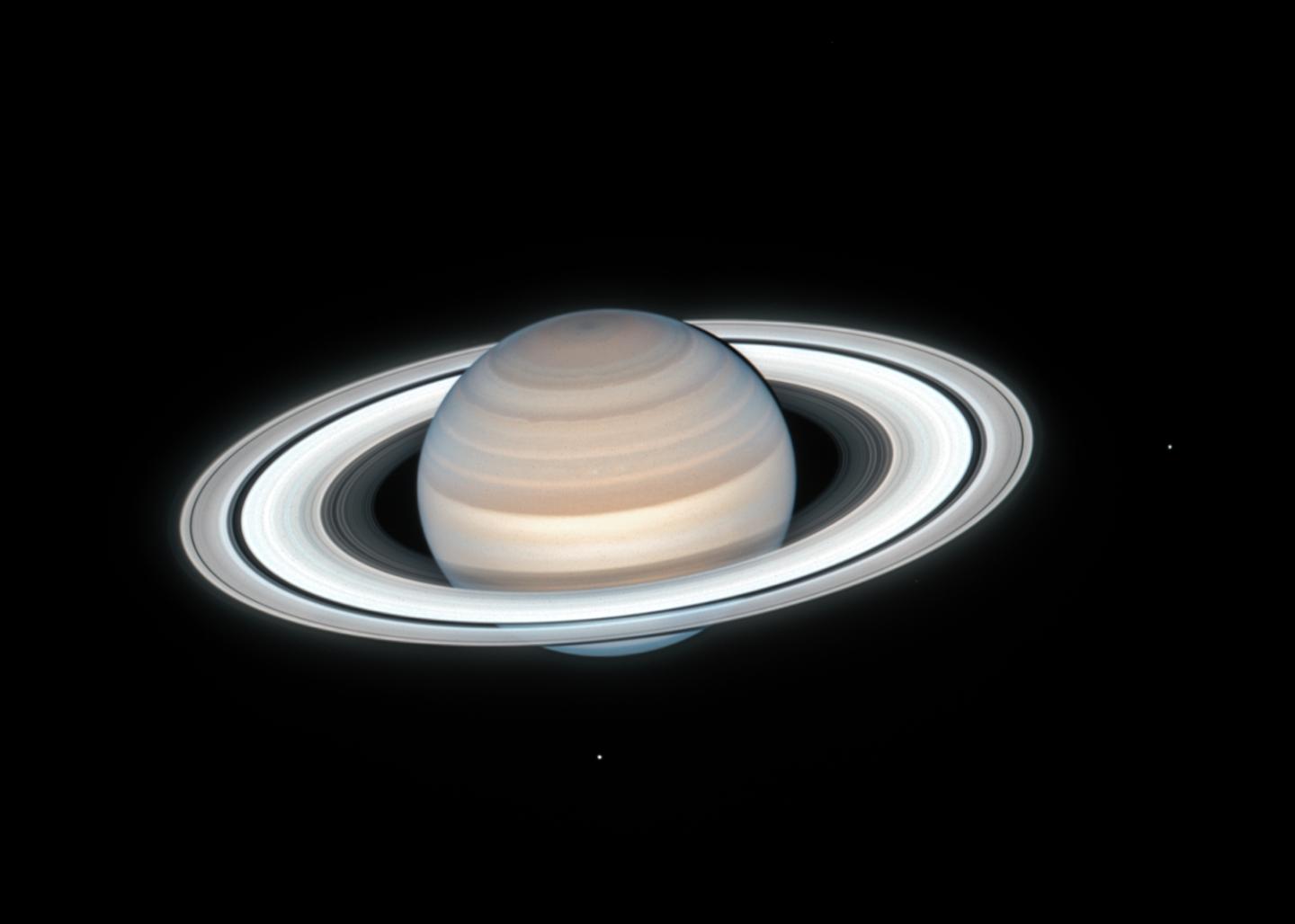
Credit: NASA, ESA, A. Simon (Goddard Space Flight Center), M.H. Wong (University of California, Berkeley), and the OPAL Team

Saturn is truly the lord of the rings in this latest snapshot from NASA’s Hubble Space Telescope, taken on July 4, 2020, when the opulent giant world was 839 million miles from Earth. This new Saturn image was taken during summer in the planet’s northern hemisphere.

Hubble found a number of small atmospheric storms. These are transient features that appear to come and go with each yearly Hubble observation. The banding in the northern hemisphere remains pronounced as seen in Hubble’s 2019 observations, with several bands slightly changing color from year to year. The ringed planet’s atmosphere is mostly hydrogen and helium with traces of ammonia, methane, water vapor, and hydrocarbons that give it a yellowish-brown color.

Hubble photographed a slight reddish haze over the northern hemisphere in this color composite. This may be due to heating from increased sunlight, which could either change the atmospheric circulation or perhaps remove ices from aerosols in the atmosphere. Another theory is that the increased sunlight in the summer months is changing the amounts of photochemical haze produced. “It’s amazing that even over a few years, we’re seeing seasonal changes on Saturn,” said lead investigator Amy Simon of NASA’s Goddard Space Flight Center in Greenbelt, Maryland. Conversely, the just-now-visible south pole has a blue hue, reflecting changes in Saturn’s winter hemisphere.

Hubble’s sharp view resolves the finely etched concentric ring structure. The rings are mostly made of pieces of ice, with sizes ranging from tiny grains to giant boulders. Just how and when the rings formed remains one of our solar system’s biggest mysteries. Conventional wisdom is that they are as old as the planet, over 4 billion years. But because the rings are so bright – like freshly fallen snow – a competing theory is that they may have formed during the age of the dinosaurs. Many astronomers agree that there is no satisfactory theory that explains how rings could have formed within just the past few hundred million years. “However, NASA’s Cassini spacecraft measurements of tiny grains raining into Saturn’s atmosphere suggest the rings can only last for 300 million more years, which is one of the arguments for a young age of the ring system,” said team member Michael Wong of the University of California, Berkeley.

Two of Saturn’s icy moons are clearly visible in this exposure: Mimas at right, and Enceladus at bottom.

This image is taken as part of the Outer Planets Atmospheres Legacy (OPAL) project. OPAL is helping scientists understand the atmospheric dynamics and evolution of our solar system’s gas giant planets. In Saturn’s case, astronomers continue tracking shifting weather patterns and storms.

###

The Hubble Space Telescope is a project of international cooperation between NASA and ESA (European Space Agency). NASA’s Goddard Space Flight Center in Greenbelt, Maryland, manages the telescope. The Space Telescope Science Institute (STScI) in Baltimore conducts Hubble science operations. STScI is operated for NASA by the Association of Universities for Research in Astronomy in Washington, D.C.

Media Contact
Claire Andreoli
[email protected]

Original Source

https://www.nasa.gov/feature/goddard/2020/hubble-sees-summertime-on-saturn

Tags: AstronomyAstrophysicsPlanets/MoonsSatellite Missions/ShuttlesSpace/Planetary Science
Share14Tweet9Share2ShareShareShare2

Related Posts

Miniature Sensor Uses Light to Detect Touch — Chemistry

Miniature Sensor Uses Light to Detect Touch

May 8, 2026
Iron Minerals Determine Whether Dissolved Organic Matter Fuels Microbes or Becomes Long-Term Carbon Storage — Chemistry

Iron Minerals Determine Whether Dissolved Organic Matter Fuels Microbes or Becomes Long-Term Carbon Storage

May 8, 2026

Kate Evans Appointed Associate Lab Director for Biological and Environmental Systems Science at ORNL

May 8, 2026

Advancing Multiscale Modeling and Overcoming Operational Challenges in Autothermal COâ‚‚-to-Methanol Reactors

May 8, 2026
Please login to join discussion

POPULAR NEWS

  • Research Indicates Potential Connection Between Prenatal Medication Exposure and Elevated Autism Risk

    840 shares
    Share 336 Tweet 210
  • New Study Reveals Plants Can Detect the Sound of Rain

    727 shares
    Share 290 Tweet 181
  • Salmonella Haem Blocks Macrophages, Boosts Infection

    61 shares
    Share 24 Tweet 15
  • Breastmilk Balances E. coli and Beneficial Bacteria in Infant Gut Microbiomes

    57 shares
    Share 23 Tweet 14

About

We bring you the latest biotechnology news from best research centers and universities around the world. Check our website.

Follow us

Recent News

New Post-Hoc Analysis Explores Daily Oral Orforglipron Use in Adults Over 65 with Obesity, Regardless of Diabetes Status

Evaluating Digoxin Use in Patients with Symptomatic Rheumatic Heart Disease

Evaluating the Effectiveness and Safety of Digitalis Glycosides in Treating Heart Failure

Subscribe to Blog via Email

Enter your email address to subscribe to this blog and receive notifications of new posts by email.

Join 82 other subscribers
  • Contact Us

Bioengineer.org © Copyright 2023 All Rights Reserved.

Welcome Back!

Login to your account below

Forgotten Password?

Retrieve your password

Please enter your username or email address to reset your password.

Log In
No Result
View All Result
  • Homepages
    • Home Page 1
    • Home Page 2
  • News
  • National
  • Business
  • Health
  • Lifestyle
  • Science

Bioengineer.org © Copyright 2023 All Rights Reserved.