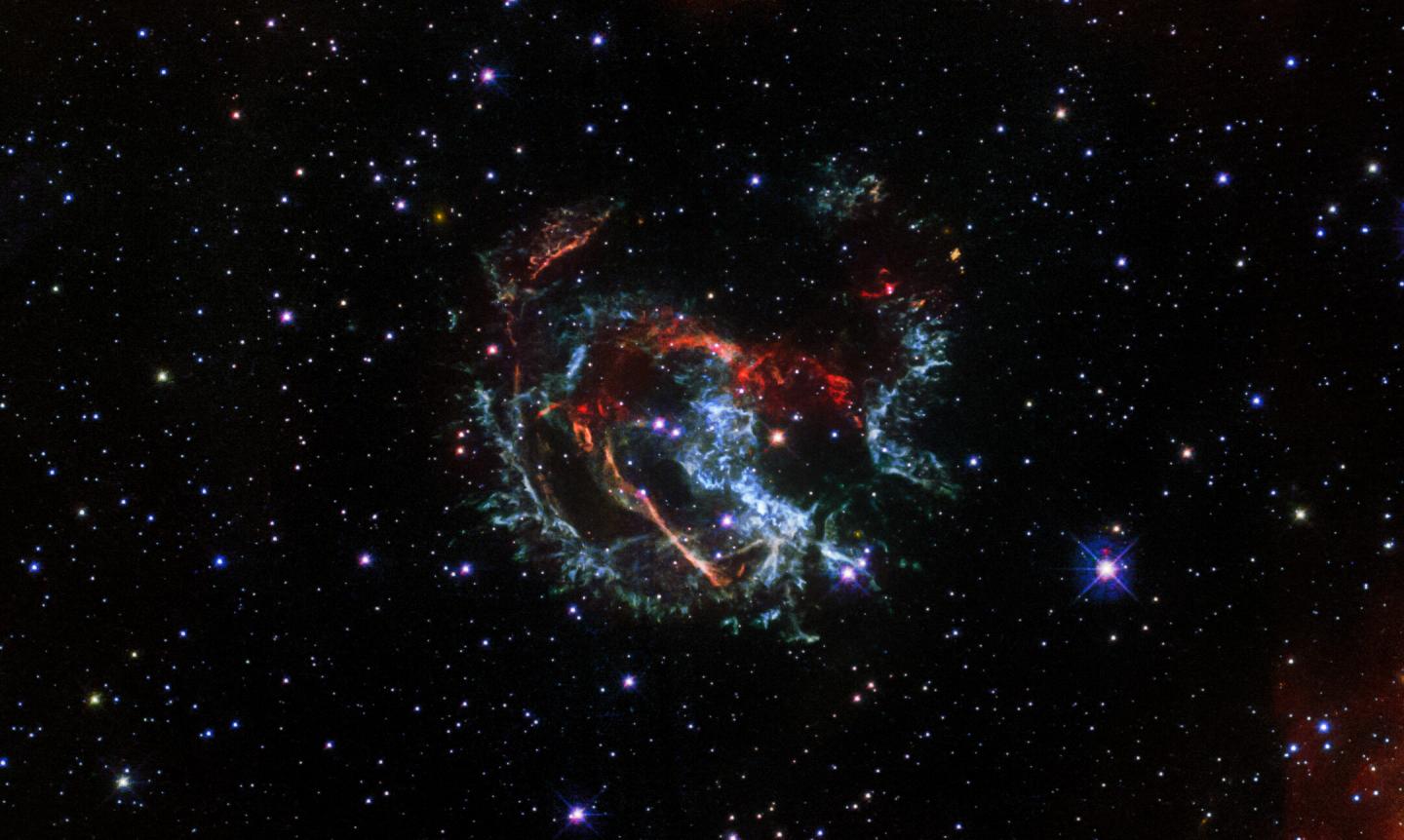
Credit: NASA, ESA, and J. Banovetz and D. Milisavljevic (Purdue University)
The NASA/ESA Hubble Space Telescope has observed the supernova remnant named 1E 0102.2-7219. Researchers are using Hubble’s imagery of the remnant object to wind back the clock on the expanding remains of this exploded star in the hope of understanding the supernova event that caused it 1700 years ago.
The featured star that exploded long ago belongs to the Small Magellanic Cloud, a satellite galaxy of our Milky Way located roughly 200 000 light-years away. The doomed star left behind an expanding, gaseous corpse — a supernova remnant — known as 1E 0102.2-7219.
Because the gaseous knots in this supernova remnant are moving at different speeds and directions from the supernova explosion, those moving toward Earth are colored blue in this composition and the ones moving away are shown in red. This new Hubble image shows these ribbons of gas speeding away from the explosion site at an average speed of 3.2 million kilometers per hour. At that speed, you could travel to the Moon and back in 15 minutes.
Researchers have studied the Hubble archive looking for visible-light images of the supernova remnant and they have analysed the data to calculate a more accurate estimate of the age and centre of the supernova blast.
According to their new estimates [1], light from this blast arrived at Earth 1700 years ago, during the decline of the Roman Empire. This supernova would only have been visible to inhabitants of Earth’s southern hemisphere. Unfortunately, there are no known records of this titanic event. Earlier studies proposed explosion dates of 2000 and 1000 years ago, but this new analysis is believed to be more robust.
To pinpoint when the explosion occurred, researchers studied the tadpole-shaped, oxygen-rich clumps of ejecta flung out by this supernova blast. Ionised oxygen is an excellent tracer because it glows brightest in visible light. By using Hubble’s powerful resolution to identify the 22 fastest moving ejecta clumps, or knots, the researchers determined that these targets were the least likely to have been slowed down by passage through interstellar material. They then traced the knots’ motion backward until the ejecta coalesced at one point, identifying the explosion site. Once that was known, they could calculate how long it took the speedy knots to travel from the explosion centre to their current location.
Hubble also measured the speed of a suspected neutron star — the crushed core of the doomed star — that was ejected from the blast. Based on the researchers’ estimates, itmust be moving at more than 3 million kilometres per hour from the centre of the explosion to have arrived at its current position. The suspected neutron star was identified in observations with the European Southern Observatory’s Very Large Telescope in Chile, in combination with data from NASA’s Chandra X-ray Observatory.
###
Notes
[1] The international team of astronomers who carried out this study consists of J. Banovetz, D. Milisavljevic, N. Sravan, R. A. Fesen, D. J. Patnaude, P. P. Plucinsky, W. P. Blair, K. E. Weil, J. A. Morse, R. Margutti, and M. R. Drout.
The Hubble Space Telescope observations involved in this study are associated with programmes 6052 (Morse), 12001 (Green), 12858 (Madore), and 13378 (Milisavljevic).
These results have been presented at the 237th American Astronomical Society virtual meeting on 14 January 2021 and will be published in the Astrophysical Journal.
Media Contact
Bethany Rose Downer
[email protected]
Original Source
https:/