• HOME
  • NEWS
  • EXPLORE
    • CAREER
      • Companies
      • Jobs
    • EVENTS
    • iGEM
      • News
      • Team
    • PHOTOS
    • VIDEO
    • WIKI
  • BLOG
  • COMMUNITY
    • FACEBOOK
    • INSTAGRAM
    • TWITTER
Monday, May 11, 2026
BIOENGINEER.ORG
No Result
View All Result
  • Login
  • HOME
  • NEWS
  • EXPLORE
    • CAREER
      • Companies
      • Jobs
        • Lecturer
        • PhD Studentship
        • Postdoc
        • Research Assistant
    • EVENTS
    • iGEM
      • News
      • Team
    • PHOTOS
    • VIDEO
    • WIKI
  • BLOG
  • COMMUNITY
    • FACEBOOK
    • INSTAGRAM
    • TWITTER
  • HOME
  • NEWS
  • EXPLORE
    • CAREER
      • Companies
      • Jobs
        • Lecturer
        • PhD Studentship
        • Postdoc
        • Research Assistant
    • EVENTS
    • iGEM
      • News
      • Team
    • PHOTOS
    • VIDEO
    • WIKI
  • BLOG
  • COMMUNITY
    • FACEBOOK
    • INSTAGRAM
    • TWITTER
No Result
View All Result
Bioengineer.org
No Result
View All Result
Home NEWS Science News Chemistry

Hubble captures a dozen galaxy doppelgangers

Bioengineer by Bioengineer
November 7, 2019
in Chemistry
Reading Time: 2 mins read
0
IMAGE
Share on FacebookShare on TwitterShare on LinkedinShare on RedditShare on Telegram

IMAGE

Credit: NASA, ESA and E. Rivera-Thorsen (Institute of Theoretical Astrophysics Oslo, Norway)


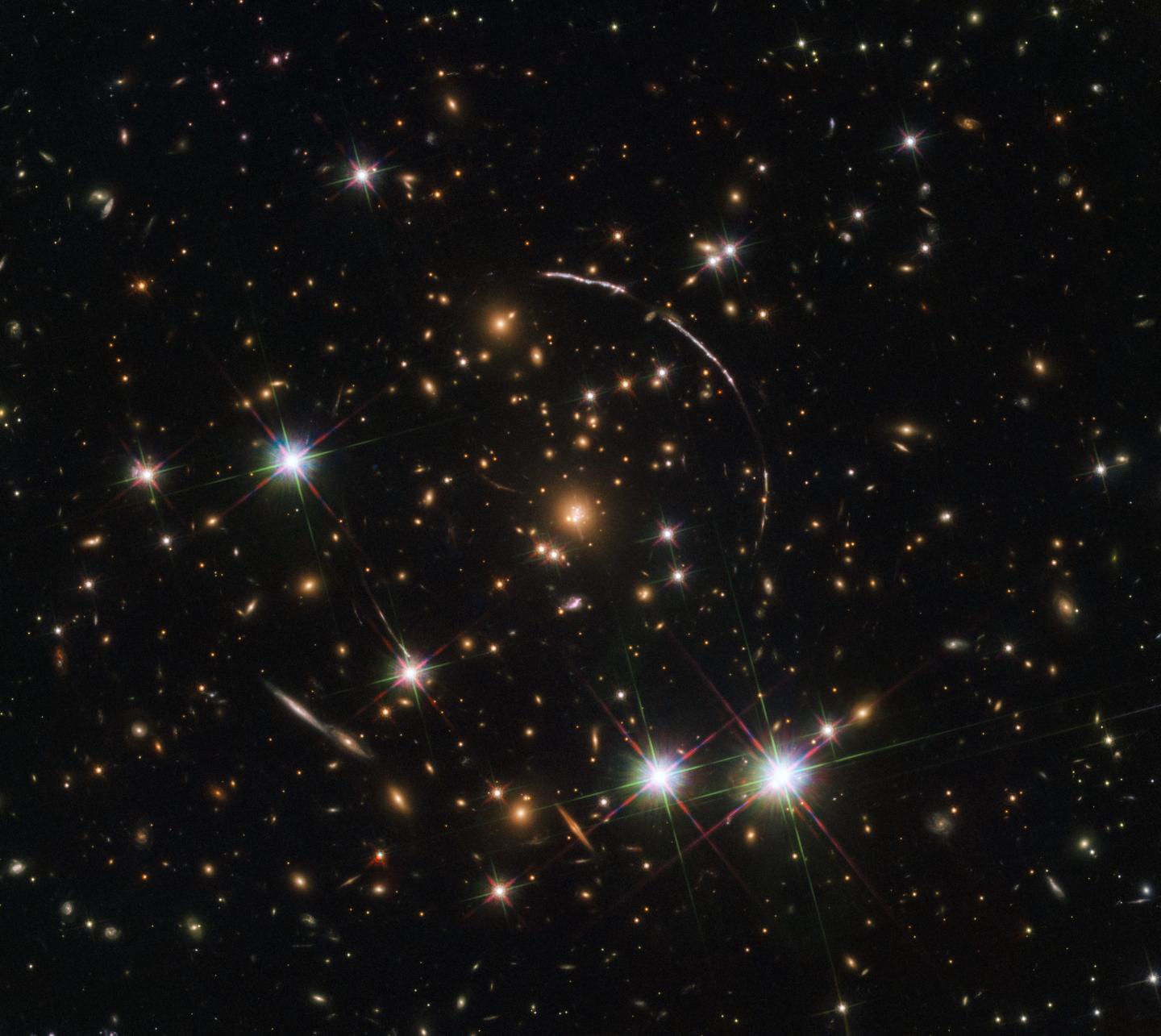
This NASA Hubble Space Telescope photo reveals a cosmic kaleidoscope of a remote galaxy, which has been split into multiple images by an effect called gravitational lensing.

Gravitational lensing means that the foreground galaxy cluster is so massive that its gravity distorts the fabric of space-time, bending and magnifying the light from the more distant galaxy behind it. This “funhouse mirror” effect not only stretches the background galaxy image, but also creates multiple images of the same galaxy.

The lensing phenomenon produces at least 12 images of the background galaxy, distributed over four major arcs. Three of these arcs are visible in the top right of the image, while one counter arc is visible in the lower left — partially obscured by a bright foreground star within the Milky Way.

The galaxy, nicknamed the Sunburst Arc (officially designated PSZ1 G311.65-18.48), is almost 11 billion light-years from Earth and has been lensed into multiple images by a massive foreground cluster of galaxies 4.6 billion light-years away.

Hubble uses these cosmic magnifying glasses to study objects that would otherwise be too faint and too small for even its extraordinarily sensitive instruments. The Sunburst Arc is no exception, despite being one of the brightest gravitationally lensed galaxies known.

The lens makes images of the Sunburst Arc that are between 10 and 30 times brighter than the background galaxy would normally look. The magnification allows Hubble to view structures as small as 520 light-years across that would be too small to see without the turboboost from the lensing effect. The structures resemble star-forming regions in nearby galaxies in the local universe, allowing astronomers to make a detailed study of the remote galaxy and its environment.

Hubble’s observations show that the Sunburst Arc is similar to galaxies that existed at a much earlier time in the history of the universe, perhaps only 150 million years after the big bang.

###

Media Contact
Claire Andreoli
[email protected]

Original Source

https://www.nasa.gov/feature/goddard/2019/hubble-captures-a-dozen-galaxy-doppelgangers

Tags: AstronomyAstrophysicsSatellite Missions/ShuttlesSpace/Planetary ScienceStars/The Sun
Share12Tweet8Share2ShareShareShare2

Related Posts

Miniature Sensor Uses Light to Detect Touch — Chemistry

Miniature Sensor Uses Light to Detect Touch

May 8, 2026
Iron Minerals Determine Whether Dissolved Organic Matter Fuels Microbes or Becomes Long-Term Carbon Storage — Chemistry

Iron Minerals Determine Whether Dissolved Organic Matter Fuels Microbes or Becomes Long-Term Carbon Storage

May 8, 2026

Kate Evans Appointed Associate Lab Director for Biological and Environmental Systems Science at ORNL

May 8, 2026

Advancing Multiscale Modeling and Overcoming Operational Challenges in Autothermal COâ‚‚-to-Methanol Reactors

May 8, 2026
Please login to join discussion

POPULAR NEWS

  • Research Indicates Potential Connection Between Prenatal Medication Exposure and Elevated Autism Risk

    840 shares
    Share 336 Tweet 210
  • New Study Reveals Plants Can Detect the Sound of Rain

    727 shares
    Share 290 Tweet 181
  • Salmonella Haem Blocks Macrophages, Boosts Infection

    61 shares
    Share 24 Tweet 15
  • Breastmilk Balances E. coli and Beneficial Bacteria in Infant Gut Microbiomes

    57 shares
    Share 23 Tweet 14

About

We bring you the latest biotechnology news from best research centers and universities around the world. Check our website.

Follow us

Recent News

New Post-Hoc Analysis Explores Daily Oral Orforglipron Use in Adults Over 65 with Obesity, Regardless of Diabetes Status

Evaluating Digoxin Use in Patients with Symptomatic Rheumatic Heart Disease

Evaluating the Effectiveness and Safety of Digitalis Glycosides in Treating Heart Failure

Subscribe to Blog via Email

Enter your email address to subscribe to this blog and receive notifications of new posts by email.

Join 82 other subscribers
  • Contact Us

Bioengineer.org © Copyright 2023 All Rights Reserved.

Welcome Back!

Login to your account below

Forgotten Password?

Retrieve your password

Please enter your username or email address to reset your password.

Log In
No Result
View All Result
  • Homepages
    • Home Page 1
    • Home Page 2
  • News
  • National
  • Business
  • Health
  • Lifestyle
  • Science

Bioengineer.org © Copyright 2023 All Rights Reserved.