Until now, complex experimental equipment was required to measure the shape of a light pulse; a team from TU Wien (Vienna), MPI Garching and LMU Munich has now made this much easier
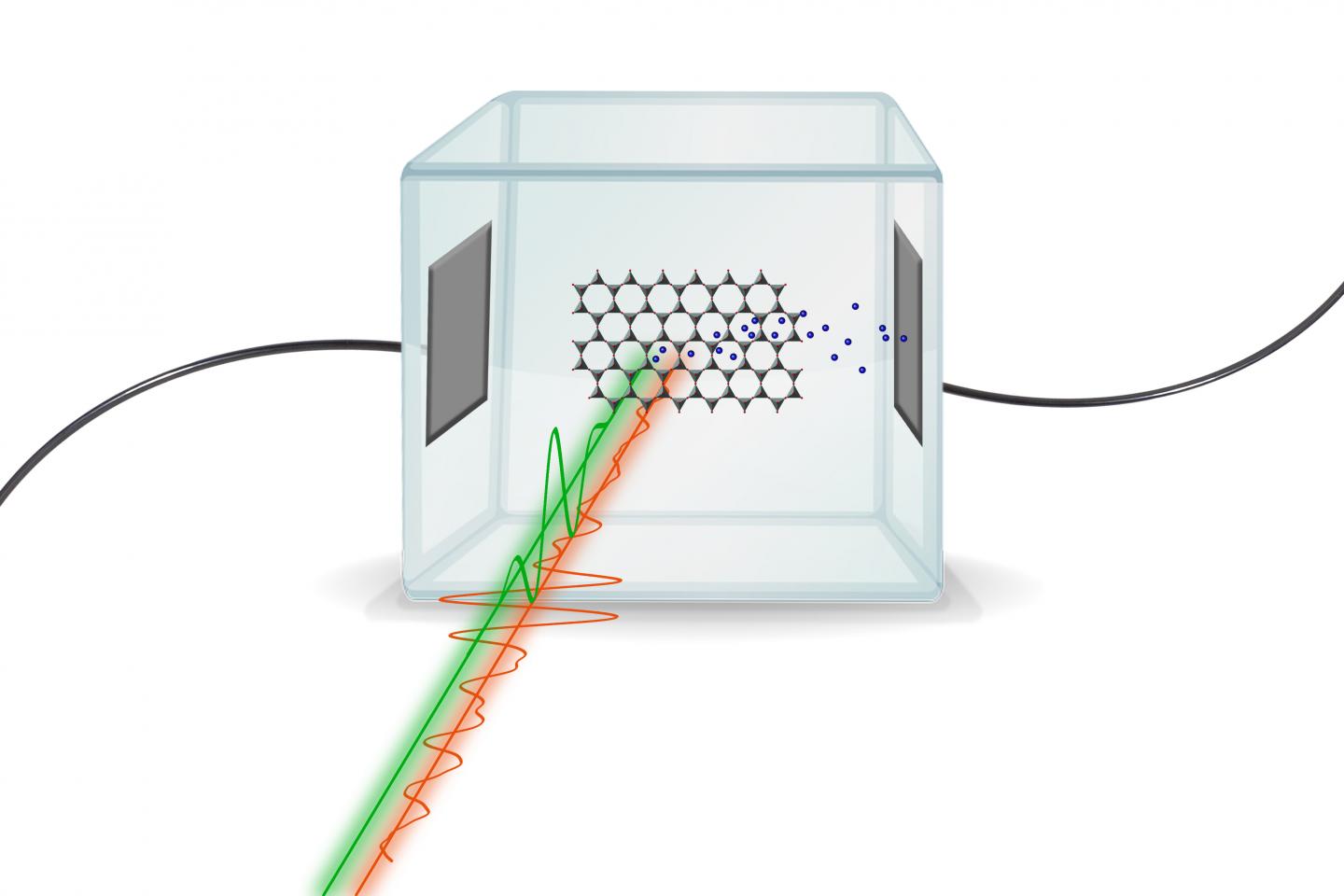
Credit: TU Wien
Today, modern lasers can generate extremely short light pulses, which can be used for a wide range of applications from investigating materials to medical diagnostics. For this purpose, it is important to measure the shape of the laser light wave with high accuracy. Until now, this has required a large, complex experimental setup. Now this can be done with a tiny crystal with a diameter of less than one millimeter. The new method has been developed by the MPI for Quantum Optics in Garching, the LMU Munich and the TU Wien (Vienna). The advance will now help to clarify important details about the interaction of light and matter.
Looking at Light with Electrons
Extremely short light pulses with a duration in the order of femtoseconds (10-15 seconds) were investigated. “In order to create an image of such light waves, they must be made to interact with electrons,” says Prof. Joachim Burgdörfer from the Institute of Theoretical Physics at the TU Wien. “The reaction of the electrons to the electric field of the laser gives us very precise information about the shape of the light pulse”.
Previously, the common way to measure an infrared laser pulse was adding a much shorter laser pulse with a wavelength in the X-ray range. Both pulses are sent through a gas. The X-ray pulse ionizes individual atoms, electrons are released, which are then accelerated by the electric field of the infrared laser pulse. The motion of the electrons is recorded, and if the experiment is carried out many times with different time shifts between the two pulses, the shape of the infrared laser pulse can eventually be reconstructed. “The experimental effort required for this method is very high,” says Prof. Christoph Lemell (TU Vienna). “A complicated experimental setup is needed, with vacuum systems, many optical elements and detectors.”
Measurement in Tiny Silicon Oxide Crystals
To bypass such complications, the idea was born to measure light pulses not in a gas but in a solid: “In a gas you have to ionize atoms first to get free electrons. In a solid it is sufficient to give the electrons enough energy so that they can move through the solid, driven by the laser field”, says Isabella Floss (TU Vienna). This generates an electric current which can be directly measured.
Tiny crystals of silicon oxide with a diameter of a few hundred micrometers are used for this purpose. They are hit by two different laser pulses: The pulse which is to be investigated can have any wavelength ranging from ultraviolet light and visible colours to long-wave infrared. While this laser pulse penetrates the crystal, another infrared pulse is fired at the target. “This second pulse is so strong that non-linear effects in the material can change the energy state of the electrons so that they become mobile. This happens at a very specific point in time, which can be tuned and controlled very precisely,” explains Joachim Burgdörfer.
As soon as the electrons can move through the crystal, they are accelerated by the electric field of the first beam. This produces an electric current which is measured directly at the crystal. This signal contains precise information about the shape of the light pulse.
Many Possible Applications
At TU Wien, the effect was studied theoretically and analysed in computer simulations. The experiment was performed at the Max Planck Institute for Quantum Optics in Garching. “Thanks to the close cooperation between theory and experiment, we have been able to show that the new method works very well, over a large frequency range, from ultraviolet to infrared,” says Christoph Lemell. “The waveform of light pulses can now be measured much more easily than before, with the help of such a much simpler and more compact setup.”
The new method opens up many interesting applications: It should be possible to precisely characterize novel materials, to answer fundamental physical questions about the interaction of light and matter, and even to analyze complex molecules – for example, to reliably and quickly detect diseases by examining tiny blood samples.
###
Contact:
Prof. Christoph Lemell
Institute for Theoretical Physics
TU Wien
Wiedner Hauptstraße 8-10, 1040 Vienna
T +43-1-58801-13612
[email protected]
Prof. Joachim Burgdörfer
Institute for Theoretical Physics
TU Wien
Wiedner Hauptstraße 8-10, 1040 Vienna
T +43-1-58801-13610
[email protected]
Dipl.-Ing. Isabella Floss
Institute for Theoretical Physics
TU Wien
Wiedner Hauptstraße 8-10, 1040 Vienna
T +43-1-58801-13605
[email protected]
Media Contact
Florian Aigner
[email protected]
0043-158-801-41027
Original Source
https:/
Related Journal Article
http://dx.