• HOME
  • NEWS
  • EXPLORE
    • CAREER
      • Companies
      • Jobs
    • EVENTS
    • iGEM
      • News
      • Team
    • PHOTOS
    • VIDEO
    • WIKI
  • BLOG
  • COMMUNITY
    • FACEBOOK
    • INSTAGRAM
    • TWITTER
Tuesday, June 23, 2026
BIOENGINEER.ORG
No Result
View All Result
  • Login
  • HOME
  • NEWS
  • EXPLORE
    • CAREER
      • Companies
      • Jobs
        • Lecturer
        • PhD Studentship
        • Postdoc
        • Research Assistant
    • EVENTS
    • iGEM
      • News
      • Team
    • PHOTOS
    • VIDEO
    • WIKI
  • BLOG
  • COMMUNITY
    • FACEBOOK
    • INSTAGRAM
    • TWITTER
  • HOME
  • NEWS
  • EXPLORE
    • CAREER
      • Companies
      • Jobs
        • Lecturer
        • PhD Studentship
        • Postdoc
        • Research Assistant
    • EVENTS
    • iGEM
      • News
      • Team
    • PHOTOS
    • VIDEO
    • WIKI
  • BLOG
  • COMMUNITY
    • FACEBOOK
    • INSTAGRAM
    • TWITTER
No Result
View All Result
Bioengineer.org
No Result
View All Result
Home NEWS Science News Biology

How to eat a poison butterfly

Bioengineer by Bioengineer
November 22, 2021
in Biology
Reading Time: 2 mins read
0
Vomiting bluejay
Share on FacebookShare on TwitterShare on LinkedinShare on RedditShare on Telegram

Scientists now understand how certain animals can feed on picturesque, orange monarch butterflies, which are filled from head to abdomen with milkweed plant toxins.
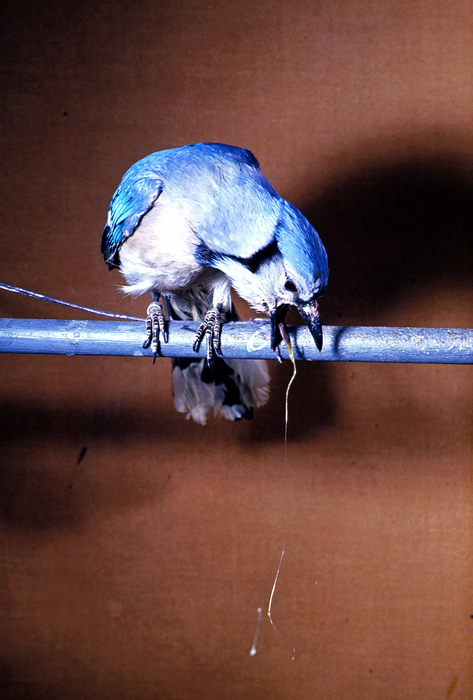
Vomiting bluejay

Credit: Lincoln Brower/Sweet Briar College

Scientists now understand how certain animals can feed on picturesque, orange monarch butterflies, which are filled from head to abdomen with milkweed plant toxins.

In high enough concentrations, milkweed can kill a horse, or a human. To be able to eat this plant, monarchs evolved a set of unusual cellular mutations. New UC Riverside research shows the animals that prey on monarchs also evolved these same mutations. 

A Current Biology journal article, published today, describes the research that revealed these mutations in four types of monarch predators — a bird, a mouse, a parasitic wasp, and a worm. 

“It’s remarkable that concurrent evolution occurred at the molecular level in all these animals,” said UCR evolutionary biologist and study lead Simon “Niels” Groen. “Plant toxins caused evolutionary changes across at least three levels of the food chain!”

Milkweed toxins target a part of animal cells called the sodium-potassium pump, which helps enable heartbeats and nerve firing. It’s so important in humans that our bodies use a third of all the energy we generate from food to power this pump. When most animals eat milkweed, the pump stops working. 

Two years ago, Groen and his colleagues wrote about amino acid changes in three places on the pump that not only allow monarch butterflies to consume milkweed, but also to accumulate the milkweed toxins in their bodies as a defense against attacks. Groen’s team engineered these same amino acid changes in fruit flies, which then became as resistant to milkweed as monarchs. 

“It’s been a very long-standing natural history observation that birds and mice are important monarch predators,” Groen said. “But in the 1970s, there weren’t the means to find out what enabled them to be successful at it. Now, with genome sequencing, we can.”

The researchers took DNA sequence information from databases for a variety of birds, wasps, and nematode worms to see if any of them evolved the amino acid changes in their sodium pumps. One of the four animals in which the team found the pump mutations includes the black-headed grosbeak, which eats up to 60% of the monarch butterflies in many colonies each year.  

It’s unclear whether there are additional adaptations that help the grosbeak and other monarch predators deal with the toxins. Groen is planning to explore this question in future studies. 

Time may be running out to learn the butterflies’ cellular secrets. Experts estimate monarch populations have declined dramatically, from roughly 500 million in the early 1990s to 100 million now. 

“Climate change is threatening the Mexican forests where they migrate every winter to mate, and as the flock of butterflies gets smaller, they’re easier prey for birds and mice,” Groen said. 


Journal

Current Biology

Subject of Research

Animals

Article Title

Predators and parasitoids of cardiac glycoside-sequestering milkweed herbivores converge on toxin resistance

Article Publication Date

22-Nov-2021

Share12Tweet8Share2ShareShareShare2

Related Posts

Advancing Gene Regulatory Network Inference Through Graph Learning and Single-Cell Genomics — Biology

Advancing Gene Regulatory Network Inference Through Graph Learning and Single-Cell Genomics

June 23, 2026
Researcher Florian Weinberger Receives ERC Advanced Grant for CARDIOSWITCH Project — Biology

Researcher Florian Weinberger Receives ERC Advanced Grant for CARDIOSWITCH Project

June 23, 2026

New Framework Enhances AI Trustworthiness in Cancer Subtyping

June 23, 2026

Dermatology AI 2.0: Advancing Skin Health Through Causal Reasoning and Autonomous Care

June 23, 2026

POPULAR NEWS

  • Saying Goodbye to PGY-6: Pediatric Fellowship Realities

    103 shares
    Share 41 Tweet 26
  • Multi-Hospital Study Reveals Long Covid Burden Is Twice as High as Current Estimates

    92 shares
    Share 36 Tweet 23
  • Detection of EDCs in Breast Milk and Infant Urine Up to Six Months Highlights Early Exposure Risks

    77 shares
    Share 31 Tweet 19
  • New Drug Candidate Developed at McMaster Shows Potential for Treating Brain Cancer

    58 shares
    Share 23 Tweet 15

About

We bring you the latest biotechnology news from best research centers and universities around the world. Check our website.

Follow us

Recent News

New ELANE Mutations Trigger Neutrophil Trap Formation

Indoor Exposure Dominates Phthalate Intake in Tianjin Kids

Engineering Drug-Responsive RNA for Precise Control

Subscribe to Blog via Email

Enter your email address to subscribe to this blog and receive notifications of new posts by email.

Join 82 other subscribers
  • Contact Us

Bioengineer.org © Copyright 2023 All Rights Reserved.

Welcome Back!

Login to your account below

Forgotten Password?

Retrieve your password

Please enter your username or email address to reset your password.

Log In
No Result
View All Result
  • Homepages
    • Home Page 1
    • Home Page 2
  • News
  • National
  • Business
  • Health
  • Lifestyle
  • Science

Bioengineer.org © Copyright 2023 All Rights Reserved.