Research confirms repression of autophagy during mitosis
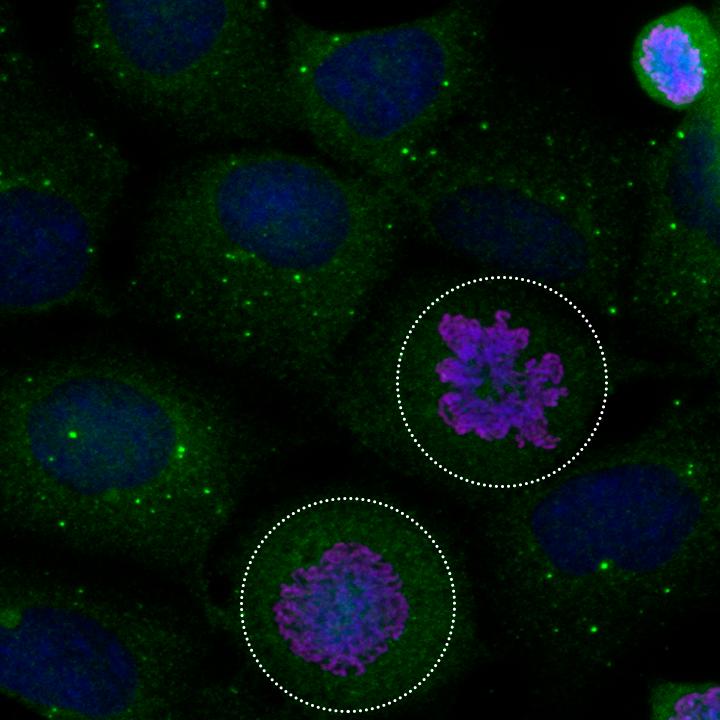
Credit: Cook lab, Babraham Institute
* The research uncovers the molecular intricacies of the cell signalling cascades that function to maintain genome integrity by repressing autophagy during the dynamic process of cell division.
Research at the Institute uniting cell signalling, autophagy, mass spectrometry and imaging expertise has resolved a fundamental question about whether the cellular recycling process is halted during cell division. In addition, the researchers have identified the mechanisms involved and described how the usual repression system and the mitosis-specific repression of autophagy interlink. The research, led by Simon Cook’s group in the Signalling research programme at the Institute, is published today in the journal Molecular Cell.
Autophagy is the cellular recycling process that balances the availability of cellular building blocks with demand. If demand exceeds availability, autophagy ensures that non-essential components are broken down and repurposed. Autophagy is essential in our cells as it allows cells to cope with stress, such as reduced nutrient availability. It is crucial for correct embryo development and problems with autophagy are linked to a wide range of diseases and disorders. Indeed, it is speculated that the repression of autophagy during mitosis reported here ensures protection of the genome during this vulnerable period, preventing genomic instability, a feature of ageing and cancer.
“Bringing together the expertise from different groups here at the Institute allowed us to provide a definitive answer on whether or not autophagy is repressed during mitosis. In addition, we’ve been able to describe the mechanisms involved to provide a much clearer understanding of what is actually happening,” said Dr Simon Cook, group leader in the Institute’s Signalling research programme.
The researchers used fluorescent markers and live-cell imaging of human cell lines to unequivocally demonstrate that autophagy is repressed during mitosis.
Under usual conditions when the cell is not dividing, the mTORC1 protein complex represses autophagy when sufficient amino acids are available in the cell to meet its requirements for protein synthesis. However, once the level of amino acids drops, mTORC1 is inactivated. This relieves the repression and autophagy kicks in, generating amino acids and other building blocks to ensure that the cell’s needs are met.
During the cell division process, the cell’s DNA, which is usually held protected in the nucleus, becomes released into the wider cellular space. This was proposed to leave the DNA vulnerable to digestion and damage by autophagy, prompting previous researchers to argue that autophagy must be repressed during cell division in order to maintain genome integrity. This concept was contested by others who reported that autophagy was maintained during the division process.
The Institute researchers found that during mitosis, the established nutrient-responsive mechanism of autophagy repression by mTORC1 was absent. Instead, it was replaced by the key regulator of mitosis itself, CDK1, which is not responsive to nutrient deprivation. This has the effect of decoupling the conditional control of autophagy, putting a definitive halt on autophagy until the cell division process is complete.
Richard Odle, first author on the paper and who undertook this work while a PhD student in Simon Cook’s group, said: “Using established models of autophagy and mTORC1 developed by the Ktistakis group, we have been able to show the lack of autophagosomes (the cell’s recycling factories) during mitosis. Furthermore, our identification of a switch in regulation from mTORC1 to CDK1 provides a fundamental new insight into autophagy during mitosis, and clarity for associated research fields going forward.”
###
Media Contact
Louisa Wood
[email protected]
44-012-234-96230
Original Source
https:/
Related Journal Article
http://dx.