• HOME
  • NEWS
  • EXPLORE
    • CAREER
      • Companies
      • Jobs
    • EVENTS
    • iGEM
      • News
      • Team
    • PHOTOS
    • VIDEO
    • WIKI
  • BLOG
  • COMMUNITY
    • FACEBOOK
    • INSTAGRAM
    • TWITTER
Tuesday, September 22, 2026
BIOENGINEER.ORG
No Result
View All Result
  • Login
  • HOME
  • NEWS
  • EXPLORE
    • CAREER
      • Companies
      • Jobs
        • Lecturer
        • PhD Studentship
        • Postdoc
        • Research Assistant
    • EVENTS
    • iGEM
      • News
      • Team
    • PHOTOS
    • VIDEO
    • WIKI
  • BLOG
  • COMMUNITY
    • FACEBOOK
    • INSTAGRAM
    • TWITTER
  • HOME
  • NEWS
  • EXPLORE
    • CAREER
      • Companies
      • Jobs
        • Lecturer
        • PhD Studentship
        • Postdoc
        • Research Assistant
    • EVENTS
    • iGEM
      • News
      • Team
    • PHOTOS
    • VIDEO
    • WIKI
  • BLOG
  • COMMUNITY
    • FACEBOOK
    • INSTAGRAM
    • TWITTER
No Result
View All Result
Bioengineer.org
No Result
View All Result
Home NEWS Science News Chemistry

How spiders distinguish living from non-living using motion-based visual cues

Bioengineer by Bioengineer
July 15, 2021
in Chemistry
Reading Time: 3 mins read
0
IMAGE
Share on FacebookShare on TwitterShare on LinkedinShare on RedditShare on Telegram

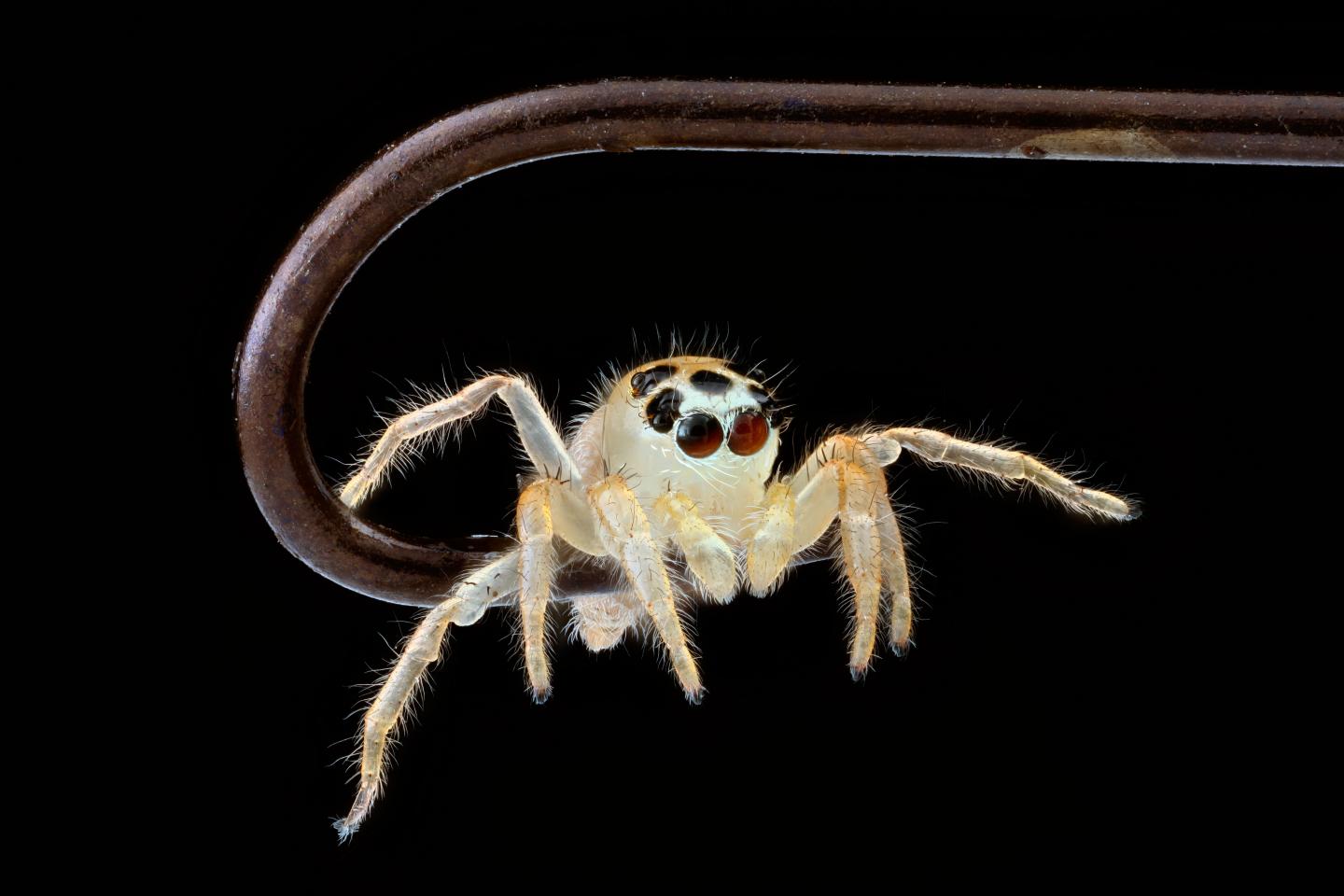
Ability to identify other animals from relative positioning of the joints not unique to vertebrates
IMAGE

Credit: Sam Droege, USGS Bee Inventory and Monitoring Lab, Flickr

Jumping spiders can distinguish living from non-living objects in their peripheral vision using the same cues used by humans and other vertebrate animals, according to a study publishing 15th July 2021 in the open-access journal PLOS Biology by Massimo De Agrò of Harvard University in the United States.

The ability to detect other living creatures in your surroundings is a key skill for any animal – it is crucial for finding mates, avoiding predators, and catching prey. The movements of vertebrates and invertebrates are distinct from inanimate objects because their rigid, jointed bones and exoskeletons constrain the relative positioning of certain body parts. Most vertebrates can recognize this biological pattern of movement from very limited visual information, such as a point-light display, which shows dots representing the positions of the main joints.

To investigate this phenomenon in invertebrates for the first time, researchers partially restrained 60 wild-caught jumping spiders (Menemerus semilimbatus) on a spherical treadmill and used a computer screen to show point-light displays on each side of their peripheral vision (only visible to their lateral eyes). They found that spiders were more likely to try to turn and face displays that showed random movements, compared to those that moved in a more biological way, with the distances between joints constrained.

The result seems contrary to the expectation that spiders should focus their attention on objects in their surroundings that appear to be living – potential prey, mate or predator. However, the authors suggest that this behavior may allow the spiders to focus their forward-facing primary eyes on unidentifiable objects to get a better look. Complex vision evolved independently in vertebrates and arthropods and so the ability to distinguish living from non-living motion using the relative positioning of the joints has most likely arisen convergently in the two groups of animals.

“Jumping spiders’ secondary eyes confirm themselves to be a marvelous tool,” the researchers add. “In this experiment, we observed how they alone can tell apart living from non-living organisms, using the semi-rigid pattern of motion that characterize the formers and without the aid of any shape cue. Finding the presence of this skill, previously known only in vertebrates, opens up new and exciting perspectives on the evolution of visual perception. My co-authors and I can’t wait to see what other visual cues can be perceived and understood by these tiny creatures.”

###

Research Article

Peer-reviewed; Experimental study; Animals

In your coverage please use these URLs to provide access to the freely available articles in PLOS Biology: http://journals.plos.org/plosbiology/article?id=10.1371/journal.pbio.3001172

Citation: De Agrò M, Rößler DC, Kim K, Shamble PS (2021) Perception of biological motion by jumping spiders. PLoS Biol 19(7): e3001172. https://doi.org/10.1371/journal.pbio.3001172

Funding: PSS was supported by the John Harvard Distinguished Science Fellows Program within the FAS Division of Science, Harvard University. The funder had no role in study design, data collection and analysis, decision to publish, or preparation of the manuscript.

Competing Interests: The authors have declared that no competing interests exist.

Media Contact
PLOS Biology
[email protected]

Related Journal Article

http://dx.doi.org/10.1371/journal.pbio.3001172

Tags: BiologyBiomechanics/BiophysicsEcology/EnvironmentEvolutionZoology/Veterinary Science
Share13Tweet8Share2ShareShareShare2

Related Posts

One-Pot Sugar Building: Rhodium Cascade Turns Simple Aldehydes into Threofuranoses

One-Pot Sugar Building: Rhodium Cascade Turns Simple Aldehydes into Threofuranoses

September 22, 2026
Natural Fibers Step Up as Plastic-Free Champions for Sustainable Food Packaging

Natural Fibers Step Up as Plastic-Free Champions for Sustainable Food Packaging

September 22, 2026

Pocket-Sized Biosensor Detects Dust Mite Allergen in Minutes

September 22, 2026

AI Takes On Invisible Chemical Threats in Food and Medicine

September 22, 2026
Please login to join discussion

POPULAR NEWS

  • Rare Arterial Injury After Yttrium-90 Radioembolization Reveals Hidden Vascular Risk

    29 shares
    Share 12 Tweet 7
  • Resilience in Heart Failure Patients Tested by Lebanon’s Overlapping Crises

    29 shares
    Share 12 Tweet 7
  • Hidden Genetic Walls: Malaria Mosquitoes on Mount Cameroon Split Into Isolated Populations

    29 shares
    Share 12 Tweet 7
  • AI Learns to Predict Mitral Valve Anatomy for Personalized Heart Repair

    29 shares
    Share 12 Tweet 7

About

We bring you the latest biotechnology news from best research centers and universities around the world. Check our website.

Follow us

Recent News

Rare Arterial Injury After Yttrium-90 Radioembolization Reveals Hidden Vascular Risk

Resilience in Heart Failure Patients Tested by Lebanon’s Overlapping Crises

Hidden Genetic Walls: Malaria Mosquitoes on Mount Cameroon Split Into Isolated Populations

Subscribe to Blog via Email

Enter your email address to subscribe to this blog and receive notifications of new posts by email.

Join 85 other subscribers
  • Contact Us

Bioengineer.org © Copyright 2023 All Rights Reserved.

Welcome Back!

Login to your account below

Forgotten Password?

Retrieve your password

Please enter your username or email address to reset your password.

Log In
No Result
View All Result
  • Homepages
    • Home Page 1
    • Home Page 2
  • News
  • National
  • Business
  • Health
  • Lifestyle
  • Science

Bioengineer.org © Copyright 2023 All Rights Reserved.