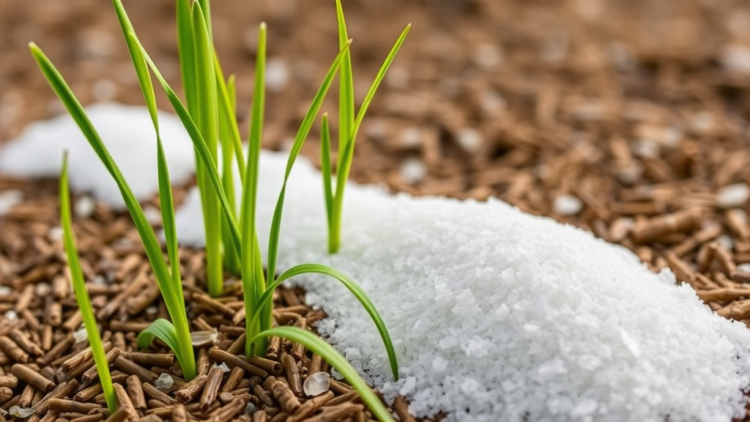
Soil salinity is quietly strangling agriculture. Around the world, roughly a fifth of all irrigated farmland is now affected by salt buildup, and in arid and semi-arid regions the problem is only getting worse as climate variability intensifies. Salt stress hits plants in two ways at once: it makes water harder to absorb, and it lets sodium ions accumulate to toxic levels inside tissues. The result is damaged membranes, degraded chlorophyll, disrupted metabolism and, ultimately, shrinking harvests. For food-security experts, finding cheap and scalable ways to help crops survive salinity has become one of the defining challenges of modern plant science.
Now a team of Indian researchers has shed new light on a remarkably simple candidate solution: silicon. In a study published in Discover Plants, Sumaiya S. Shaikh, Mahendra L. Ahire and colleagues at Yashavantrao Chavan Institute of Science, Savitribai Phule Pune University and partner institutions traced, gene by gene, how a modest dose of silicon transforms the way finger millet copes with salt. Their findings reveal that this humble element, long treated as a biostimulant curiosity, orchestrates a sweeping reprogramming of plant metabolism.
Finger millet, Eleusine coracana, was a fitting subject for the investigation. The tetraploid cereal, widely grown across semi-arid Asia and Africa, ranks fourth among small millets globally and is prized for its calcium, iron, dietary fiber, essential amino acids and antioxidants. It is often described as a climate-resilient crop, yet it is no halophyte: salt still cuts into its germination, photosynthesis and productivity. The team worked with ST-JA-WA, a salt-tolerant landrace previously identified by screening 27 varieties collected from farmers in Western Maharashtra.
The experimental design was straightforward but rigorous. Seedlings were grown for ten days under four conditions: a nutrient-solution control, 200 millimolar sodium chloride, 10 parts per million of silicon supplied as silicic acid, and the salt-plus-silicon combination. Pure salt stress dragged germination down to 93.33 percent, but adding silicon lifted it back to 98.89 percent, with improvements across root length, shoot length and biomass. Silicon alone did not spur extra growth under normal conditions, which fits its reputation as a stress-alleviator rather than a general growth promoter.
The biochemical evidence pointed to a coherent protective story. Salt-stressed seedlings accumulated more than twice the malondialdehyde of controls, a hallmark of membrane lipid peroxidation, but silicon supplementation cut that damage by roughly a third. Total chlorophyll, which collapsed under salt, more than doubled again when silicon was present, and carotenoids followed the same pattern. Ion analysis added another layer: salt raised sodium and lowered potassium, while silicon reduced sodium accumulation and boosted calcium, a key secondary messenger that helps activate downstream stress-signalling and defense pathways.
Osmolytes, the small molecules plants use to keep water in their cells, told an equally telling story. Under salt stress, proline, glycine betaine and total soluble sugars all rose sharply, as expected for plants fighting osmotic pressure. Yet with silicon added, these osmolytes declined significantly, along with the expression of biosynthetic genes such as Δ¹-pyrroline-5-carboxylate synthetase, sucrose synthase and betaine aldehyde dehydrogenase. The interpretation is subtle: silicon did not disable osmotic adjustment; it lowered the stress burden so that plants no longer needed to pay the full metabolic cost of it.
The antioxidant system, by contrast, was amped up rather than dialed down. Salt stress already elevated the activities of superoxide dismutase, catalase, ascorbate peroxidase and guaiacol peroxidase, the enzymatic front line against reactive oxygen species. Silicon pushed them further, with superoxide dismutase activity rising 1.73-fold and catalase 1.26-fold under the combined treatment. Crucially, transcript abundance for all four enzyme-coding genes rose in parallel with enzyme activity, indicating that the effect runs through gene regulation rather than mere biochemical coincidence.
The deepest insights came from the transcriptome. Sequencing on an Illumina NovaSeq 6000 generated roughly 727.7 million clean reads across treatments, and de novo assembly yielded 429,065 unique transcripts, with 90.80 percent of reads mapping back successfully. Of these, 23,753 were differentially expressed across comparisons. In the most striking contrast, comparing salt-stressed seedlings with and without silicon identified 3,744 upregulated and 24,057 downregulated transcripts, evidence of massive transcriptional reprogramming. Salt alone suppressed glycolysis, but silicon flipped the switch: genes encoding glucose-6-phosphate isomerase, phosphofructokinase, glyceraldehyde-3-phosphate dehydrogenase, enolase and pyruvate kinase all surged, driving more carbon through glycolysis to meet the energy demands of stress survival.
That metabolic momentum carried into photosynthesis. Under silicon plus salt, transcripts for phosphoenolpyruvate carboxylase and RuBisCO increased, alongside enzymes of carbon assimilation such as malate dehydrogenase and malic enzyme, dovetailing neatly with the observed restoration of pigment content. Silicon also revved up phospholipid biosynthesis genes, the mevalonate pathway feeding sterol production, and the tryptophan-dependent route to auxin, suggesting coordinated investment in membrane repair, structural reinforcement and growth signaling. The authors are careful to note that phospholipid content itself was not directly measured, so the data support an association at the transcriptional level rather than a proven increase in lipid production.
What emerges is a systems-level picture of a cheap, abundant element acting as a metabolic conductor. Silicon simultaneously protects membranes, tunes ion homeostasis, eases the osmotic burden, supercharges antioxidant defenses and redirects carbon and hormonal fluxes toward resilience. For subsistence farmers relying on finger millet in salt-prone landscapes, the prospect of a low-cost silicon amendment is compelling, and the mechanistic blueprint offered here could guide breeding or biotechnology aimed at replicating the same gene-expression signature in other cereals. As salinity creeps across more of the world’s irrigated fields, this unpretentious grain and its mineral ally may prove an unexpectedly powerful team.
Subject of Research: Silicon-mediated salinity tolerance mechanisms in finger millet revealed by transcriptomic analysis
Article Title: Unraveling silicon-induced salinity tolerance mechanism in finger millet (Eleusine coracana) through a transcriptomic approach
Article References: Shaikh, S. S., Gore, N. T., Mali, A. A., Umdale, S. D., Mundada, P. S., Mankar, G. D., Barvkar, V. T., Nikam, T. D., & Ahire, M. L. (2026). Unraveling silicon-induced salinity tolerance mechanism in finger millet (Eleusine coracana) through a transcriptomic approach. Discover Plants, 3(1), Article 420. https://doi.org/10.1007/s44372-026-00893-6
Image Credits: AI Generated
DOI: 10.1007/s44372-026-00893-6
Keywords: finger millet, silicon, salinity stress, transcriptomics, antioxidant enzymes, glycolysis, photosynthesis, osmolytes, auxin biosynthesis, ion homeostasis, plant stress responses, crop resilience
Cite Scienmag News
APA MLA Chicago
Alan Morgan. (September 25, 2026). How Silicon Helps a Hardy Millet Beat Salt Stress at the Gene Level. Scienmag. https://scienmag.com/how-silicon-helps-a-hardy-millet-beat-salt-stress-at-the-gene-level/
Alan Morgan. “How Silicon Helps a Hardy Millet Beat Salt Stress at the Gene Level.” Scienmag, 25 September 2026, https://scienmag.com/how-silicon-helps-a-hardy-millet-beat-salt-stress-at-the-gene-level/. Accessed 25 September 2026.
Alan Morgan. “How Silicon Helps a Hardy Millet Beat Salt Stress at the Gene Level.” Scienmag. September 25, 2026. https://scienmag.com/how-silicon-helps-a-hardy-millet-beat-salt-stress-at-the-gene-level/
Copy citation Download RIS
Tags: antioxidant enzymesauxin biosynthesiscrop resiliencefinger milletgene-level response to salinity in milletgenetic mechanisms of salt tolerance in cropsglycolysisimpact of soil salinity on agricultureimproving crop yields in saline soilsion homeostasisosmolytesphotosynthesisplant membrane protection against salt-induced damageplant metabolic reprogramming by siliconplant stress responsesrice and millet salt stress resiliencerole of silicon in chlorophyll preservation under salt stresssalinity stresssalt stress mitigation in cropssiliconsilicon as a biostimulant for drought and salt stresssilicon in plant stress tolerancesodium ion toxicity in plantsTranscriptomics