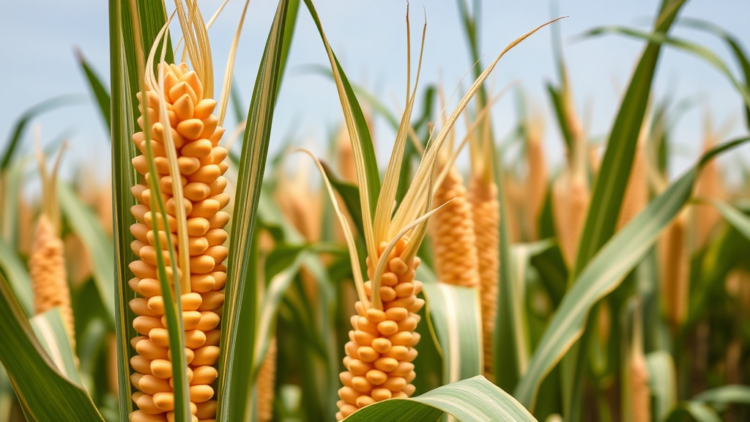
Every ear of corn is a record of thousands of microscopic decisions. As the maize plant builds its female inflorescence, a tiny dome of stem cells known as the ear inflorescence meristem must produce just the right number of branch meristems, spikelets and florets, because the geometry of that developmental cascade ultimately fixes how many rows of kernels the mature cob will carry. Kernel row number, or KRN, has long been recognized by breeders as one of the most consequential yield components in field corn, since each additional row multiplies the grain-bearing capacity of every ear on the plant. A new study published in the Indian Journal of Genetics and Plant Breeding by Bhargava Kotte, Ganapati Mukri and colleagues at ICAR-Indian Agricultural Research Institute now connects this architectural trait directly to the molecular machinery behind heterosis, the phenomenon by which hybrids routinely outperform both of their inbred parents.
The research focuses on four genes that sit at the heart of floral meristem regulation: fasciated 2 (fea2), fasciated 4 (fea4), tassel dwarf 1 (td1) and tassel sheath 4 (tsh4). These are not obscure players. fea2 encodes a leucine-rich repeat receptor-like protein homologous to the Arabidopsis CLAVATA2 component, and quantitative variation at the FASCIATED EAR2 locus is known to control a substantial share of natural KRN variation in maize. td1 encodes a CLAVATA1-type receptor kinase, fea4 encodes a bZIP transcription factor that regulates shoot meristem size, and tsh4 encodes an SBP-box transcription factor that establishes meristem boundaries and governs the initiation of lateral primordia. Together they form part of a signaling network that balances stem cell proliferation against differentiation in the developing ear, and perturbing that balance changes how many kernel rows an ear can support.
What the new work adds is a hybrid dimension. Heterosis, or hybrid vigor, is the foundation of modern maize production, with single-cross hybrids dominating commercial acreage because of their dramatic yield advantage over inbred lines. Yet the molecular determinants of that advantage remain only partially resolved, and most explanations invoke combinations of dominance, overdominance, epistasis and dosage effects spread across the genome. The Indian team hypothesized that genes governing floral meristem differentiation, being intimately tied to a primary yield component, might leave an expression-level fingerprint on the magnitude of hybrid yield, and that measuring that fingerprint could illuminate why certain parental combinations deliver exceptional performance.
To test the idea, the researchers assembled a factorial breeding design. Five inbred lines, all carrying relatively low KRN, were crossed with two testers, one characterized by a high kernel row number and the other by a low one, in a classic line-by-tester mating scheme. This produced a panel of ten hybrid combinations whose agronomic performance, including grain yield and its component traits, was evaluated in a randomized complete block design. The line-tester architecture is a standard tool of hybrid breeding because it simultaneously estimates combining ability and generates testcross progeny, but here it served an additional purpose: it created pairs of hybrids sharing a common female parent while differing in the KRN status of their tester parent, allowing the team to isolate the influence of that genetic background.
The molecular arm of the study used quantitative reverse-transcription PCR, in which messenger RNA extracted from the relevant tissue was converted into complementary DNA and quantified against an internal standard. By comparing expression levels in each hybrid against two benchmarks, the mid-parent value, which is the average of the two parents, and the better-parent value, which is the level of the higher-expressing parent, the team could classify each gene’s behavior in each hybrid as additive, exceeding mid-parent, or exceeding the better parent. These classifications matter because expression above parental levels in a hybrid is a candidate molecular signature of heterosis, a concept supported by transcriptomic studies of maize ears at the spikelet and floret differentiation stages.
The results split cleanly along tester lines. In the hybrid AI 5116 × AI 543, which pairs the common female parent with the high-KRN tester, expression of fea2 exceeded the better-parental value, fea4 exceeded the mid-parental value, and the two remaining genes, td1 and tsh4, showed high expression that tracked with the strong yield performance of this combination. In contrast, in the sibling hybrid AI 5116 × PML 105, which carries the low-KRN tester, fea2 again exceeded the better-parental value and fea4 exceeded the better-parental value, but td1 and tsh4 were expressed below the mid-parental level. Because both parents of this second combination were low in KRN, and because its yield was correspondingly weaker, the contrast suggests that the expression behavior of td1 and tsh4 in particular separates high-yielding from low-yielding hybrid architectures.
The pattern is biologically coherent. td1 and tsh4 act within the same developmental window, shaping how the inflorescence meristem partitions itself into kernels, branches and bracts. If their expression in a hybrid rises above what either parent achieves alone, the developing ear may gain additional meristem capacity that translates into more kernel rows and, ultimately, more grain. Conversely, when expression of these genes dips below even the parental average, the hybrid’s ears may fail to exploit the developmental potential that heterosis is expected to unlock. The consistency of fea2 overexpression across both hybrids, regardless of tester, hints that this receptor may be a more general participant in hybrid ear development, while the td1 and tsh4 responses appear contingent on the genetic background contributed by the tester.
For breeders, the practical implication is that tester choice is not merely a matter of agronomic performance statistics. If the expression dynamics of meristem genes can be assayed early, seedlings or young plants could be screened for the expression profiles associated with superior hybrid yield, potentially compressing the years of field trialing normally required to identify elite combinations. The study’s authors emphasize that the expression patterns of these floral meristem genes appear to play a key role in the heterosis of grain yield and underscore the importance of testers in designing cross combinations and subjecting them to finer molecular analysis. In a breeding landscape increasingly shaped by genomic prediction and high-throughput phenotyping, a small set of developmentally strategic genes with heterosis-linked expression would be a valuable addition to the selection toolkit.
The work also slots into a broader scientific conversation. Recent genome-wide association studies and multi-parent populations have mapped numerous quantitative trait loci for kernel row number, while transcriptome comparisons of maize ear heterosis have revealed asymmetric expression signatures between the cob and florets during critical differentiation stages. By targeting specific, mechanistically understood meristem genes rather than genome-wide markers, the new study offers a functional bridge between those statistical maps and the developmental biology that produces the phenotype. It also echoes the long arc of maize domestication, during which selection on genes such as tb1 and the teosinte branched pathway transformed a branching wild grass into the single-stalked, large-eared crop that feeds the world, demonstrating that inflorescence architecture has always been the crucible of maize productivity.
Important caveats remain. The experiment rested on a modest number of parental genotypes and hybrid combinations evaluated within a single experimental framework, so the generality of the expression-yield association across diverse heterotic groups, environments and growing seasons will require confirmation. Gene expression measured at one developmental stage cannot capture the full temporal choreography of ear formation, and heterosis is indisputably polygenic, with thousands of loci contributing alongside the four studied here. Nevertheless, the central finding stands: in these materials, high expression of td1 and tsh4 accompanied the high-yielding hybrid descended from a high-KRN parent, while sub-mid-parent expression of the same genes accompanied the weaker combination. As the authors and their institution, which supported the work through ICAR resources and a Junior Research Fellowship to the first author, continue this line of inquiry, meristem gene expression profiling may well evolve from an academic curiosity into a predictive breeding tool, helping breeders decide, before a single seed is planted in a yield trial, which parental crosses are most likely to deliver the vigorous, high-row-count ears that modern maize agriculture demands.
Subject of Research: Expression of floral meristem genes fea2, fea4, td1 and tsh4 in relation to kernel row number and heterosis for grain yield in maize
Article Title: Understanding the Role of fasciated 2, fasciated 4, tassel dwarf 1 and tassel sheath 4 Genes in the Manifestation of Grain Yield in Field Corn (Zea mays L.)
Article References: Kotte, B., Bhavana, P., Mukri, G., Gadag, R. N., Bhat, J. S., Singh, C., Gupta, N. C., Gowtham, K. V., Shilpa, K., Prabha, C., & Kumar, S. (2026). Understanding the Role of fasciated 2, fasciated 4, tassel dwarf 1 and tassel sheath 4 Genes in the Manifestation of Grain Yield in Field Corn (Zea mays L.). Indian Journal of Genetics and Plant Breeding, 86(2), 165-176. https://doi.org/10.1007/s44489-026-00023-2
Image Credits: AI Generated
DOI: 10.1007/s44489-026-00023-2
Keywords: maize, Zea mays, kernel row number, heterosis, fea2, fea4, td1, tsh4, floral meristem, gene expression, hybrid breeding, grain yield
Cite Scienmag News
APA MLA Chicago
Juliet Wilcox. (September 25, 2026). Maize Meristem Genes Offer New Clues to the Molecular Roots of Hybrid Yield. Scienmag. https://scienmag.com/maize-meristem-genes-offer-new-clues-to-the-molecular-roots-of-hybrid-yield/
Juliet Wilcox. “Maize Meristem Genes Offer New Clues to the Molecular Roots of Hybrid Yield.” Scienmag, 25 September 2026, https://scienmag.com/maize-meristem-genes-offer-new-clues-to-the-molecular-roots-of-hybrid-yield/. Accessed 25 September 2026.
Juliet Wilcox. “Maize Meristem Genes Offer New Clues to the Molecular Roots of Hybrid Yield.” Scienmag. September 25, 2026. https://scienmag.com/maize-meristem-genes-offer-new-clues-to-the-molecular-roots-of-hybrid-yield/
Copy citation Download RIS
Tags: fea2fea4floral meristemfloral meristem development in corngene expressiongene expression in maize floral meristemgenetic basis of kernel row numbergenetic control of maize ear morphologygrain yieldheterosisheterosis and hybrid vigor in maizehybrid breedinghybrid maize yield improvementkernel row numbermaizeMaize meristem gene regulationmolecular genetics of maize inflorescence architecturemolecular mechanisms underlying hybrid maize productivityplant developmental genetics in crop breedingrole of fea2 and fea4 genes in maizetassel dwarf 1 gene function in maizetd1tsh4Zea mays