• HOME
  • NEWS
  • EXPLORE
    • CAREER
      • Companies
      • Jobs
    • EVENTS
    • iGEM
      • News
      • Team
    • PHOTOS
    • VIDEO
    • WIKI
  • BLOG
  • COMMUNITY
    • FACEBOOK
    • INSTAGRAM
    • TWITTER
Friday, July 10, 2026
BIOENGINEER.ORG
No Result
View All Result
  • Login
  • HOME
  • NEWS
  • EXPLORE
    • CAREER
      • Companies
      • Jobs
        • Lecturer
        • PhD Studentship
        • Postdoc
        • Research Assistant
    • EVENTS
    • iGEM
      • News
      • Team
    • PHOTOS
    • VIDEO
    • WIKI
  • BLOG
  • COMMUNITY
    • FACEBOOK
    • INSTAGRAM
    • TWITTER
  • HOME
  • NEWS
  • EXPLORE
    • CAREER
      • Companies
      • Jobs
        • Lecturer
        • PhD Studentship
        • Postdoc
        • Research Assistant
    • EVENTS
    • iGEM
      • News
      • Team
    • PHOTOS
    • VIDEO
    • WIKI
  • BLOG
  • COMMUNITY
    • FACEBOOK
    • INSTAGRAM
    • TWITTER
No Result
View All Result
Bioengineer.org
No Result
View All Result
Home NEWS Science News Chemistry

How roots find their way to water

Bioengineer by Bioengineer
February 12, 2020
in Chemistry
Reading Time: 3 mins read
0
IMAGE
Share on FacebookShare on TwitterShare on LinkedinShare on RedditShare on Telegram

High-resolution 3D microscopy shows how plants adapt flexibly to their surroundings
IMAGE

Credit: Daniel von Wangenheim

FRANKFURT. Plants use their roots to search for water. While the main root digs down-wards, a large number of fine lateral roots explore the soil on all sides. As researchers from Nottingham, Heidelberg and Goethe University of Frankfurt report in the current issue of “Nature Plants“, the lateral roots already “know” very early on where they can find water.

For his experiment, Daniel von Wangenheim, a former doctoral researcher in Professor Ernst Stelzer’s Laboratory for Physical Biology and most lately a postdoc at Malcolm Ben-nett’s, mounted thale cress roots along their length in a nutrient solution. They were, how-ever, not completely immersed and their upper side left exposed to the air. He then ob-served with the help of a high-resolution 3D microscope how the roots branched out.

To his surprise, he discovered that almost as many lateral roots formed on the air side as on the side in contact with the nutrient solution. As he continued to follow the growth of the roots with each cell division in the microscope, it became evident that the new cells drive the tip of the root in the direction of water from the very outset, meaning that if a lateral root had formed on the air side, it grew in the direction of the agar plate.

“It’s therefore clear that plants first of all spread their roots in all directions, but the root obvi-ously knows from the very first cell divisions on where it can find water and nutrients,” says Daniel von Wangenheim, summarizing the results. “In this way, plants can react flexibly to an environment with fluctuating resources.”

###

The result is based on many hours of film material recorded using Light Sheet Fluorescence Microscopy (LSFM), a technique developed by Ernst Stelzer. In a vivid video clip, Daniel von Wangenheim shows the root-branching process in slow motion. His tweet has already attracted considerable attention from his colleagues in the field.

https://twitter.com/DvonWangenheim/status/1224365891292405760)

Publication: Daniel von Wangenheim, Jason Banda, Alexander Schmitz, Jens Boland, An-thony Bishopp, Alexis Maizel, Ernst H. K. Stelzer and Malcolm Bennett: Early developmental plasticity of lateral roots in response to asymmetric water availability, in Nature Plants (3 February 2020), https://doi.org/10.1038/s41477-019-0580-z)

A picture can be downloaded under: http://www.uni-frankfurt.de/85595433

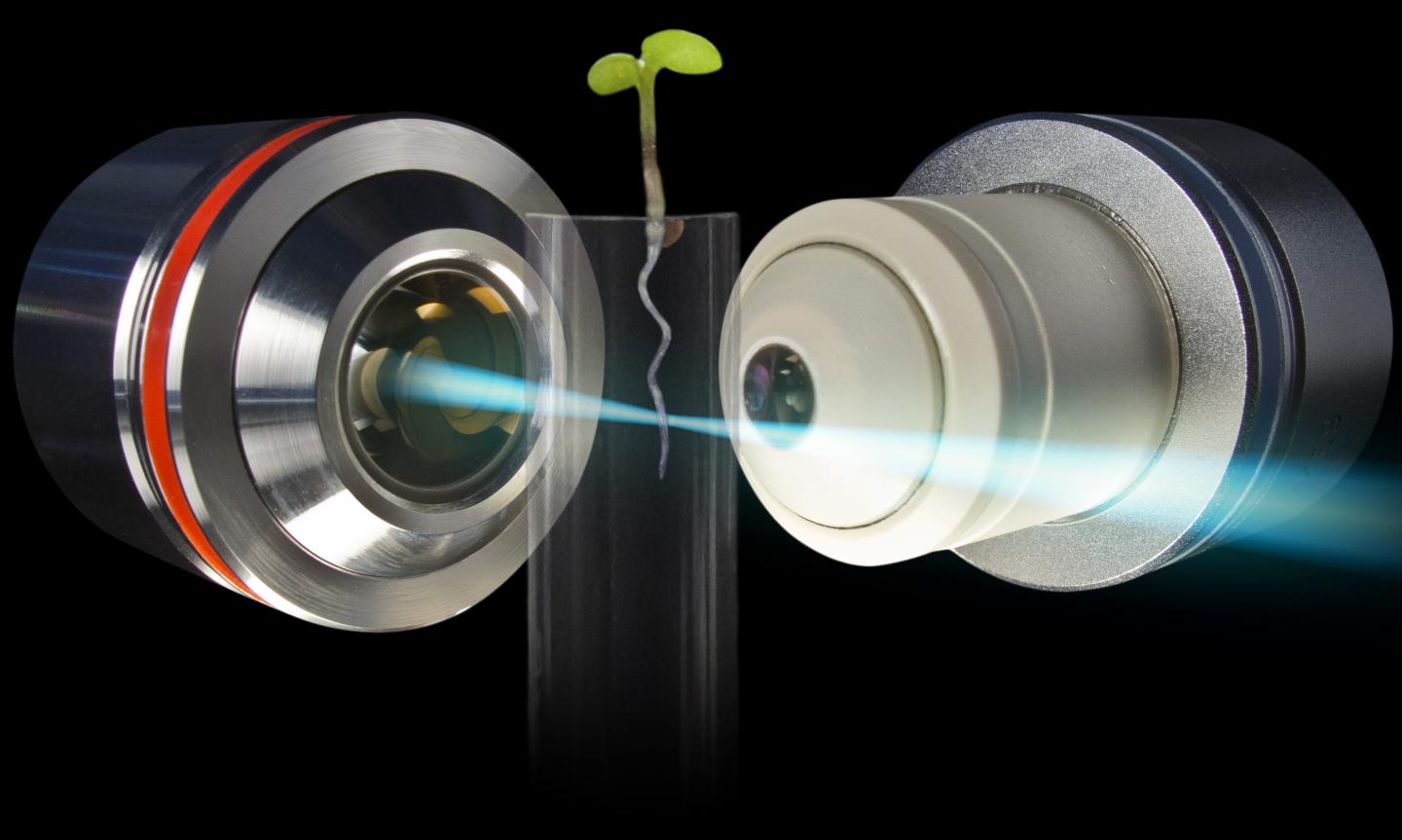
Caption: Light Sheet Fluorescence Microscopy is based on two processes: 1) lateral illumination of the specimen with laser light along a plane and 2) detection of fluorescent light emitted from a thin volume centred around the illumination plane. The plant (Arabidopsis thaliana) is mounted in a three-dimensional assembly, stands upright in a plant-derived gel appropriate for the species and supplied with medium and light.

Image rights: Daniel von Wangenheim.

Further information: Dr Daniel von Wangenheim, Plant and Crop Sciences, School of Biosci-ences, University of Nottingham, UK, Email: [email protected]

Professor Ernst Stelzer, Institute for Cell Biology and Neuroscience and Buchmann Institute for Molecular Life Sciences, Riedberg Campus, Tel.: +49(0)69-798-42547, Email: [email protected]

Media Contact
Dr. Daniel von Wangenheim
[email protected]

Related Journal Article

http://dx.doi.org/10.1038/s41477-019-0580-z

Tags: BiologyBiomechanics/BiophysicsCell BiologyClimate ChangeEcology/Environment
Share12Tweet8Share2ShareShareShare2

Related Posts

Artificial Intelligence Transforms Material Synthesis Methods

Artificial Intelligence Transforms Material Synthesis Methods

July 10, 2026
Computer Chip Uses Vibrations for Memory Storage

Computer Chip Uses Vibrations for Memory Storage

July 10, 2026

Rapid Screening Advances Discovery of Nanocrystals

July 10, 2026

New Eco-Friendly Method Developed for Alcohol Oxidation

July 10, 2026
Please login to join discussion

POPULAR NEWS

  • Detection of EDCs in Breast Milk and Infant Urine Up to Six Months Highlights Early Exposure Risks

    77 shares
    Share 31 Tweet 19
  • New Drug Candidate Developed at McMaster Shows Potential for Treating Brain Cancer

    58 shares
    Share 23 Tweet 15
  • KTU Researchers Explore Ultrasound’s Role in Enhancing Blood Flow Beyond Diagnostics

    53 shares
    Share 21 Tweet 13
  • 高齢者の骨粗鬆症治療の持続性比較

    51 shares
    Share 20 Tweet 13

About

We bring you the latest biotechnology news from best research centers and universities around the world. Check our website.

Follow us

Recent News

Delirium Rates in German Nursing Homes Revealed in New Study

Unraveling How General Anesthesia Works at the Molecular Level

First Clinical Trial of Stem Cell Therapy for Huntington’s Disease Announced

Subscribe to Blog via Email

Enter your email address to subscribe to this blog and receive notifications of new posts by email.

Join 84 other subscribers
  • Contact Us

Bioengineer.org © Copyright 2023 All Rights Reserved.

Welcome Back!

Login to your account below

Forgotten Password?

Retrieve your password

Please enter your username or email address to reset your password.

Log In
No Result
View All Result
  • Homepages
    • Home Page 1
    • Home Page 2
  • News
  • National
  • Business
  • Health
  • Lifestyle
  • Science

Bioengineer.org © Copyright 2023 All Rights Reserved.