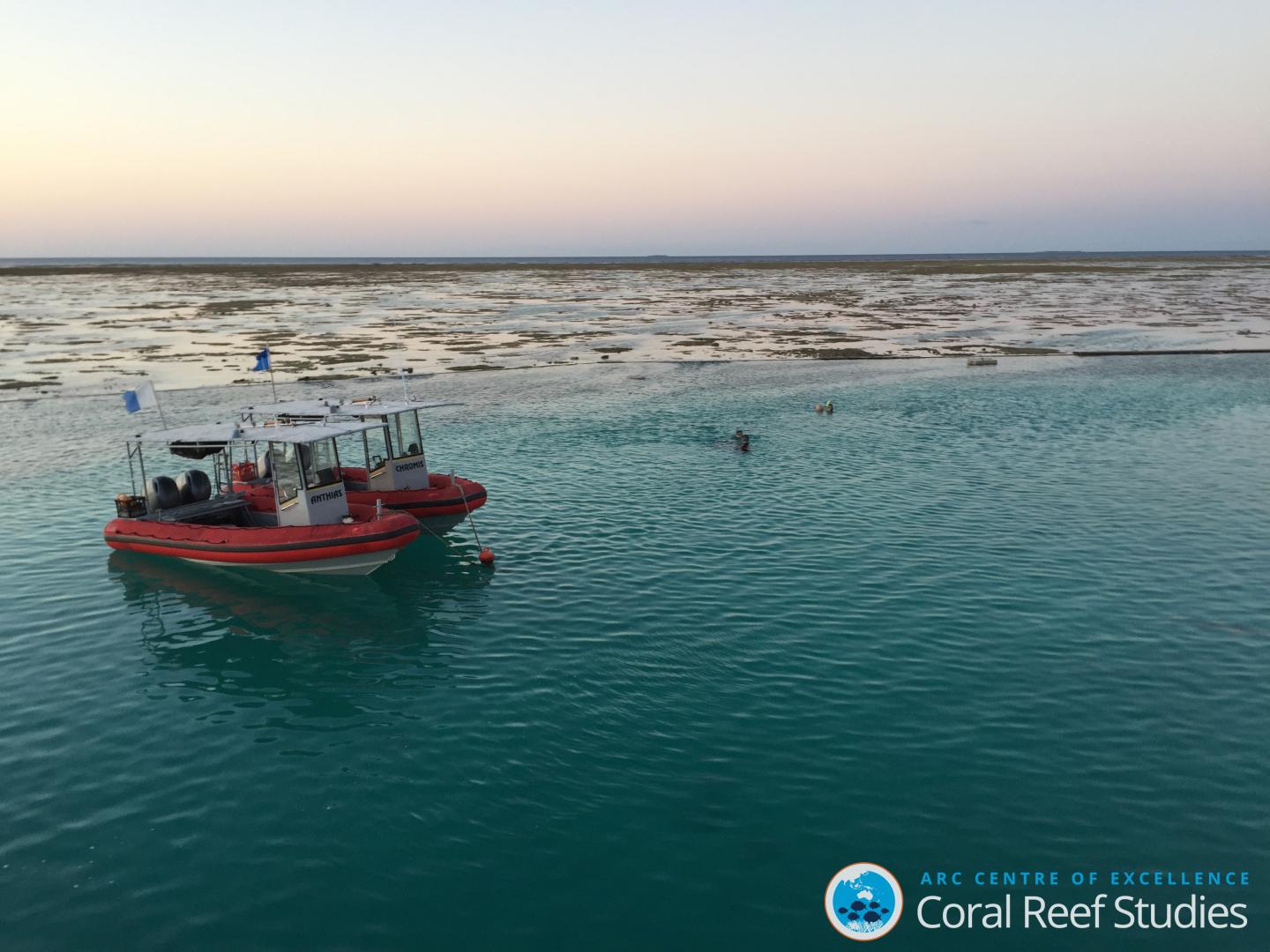
Credit: Graeme Cumming
A world-first study examining the scales of management of the Great Barrier Reef has the potential to help sustain other ecosystems across the world.
Massive marine ecosystems like the Great Barrier Reef aren’t just a vibrant home to fish, corals and other creatures, they are also an important source of people’s food, livelihoods and recreation.
The new study suggests the way people are managed when undertaking various activities within the marine park–like fishing, boating, and scientific research–could serve as an exemplary model for sustainably managing other ecosystems that humans use.
“There is plenty of evidence to suggest that the Great Barrier Reef is managed at appropriate scales within its boundaries,” said lead author Professor Graeme Cumming, incoming Director of the ARC Centre of Excellence for Coral Reef Studies.
The reef served as a case study for mapping and measuring different scale matches between people and ecosystems. Prof Cumming explains the concept of scale matches using a backyard garden as an example of an ecosystem.
“For a house with a garden, you already have permission to manage that garden–to mow the lawn and trim the trees inside your fences. To look after all the parts of it. That’s a scale match,” Prof Cumming said.
He says being able to manage only a flower bed within the garden is a small-scale match. “If you only have permission to manage the flower bed in your garden, you can manage the flowers, but your lawn and trees become unkempt. The weeds and pests affecting the flowers may come from an adjacent part of the garden, which you’d then have no control over,” he said.
The Great Barrier Reef Marine Park Authority (GBRMPA) manages the entire marine park. Some permits, such as permission to access areas by boat as part of a commercial operation, may cover most of the park.
GBRMPA also manages smaller scale permits within the marine park boundaries–small-scale matches that work best for activities like commercial tourism, lobster fisheries or the installation of certain structures like jetties or moorings.
The study found the permits issued for human activities generally occurred at larger scales than the particular individual marine features of interest, such as reefs or islands.
“The finding that people are managed at a broader scale than ecological variation suggests a general principle for permitting and management,” Prof Cumming said. “In essence, people like to have choices about where they go and how they respond to change. This means that they prefer to operate at a broader spatial scale than the ecological features they are interested in, rather than the same scale.”
The findings suggest this approach to managing people at broader rather than finer scales may be more effective. For small protected areas, increasing the size of the permissible area may even be critical.
However, GBRMPA can’t manage the ecosystem’s biggest impact, which lies outside park boundaries: climate change.
“Broad scale problems, like climate change, can only be managed with broad scale solutions, like global action,” Prof Cumming said. “This is a scale mismatch because these impacts come from well outside the marine park boundaries.”
GBRMPA also don’t have control over what happens on the land directly adjacent to the reef. Not being able to stop pollutants and pesticides in storm water reaching the reef is another scale mismatch.
Prof Cumming says comparing the results of this study to similar data from other marine parks, including those that are recognised as dysfunctional, will help determine if the management of the Great Barrier Reef Marine Park is unusual or typical.
“This study does not offer a direct solution for management,” Prof Cumming said. “But it provides a new approach that extends our toolbox for diagnosing social-ecological scale mismatches and responding to them.”
###
PAPER
Cumming S, Dobbs K. (2020). ‘Quantifying social-ecological scale mismatches suggests people should be managed at broader scales than ecosystems’. One Earth. DOI: 10.1016/j.oneear.2020.07.007
CONTACTS
Professor Graeme Cumming
E: [email protected]
Melissa Lyne
Media Manager, Coral CoE
P: +61 (0) 415 514 328
E: [email protected]
Media Contact
Melissa Lyne
[email protected]
Related Journal Article
http://dx.