• HOME
  • NEWS
  • EXPLORE
    • CAREER
      • Companies
      • Jobs
    • EVENTS
    • iGEM
      • News
      • Team
    • PHOTOS
    • VIDEO
    • WIKI
  • BLOG
  • COMMUNITY
    • FACEBOOK
    • INSTAGRAM
    • TWITTER
Wednesday, May 13, 2026
BIOENGINEER.ORG
No Result
View All Result
  • Login
  • HOME
  • NEWS
  • EXPLORE
    • CAREER
      • Companies
      • Jobs
        • Lecturer
        • PhD Studentship
        • Postdoc
        • Research Assistant
    • EVENTS
    • iGEM
      • News
      • Team
    • PHOTOS
    • VIDEO
    • WIKI
  • BLOG
  • COMMUNITY
    • FACEBOOK
    • INSTAGRAM
    • TWITTER
  • HOME
  • NEWS
  • EXPLORE
    • CAREER
      • Companies
      • Jobs
        • Lecturer
        • PhD Studentship
        • Postdoc
        • Research Assistant
    • EVENTS
    • iGEM
      • News
      • Team
    • PHOTOS
    • VIDEO
    • WIKI
  • BLOG
  • COMMUNITY
    • FACEBOOK
    • INSTAGRAM
    • TWITTER
No Result
View All Result
Bioengineer.org
No Result
View All Result
Home NEWS Science News Biology

How manganese produces a parkinsonian syndrome

Bioengineer by Bioengineer
January 16, 2019
in Biology
Reading Time: 2 mins read
0
IMAGE
Share on FacebookShare on TwitterShare on LinkedinShare on RedditShare on Telegram

IMAGE

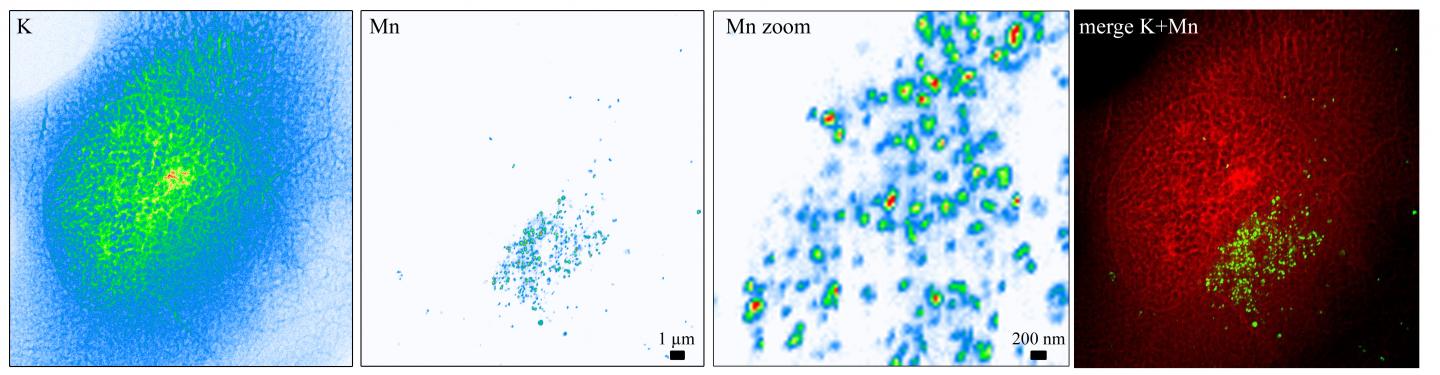
Credit: © Asuncion Carmona / CENBG / CNRS


Using X-ray fluorescence at synchrotrons DESY and ESRF, researchers in the Centre d’Etudes Nucléaires de Bordeaux Gradignan (CNRS/Université de Bordeaux) have demonstrated the consequences of a mutation responsible for a hereditary parkinsonian syndrome: accumulated manganese in the cells appears to disturb protein transport. This work, carried out with colleagues at the University of Texas at Austin (USA), was published in the print issue of ACS Chemical Neuroscience on January 16, 2018.

Parkinsonian syndrome is a set of diseases with symptoms similar to Parkinson’s disease. Some are caused by high quantities of manganese, a metal essential to the body at trace levels. This is especially so for a hereditary form of the disease caused by a genetic mutation responsible for a toxic accumulation of manganese in cells.

The team of researchers has shown a key mechanism for the disease caused by this mutation. At the DESY synchrotron (Hamburg, Germany), they have been able to locate manganese inside individual cells, (1) using the fluorescent signature it produces under an X-ray beam. Manganese concentrates essentially in the Golgi apparatus, a cellular compartment which acts as a dispatch center for proteins. The proteins receive a label and are accordingly packaged within vesicles to other compartments, or to the outside of the cell. It is in these vesicles–barely 50 nm in diameter–that manganese accumulates, as the researchers have demonstrated by repeating their experiments in the ESRF synchrotron (The European synchrotron, Grenoble), with even higher sensitivity and spatial resolution. This is the only place in the world where the equipment’s spatial resolution and sensitivity were sufficient to detect the minute amounts of manganese in the vesicles.

The researchers think that this manganese accumulation disturbs protein export towards the outside of the cell, altering nerve cell function and leading to parkinsonian symptoms. This must still be confirmed by reproducing these experiments with neurons from animal models for this disease, which are being developed.

###

Notes: (1) HeLa cells, a widely used model in cell biology, from a tumor.

Media Contact
Veronique Etienne
[email protected]
33-144-965-137

Original Source

http://www.cnrs.fr/en/how-manganese-produces-parkinsonian-syndrome

Related Journal Article

http://dx.doi.org/10.1021/acschemneuro.8b00451

Tags: BiochemistryCell BiologyMedicine/Healthneurobiology
Share12Tweet8Share2ShareShareShare2

Related Posts

UMass Chan Scientists Pioneer Gene Editing Technology That Rewrites Entire Genome Chapters — Biology

UMass Chan Scientists Pioneer Gene Editing Technology That Rewrites Entire Genome Chapters

May 13, 2026
Scientists Observe Rice Plants Capturing and Eliminating Fall Armyworm Caterpillars — Biology

Scientists Observe Rice Plants Capturing and Eliminating Fall Armyworm Caterpillars

May 13, 2026

Study Finds Genetic Risk for Schizophrenia Emerges in Early Adolescence

May 13, 2026

How Water Fleas Sense Their Predators: A Scientific Insight

May 13, 2026
Please login to join discussion

POPULAR NEWS

  • Research Indicates Potential Connection Between Prenatal Medication Exposure and Elevated Autism Risk

    842 shares
    Share 337 Tweet 211
  • New Study Reveals Plants Can Detect the Sound of Rain

    729 shares
    Share 291 Tweet 182
  • Salmonella Haem Blocks Macrophages, Boosts Infection

    62 shares
    Share 25 Tweet 16
  • Breastmilk Balances E. coli and Beneficial Bacteria in Infant Gut Microbiomes

    57 shares
    Share 23 Tweet 14

About

We bring you the latest biotechnology news from best research centers and universities around the world. Check our website.

Follow us

Recent News

New Study Confirms Reliability of Depression Screening in Chronic Pain Patients

Particulate Matter at Low Air Concentrations Linked to Increased Kidney Disease Hospitalizations

UMass Chan Scientists Pioneer Gene Editing Technology That Rewrites Entire Genome Chapters

Subscribe to Blog via Email

Enter your email address to subscribe to this blog and receive notifications of new posts by email.

Join 82 other subscribers
  • Contact Us

Bioengineer.org © Copyright 2023 All Rights Reserved.

Welcome Back!

Login to your account below

Forgotten Password?

Retrieve your password

Please enter your username or email address to reset your password.

Log In
No Result
View All Result
  • Homepages
    • Home Page 1
    • Home Page 2
  • News
  • National
  • Business
  • Health
  • Lifestyle
  • Science

Bioengineer.org © Copyright 2023 All Rights Reserved.