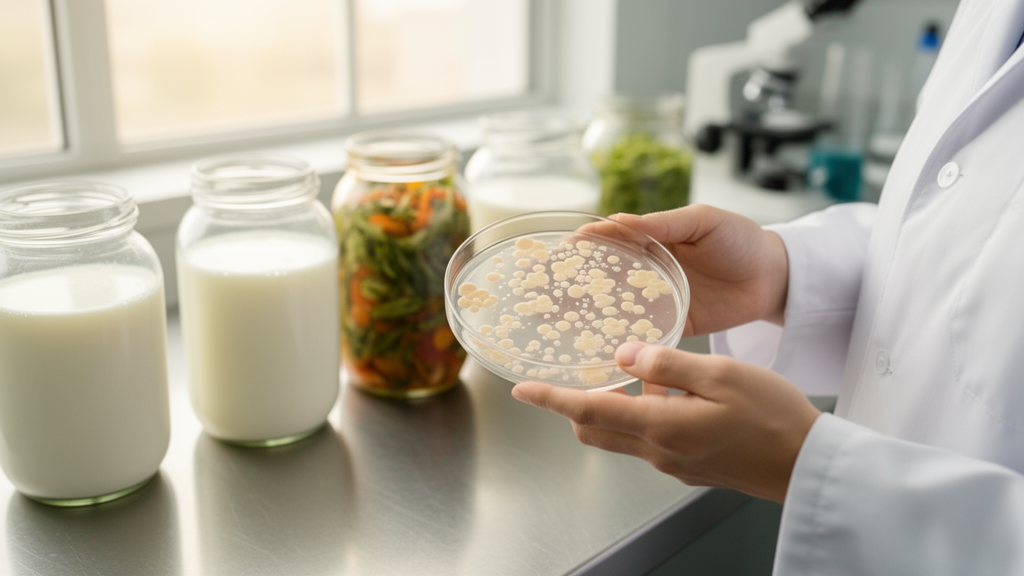
Few microbes have shaped human civilization as quietly, and as profoundly, as Lactobacillus. For roughly 8,000 years, these Gram-positive, non-sporulating bacteria have transformed milk, vegetables, cereals, and meats into foods that last longer, taste better, and nourish more deeply. Now a comprehensive review published in Frontiers in Industrial Microbiology argues that this ancient workhorse is entering its most transformative era yet, one defined not by tradition but by genomics, precision fermentation, and microbiome-targeted design. The review, led by Ritisha Goel and Richa Arora of Punjab Agricultural University in India alongside colleagues at Central Agricultural University Imphal and the University of São Paulo, weaves together taxonomy, metabolic biochemistry, food safety science, and industrial biotechnology into a single picture of where fermented food is heading.
At the heart of the review is a deceptively simple biochemical story. Lactic acid bacteria, or LAB, ferment carbohydrates through two distinct pathways. Homolactic fermenters route sugars through the Embden-Meyerhof glycolytic pathway, converting each glucose molecule into two molecules of pyruvate, generating two ATP and two NADH before lactate dehydrogenase reduces pyruvate to lactic acid and regenerates NAD+ to keep glycolysis running. Heterolactic fermenters take the pentose phosphate and phosphoketolase routes instead, yielding lactic acid alongside ethanol, acetic acid, and carbon dioxide. That difference matters industrially: homofermentative strains deliver high lactic acid yields suited to large-scale production, while the carbon dioxide released by heterofermenters can cause packaging expansion and textural defects in dairy products, limiting their use in yogurt and cheese manufacture even as it proves essential in kimchi, sauerkraut, and sourdough.
Acidification is only the beginning. The review catalogs an arsenal of antimicrobial metabolites, organic acids, hydrogen peroxide, and diacetyl among them, that suppress spoilage organisms and pathogens such as Salmonella, Listeria, Escherichia, Aspergillus, Fusarium, and Penicillium. The most celebrated of these weapons are bacteriocins, ribosomally synthesized antimicrobial peptides including nisin, pediocin, plantaricin, and lacticin. Unlike conventional antibiotics, bacteriocins are typically degraded by gastrointestinal proteases such as trypsin and pepsin, which limits their persistence in the gut and spares the resident microbiota. Their production is genetically encoded through operons requiring tightly coordinated expression of precursor processing, export, self-protection, and regulatory genes, governed by a quorum-sensing three-component system of inducing peptide, histidine kinase, and response regulator. Recent work combining omics and synthetic biology has improved yields and broadened antimicrobial spectra, positioning bacteriocins as clean-label alternatives to chemical preservatives.
The review also highlights a quieter safety contribution: the degradation of biogenic amines, non-volatile nitrogenous compounds formed by amino acid decarboxylation that can act as food intoxicants. Certain Lactiplantibacillus plantarum strains possess amine oxidase activity or produce metabolites capable of breaking down or suppressing these amines, reducing toxicity risk in fermented products. Combined with bacteriocin stability across varied pH ranges and temperatures, and evidence that some LAB bacteriocins show efficacy against Listeria monocytogenes, a persistent problem in raw-milk cheeses, the picture is of a biological preservation system that enhances rather than compromises food quality, even promoting desirable proteolysis during ripening.
Perhaps the most striking structural change the review documents is taxonomic. In 2020, Zheng and colleagues reorganized the sprawling genus Lactobacillus, once defined by phenotypic traits such as morphology, growth temperature, and carbohydrate utilization, into 25 genera based on genomic relationships, conserved protein sequences, and ecological adaptation. Lactobacillus plantarum became Lactiplantibacillus plantarum; Lactobacillus casei became Lacticaseibacillus casei; Lactobacillus brevis became Levilactobacillus brevis; and Lactobacillus fermentum became Limosilactobacillus fermentum, while L. acidophilus, L. helveticus, and L. delbrueckii retained their original genus. This is not pedantry. Accurate taxonomy underpins strain selection, regulatory classification, and the genomic safety assessments that increasingly determine which cultures may enter the food supply.
That safety question is where the review turns most consequential. Traditional probiotic evaluation relied on phenotypic characteristics, antimicrobial activity, gastrointestinal tolerance, adhesion properties, which the authors argue cannot reliably identify virulence factors, transferable antimicrobial resistance genes, or mobile genetic elements. Whole-genome sequencing is filling the gap. Lactiplantibacillus plantarum TWK10 underwent comprehensive genomic analysis revealing no virulence factors, resistance genes, or biogenic amine synthesis genes, confirming its suitability for food applications. Strain LVS14, genomically validated as free of safety-related risk genes, was subsequently incorporated into fermented milk as a starter culture, improving sensory quality while maintaining probiotic functionality. And strain Z-5, isolated from traditional fermented foods, showed plantaricin biosynthesis genes and strong inhibition of Listeria monocytogenes, marking it as a candidate dairy biopreservative. The review frames this shift from species-level assumptions to strain-level genomic validation as an essential component of modern regulatory frameworks, complementing GRAS status with multi-tiered assessment combining phenotypic screening for hemolytic activity, biogenic amine formation, and antibiotic susceptibility with whole-genome analysis.
The metabolic repertoire extends well beyond preservation. Exopolysaccharides, high-molecular-weight biopolymers whose biosynthesis proceeds through carbohydrate uptake, activated sugar nucleotide formation, cytoplasmic assembly of repeating units, and polymerization with export, improve viscosity and water-holding capacity in yogurt, with reported levels ranging from roughly 20 to 200 milligrams per liter depending on strain and conditions. Vitamin biofortification is equally impressive: co-culturing Lactiplantibacillus plantarum with Lactobacillus acidophilus in soy milk tripled riboflavin content to 481 micrograms per liter over 11 hours, while Limosilactobacillus reuteri produced up to 18.36 micrograms per milliliter across coconut, soy, oat, and cow-milk beverages. Lactococcus lactis strains yielded extracellular folate between 10.37 and 31.10 micrograms per milliliter, and engineered menaquinone (vitamin K2) production in Lactococcus lactis subsp. cremoris reached its highest yield with combined mvk, preA, and menA gene expression. In one folate screening study, levels rose 54 percent by day 30 and 108 percent by day 60, driven primarily by L. casei VC199 and L. paracasei SE160.
These capabilities are being redeployed across an expanding product landscape. In dairy, yogurt fermentation drops pH from 6.8 to 4.5, dissociating colloidal calcium phosphate and destabilizing casein micelles into a continuous gel matrix, with incubation temperatures between 37 and 45 degrees Celsius influencing gel strength and strain-specific acidification rates determining final viscosity and firmness. Comparative studies show dairy matrices support rapid acidification to pH 4.4 to 4.6, while oat-based systems acidify more slowly to pH 4.8 to 5.2 due to limited fermentable sugars, yet LAB maintain viability above 10^7 CFU per milliliter across both. In vegetable fermentations, LAB dominance drives pH below 4.0 within 48 to 72 hours, with pickle fermentations reaching pH 3.8 to 3.9 after two days. In sourdough, LAB-yeast co-cultures increase lactic and acetic acid concentrations by roughly 30 to 45 percent compared with single-culture fermentations, improving dough elasticity, loaf volume, and even enabling partial degradation of FODMAP components for sensitive consumers. In fermented meats, LAB-driven proteolysis shapes flavor and texture while improving color retention and reducing lipid and protein oxidation in dry-cured products.
Beverage innovation may be the most visible frontier. Re-fermenting sterilized kombucha with Acetobacter combined with Lactiplantibacillus plantarum eliminated ethanol entirely, reducing concentration from 0.66 percent to undetectable levels through ethanol oxidation, while raising total polyphenols from 215.32 to 336.33 milligrams of gallic acid equivalents per liter and flavonoids from 163.38 to 196.35 milligrams of catechin equivalents per liter, with enhanced antioxidant activity and improved sensory acceptability. Emerging next-generation products now include fermented soy yogurt, almond yogurt, coconut kefir, symbiotic beverages, and fermented millet, quinoa, and oat cereals, responding to consumer demand for plant-based, functional, and microbiome-supporting foods. Co-culture strategies, in which cross-feeding microbes supply amino acids, peptides, and vitamins to one another, are being optimized for these matrices, with microbial ecology models improving reproducibility.
The review closes with clear-eyed acknowledgment of the obstacles ahead. Strain instability, viability loss during processing and gastrointestinal transit, antibiotic resistance concerns, and fragmented global regulatory frameworks all constrain industrial deployment, and encapsulation technologies using alginate, chitosan, whey proteins, and lipid carriers are emerging as critical countermeasures. Personalized nutrition, in which fermented foods are matched to individual microbiome profiles, remains scientifically promising but faces scalability, cost, and data privacy barriers that current regulation has yet to accommodate. Still, the trajectory is unmistakable: the convergence of microbial biotechnology, precision fermentation, and genomic innovation is converting an 8,000-year-old craft into a predictive, safety-validated engineering discipline, one in which the same bacteria that made yogurt possible may soon deliver designer vitamins, targeted biopreservation, and microbiome-tailored foods at industrial scale.
Subject of Research: The role of Lactobacillus and lactic acid bacteria in fermented food safety, metabolism, and next-generation functional food development
Article Title: Understanding of the interaction of Lactobacillus in fermented food and beverages: targeting food safety and new foods
Article References: Goel, R., Goyal, R., Moria, T., Arora, R., Sarangi, P. K., & Chandel, A. K. (2026). Understanding of the interaction of Lactobacillus in fermented food and beverages: targeting food safety and new foods. Frontiers in Industrial Microbiology, 4, Article 1846356. https://doi.org/10.3389/finmi.2026.1846356
Image Credits: AI Generated
DOI: 10.3389/finmi.2026.1846356
Keywords: Lactobacillus, lactic acid bacteria, fermented foods, food safety, bacteriocins, probiotics, whole-genome sequencing, exopolysaccharides, precision fermentation, functional foods, plant-based beverages, microbiome
News Source: Daisy Hatcher. (October 16, 2026). How Lactobacillus Is Rewriting the Rules of Fermented Food Safety and Next-Generation Nutrition. Scienmag.