Credit: Leandro Avelar
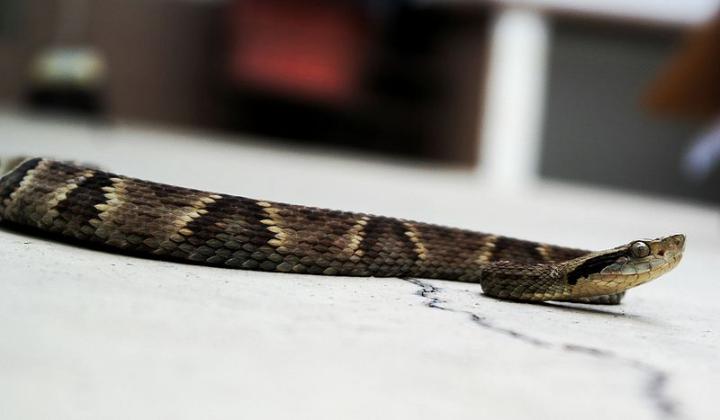
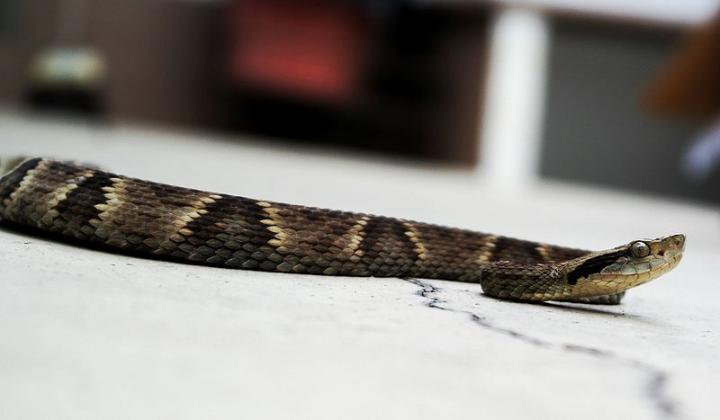
A bite from a lancehead snake can be fatal. Species in the family, found throughout Central and South America, have venom that can disrupt blood clotting and cause hemorrhage, strokes and kidney failure.
Solange Serrano, a researcher at the Laboratory of Applied Toxicology at the Instituto Butantan in Sao Paulo, Brazil, studies the protein toxins in venom from these snakes. In a recent article in the journal Molecular & Cellular Proteomics, scientists from Serrano's laboratory, in collaboration with researchers at the University of New Hampshire, report on the sweet side of snake venom toxins.
The researchers looked at glycans, a group of sugar molecules attached in a complex chain, often with many branches, that can be attached to proteins. According to Serrano, most proteins in lancehead venom are modified with glycans, which can affect the proteins' folding, stability and binding. But very little is known about glycan structure in the snakes' venom.
Serrano's graduate student Debora Andrade-Silva visited the laboratory of glycomics expert Vernon Reinhold in New Hampshire to learn techniques for structural characterization of glycans. While there, Andrade-Silva and colleagues characterized the structure of 60 glycan chains in eight lancehead, or Bothrops, species' venoms. The researchers isolated the glycans and analyzed them by mass spectrometry, breaking down each complex molecule into smaller, simpler ions. By piecing together the spectra of many such ions, it was possible to tell which sugars were present and how they were linked into tree-like glycan structures.
Lancehead venom contains nearly 100 milligrams of protein per milliliter of liquid. At this concentration, protein solutions tend to become very viscous or form gels. Analyzing the structures of glycans attached to the proteins, the researchers found that a disproportionate number were tipped with sialic acid, a sugar with a negative charge. "Glycans containing sialic acid may help in venom solubility and increase toxin half-life," said Serrano. Sialic acid on a toxic enzyme may also bind to host proteins called siglecs, pulling the enzyme closer to target cells for greater effect; this has been observed in other types of venom.
While Serrano's group conducts basic research on venom composition, the applications are very close to home. Another department of the Instituto Butantan produces most of the antivenom available in Brazil. Serrano said she hopes that basic research into venom toxins will help researchers develop improved treatments for envenomation.
"The antivenoms do a reasonable job, but they are not so good at neutralizing the local effects of snakebite," including swelling, hemorrhage and necrosis, Serrano said. These effects can be severe enough that doctors must sometimes amputate bitten limbs. Better understanding how venom differs between snake species could improve the efficacy of antivenom treatment. Andrade-Silva and Serrano are now working to map the structures from the glycan inventory back onto the proteins they modify. Because some venom proteins have been repurposed as medicines, knowing more about how glycosylation helps each protein fold, hold its shape, and attach to binding partners may further have applications in biotechnology.
###
This work was funded by grants from the Sao Paulo Research Foundation, or FAPESP, and Brazil's National Council for Scientific and Technological Development, or CNPq.
Media Contact
Laurel Oldach
[email protected]
240-283-6648
@asbmb
http://www.asbmb.org
Related Journal Article
http://dx.doi.org/10.1074/mcp.RA118.000748