A new paper in Genome Biology and Evolution, published by Oxford University Press, maps out for the first time how Hydra, which are a group of small aquatic animals, can regenerate their own heads by changing the way that their genes are regulated, known as epigenetics.
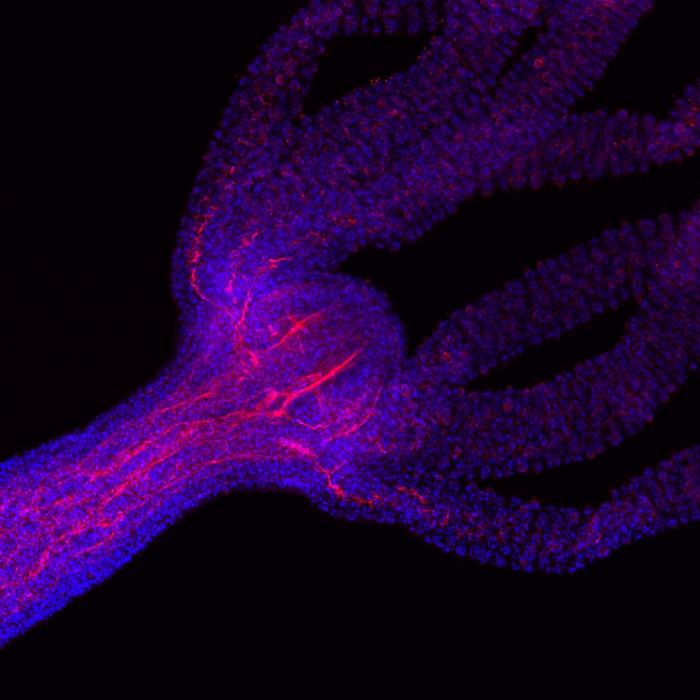
Credit: David Plachetzki
A new paper in Genome Biology and Evolution, published by Oxford University Press, maps out for the first time how Hydra, which are a group of small aquatic animals, can regenerate their own heads by changing the way that their genes are regulated, known as epigenetics.
Hydra belong to the group of animals that consists of about 10,000 species divided into two major groups: Anthozoa (comprising of sea anemones, corals, and sea pens) and Medusozoa (sea wasps, jellyfish, and hydra). Hydra, which live in temperate and tropical regions, are commonly believed to be biologically immortal; Hydra stem cells have a capacity for unlimited self-renewal.
Whole-body regeneration occurs in a few animal species. The extent to which the genes and gene regulatory networks driving regeneration vary across species remains largely unexplored. Scientists still don’t understand the mechanism driving Hydra head regeneration. Previous studies have found evidence of regulation by multiple developmental pathways. Researchers have found several genes associated with head regeneration.
To understand the rudiments controlling Hydra head regeneration, researchers first identified 27,137 elements that are active in one or more sections of the organism body or regenerating tissue. Researchers used histone modification ChIP-seq, a method used to analyze how proteins interact with DNA, to identify 9998 candidate proximal promoter and 3018 candidate enhancer-like regions respectively. Their research shows that a subset of these regulatory elements is remodeled during head regeneration and identifies a set of transcription factor motifs that are enriched in the regions activated during head regeneration. These enriched motifs included developmental transcription factors.
This work identifies for the first time the specific candidate regulatory elements of the genome that change during Hydra head regeneration, which determine how organisms develop by turning on or off genes depending on need. “One exciting finding of this work is that the head regeneration and budding programs in Hydra are quite different, said the paper’s lead author, Aide Macias-Muñoz. “Even though the result is the same (a Hydra head), gene expression is much more variable during regeneration. Accompanying dynamic gene expression is dynamic chromatin remodeling at sites where developmental transcription factors bind. These findings suggest that complex developmental enhancers were present before the Cnidaria and Bilateria split.”
The paper “Coordinated gene expression and chromatin regulation during Hydra head regeneration” is available (at midnight on December 8th) at: https://academic.oup.com/gbe/article-lookup/doi/10.1093/gbe/evab221.
Direct correspondence to:
Aide Macias-Muñoz
Department of Developmental and Cell Biology
University of California Irvine,
Irvine, CA 92697
[email protected]
To request a copy of the study, please contact:
Daniel Luzer
[email protected]
Journal
Genome Biology and Evolution
DOI
10.1093/gbe/evab221
Method of Research
Experimental study
Subject of Research
Animals
Article Title
Coordinated gene expression and chromatin regulation during Hydra head regeneration
Article Publication Date
8-Dec-2021
COI Statement
N/A