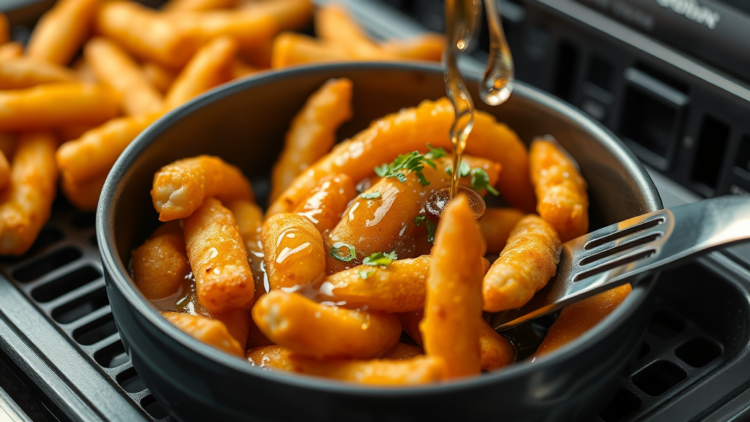
Fried food occupies a paradoxical place in the modern diet. It delivers the flavors, colors, and crisp textures that consumers crave, yet it also carries a caloric and metabolic burden that public health authorities have warned about for decades. In deep-fat frying, oil uptake can reach as much as 50 percent of the food’s total weight, and excessive consumption of such oil-rich products is linked to obesity, high blood pressure, cardiovascular disease, diabetes, and certain cancers. A comprehensive new review published in Food Science & Nutrition argues that the field has been measuring the problem the wrong way: instead of treating absorbed oil as a single number, researchers should track where, when, and how different fractions of oil enter food during frying and cooling.
The review, led by Arash Ghaitaranpour of Ferdowsi University of Mashhad together with Mohsen Esmaiili, Zoleykha Fahimi vajargahi, and Michael O. Ngadi, reexamines frying technologies through the lens of three distinct oil fractions first described in classic work on French fries. Surface oil, or SO, is the film that clings to the outside of a fried product without penetrating its microstructure. Penetrated surface oil, or PSO, is oil that begins on the surface but is later sucked into the porous crust. Structural oil, or STO, is oil that migrates into the food’s interior during frying itself. By separating total oil content into these components, the authors reveal that seemingly contradictory results across decades of frying research begin to make sense: different technologies reduce oil uptake by intervening at entirely different stages of the process.
The physics of oil absorption is more subtle than most people assume. During frying, two countercurrent mass transfer processes unfold simultaneously. Water and water-soluble compounds migrate from the food’s moist core toward the surface, where they evaporate violently, while heat flows inward through convection and conduction. The escaping vapor generates positive pressure inside the food, and this outward flow actually resists oil penetration during most of the frying period. As a result, structural oil typically represents only a small share of total oil content. The crucial event happens after the food leaves the fryer. As the product cools below 100 degrees Celsius, water vapor inside the pores condenses, internal pressure drops sharply, and the resulting vacuum effect draws surface oil deep into the crust. Studies consistently show that more oil is absorbed during cooling than during frying itself, making the cooling stage the dominant target for oil reduction strategies.
Capillary forces add a second layer of complexity. The crust of a fried product is far more porous than its core; in French fries, the crust can be roughly six times more porous. Oil movement through these microscopic channels is governed by capillary pressure, which depends on pore radius, the contact angle between oil and the food surface, and oil surface tension. Smaller pores generate higher capillary pressures and thus greater oil uptake, and degraded frying oil, thickened by polymerization products and enriched with surface-active compounds formed during oxidation and hydrolysis, adheres more stubbornly to food surfaces. These findings help explain why oil quality, not just oil quantity, shapes the nutritional outcome of frying.
Viewed through this fraction-specific framework, each frying technology reveals a distinct mechanism of action. In conventional deep-fat frying, most absorbed oil ends up as penetrated surface oil drawn in during cooling. Pressure frying, widely used in commercial food service for meat and poultry, shortens frying time and improves moisture retention, but the review highlights an underappreciated factor: the pressure-release stage. When pressure is broken, vapor and liquids escape from the product, blocking oil entry and potentially expelling some oil already absorbed. Higher applied pressures consistently produce lower total oil content, suggesting that the pressure cycle itself, not merely faster cooking, drives the reduction.
Vacuum frying, performed at reduced pressure and correspondingly lower temperatures, preserves heat-sensitive nutrients and slows oil degradation. Yet its oil-saving benefit depends critically on how the vacuum is broken. When pressure returns to atmospheric levels, condensing vapor can pull oil inward; however, a rapid vacuum-breaking rate compresses the product, shrinking the internal space available for oil. The relationship between vacuum-breaking rate and oil absorption is roughly linear and inverse, meaning that fast decompression can substantially cut total oil content. The authors stress that vacuum breaking should be judged by processing conditions rather than labeled universally beneficial or harmful. Combined with centrifugal deoiling immediately after frying, careful pressure management allows vacuum-fried products to achieve markedly lower fat levels.
Hot-air frying, the technology behind the wildly popular domestic air fryer, operates on a fundamentally different principle. Because only a small amount of oil is sprayed onto the food rather than immersing it in a bath, little surface oil exists after frying, leaving almost nothing for capillary suction to draw in during cooling. The review’s fraction-based analysis shows that post-frying oil uptake in hot-air frying is effectively negligible; the lower total oil content stems from limited oil availability, not from altered cooling physics. Oil penetration during frying follows a latent phase, an acceleration phase in which most crust moisture evaporates, and a declining phase, but the absence of a substantial surface oil reservoir distinguishes this method from all pressure-based approaches.
Microwave frying presents the most inconsistent evidence of the technologies examined. Volumetric heating, generated by dipole rotation of water molecules and polar constituents, produces rapid internal steam generation and structural channels that can either restrain oil entry or create pathways for deeper penetration. Some studies report lower oil uptake at high microwave power, where fast water escape opposes absorption; others observe increased absorption from structural damage and uneven heating. Notably, microwave-fried products cooled at room temperature showed little post-frying oil change, and total oil content actually decreased when products were kept in a hot microwave cavity, apparently because reduced oil viscosity allowed surface oil to drain away. Infrared frying, by contrast, forms a smooth, hard crust quickly in starchy foods, reducing surface oil adhesion, though early crust formation can later crack and admit more penetrated surface oil during cooling. The authors caution that quantitative fraction data for infrared frying remain scarce.
The most novel technology reviewed is G-frying, in which centrifugal force is applied during or immediately after frying. Rotating the fryer basket strips vapor bubbles from the food surface, enhancing heat transfer and moisture loss, and then physically flings surface oil off the product before the vacuum effect can pull it inside. Because surface oil constitutes the largest share of total oil content in conventional frying, actively removing it represents a uniquely direct intervention. Oil removal efficiency depends on product orientation and structure, with vertically positioned samples draining better, while centrifugation speed and cooling time show surprisingly limited effects. Preliminary studies suggest G-fried products exhibit reduced oil uptake, improved texture, and reduced oil oxidation thanks to shorter heating exposure, though industrial validation is still limited.
The broader message of the review is methodological as much as technological. Because each frying technology alters a different stage of oil migration, comparing methods solely on final total oil content obscures the mechanisms that actually matter and renders much of the existing literature difficult to reconcile. The authors call for standardized fraction-specific analytical methods, real-time oil tracking, and industrial-scale validation, particularly for emerging approaches like G-frying and infrared frying. For food scientists and manufacturers, the implication is clear: designing healthier fried products requires not just less oil, but a precise understanding of which oil fraction to target, and when. For consumers watching the air fryer revolution reshape home cooking, the science now explains why it works, and hints at how the next generation of fryers could deliver the same crunch with even less fat.
Subject of Research: Fraction-specific oil absorption mechanisms in conventional and emerging food frying technologies
Article Title: From Deep‐Fat Frying to G‐Frying: Exploring Absorption Dynamics of Oil Fractions in Fried Foods
Article References: Ghaitaranpour, A., Esmaiili, M., vajargahi, Z. F., & Ngadi, M. O. (2026). From Deep‐Fat Frying to G‐Frying: Exploring Absorption Dynamics of Oil Fractions in Fried Foods. Food Science & Nutrition, 14(9), Article e72391. https://doi.org/10.1002/fsn3.72391
Image Credits: AI Generated
DOI: 10.1002/fsn3.72391
Keywords: deep-fat frying, oil absorption, surface oil, penetrated surface oil, structural oil, vacuum frying, air frying, microwave frying, G-frying, capillary pressure, vacuum effect, fried food health
Cite Scienmag News
APA MLA Chicago
Alan Morgan. (September 22, 2026). How Frying Technologies Shape Oil Absorption in Fried Foods. Scienmag. https://scienmag.com/how-frying-technologies-shape-oil-absorption-in-fried-foods/
Alan Morgan. “How Frying Technologies Shape Oil Absorption in Fried Foods.” Scienmag, 22 September 2026, https://scienmag.com/how-frying-technologies-shape-oil-absorption-in-fried-foods/. Accessed 22 September 2026.
Alan Morgan. “How Frying Technologies Shape Oil Absorption in Fried Foods.” Scienmag. September 22, 2026. https://scienmag.com/how-frying-technologies-shape-oil-absorption-in-fried-foods/
Copy citation Download RIS
Tags: air fryingcapillary pressuredeep-fat fryingfactors influencing oil absorption during fryingfood microstructure and oil infiltrationfried food healthFrying technology impact on oil absorptionG-fryinghealth effects of oil-rich fried foodsmeasurement of oil penetration in fried productsmicrowave fryingnutritional analysis of fried foodsoil absorptionoil fraction dynamics in frying processoil uptake in fried foodspenetrated surface oilpublic health implications of fried food consumptionrole of frying temperature and time on oil absorptionstructural oilsurface oilsurface oil versus penetrated oil in fryingtechniques to reduce oil absorption in fryingvacuum effectvacuum frying