• HOME
  • NEWS
  • EXPLORE
    • CAREER
      • Companies
      • Jobs
    • EVENTS
    • iGEM
      • News
      • Team
    • PHOTOS
    • VIDEO
    • WIKI
  • BLOG
  • COMMUNITY
    • FACEBOOK
    • INSTAGRAM
    • TWITTER
Thursday, June 25, 2026
BIOENGINEER.ORG
No Result
View All Result
  • Login
  • HOME
  • NEWS
  • EXPLORE
    • CAREER
      • Companies
      • Jobs
        • Lecturer
        • PhD Studentship
        • Postdoc
        • Research Assistant
    • EVENTS
    • iGEM
      • News
      • Team
    • PHOTOS
    • VIDEO
    • WIKI
  • BLOG
  • COMMUNITY
    • FACEBOOK
    • INSTAGRAM
    • TWITTER
  • HOME
  • NEWS
  • EXPLORE
    • CAREER
      • Companies
      • Jobs
        • Lecturer
        • PhD Studentship
        • Postdoc
        • Research Assistant
    • EVENTS
    • iGEM
      • News
      • Team
    • PHOTOS
    • VIDEO
    • WIKI
  • BLOG
  • COMMUNITY
    • FACEBOOK
    • INSTAGRAM
    • TWITTER
No Result
View All Result
Bioengineer.org
No Result
View All Result
Home NEWS Science News Biology

How flies lay off the extra salty snacks

Bioengineer by Bioengineer
June 29, 2022
in Biology
Reading Time: 3 mins read
0
Fly’s labellum with high-salt neurons labeled in green.
Share on FacebookShare on TwitterShare on LinkedinShare on RedditShare on Telegram

Fruit flies are known for their sweet tooth, but new research also indicates they may offer hints to how animals sense—and avoid—high concentrations of salt.
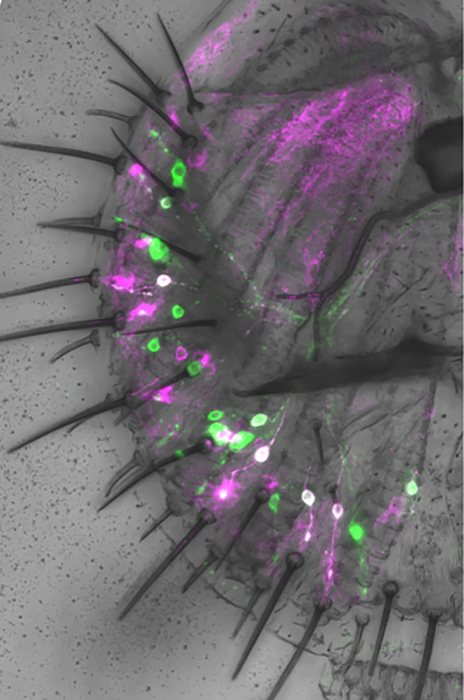
Fly’s labellum with high-salt neurons labeled in green.

Credit: University of British Columbia

Fruit flies are known for their sweet tooth, but new research also indicates they may offer hints to how animals sense—and avoid—high concentrations of salt.

Using mutant fruit flies, University of British Columbia zoologists have identified a new high-salt receptor on the tongue of Drosophila—receptor IR7c. IR7c governs the insects’ ability to detect dangerously high concentrations of salt, typically over 0.25 moles per litre, or about half as salty as sea water.

“In flies, high salt avoidance is driven by both bitter taste neurons and a separate class of neurons dedicated entirely to detecting high concentrations of salt,” says PhD student Sasha McDowell, lead author of the study published today in Current Biology.

“When we switched off the IR7c receptor, the flies lost their typical physiological responses and behavioral aversion to high concentrations of monovalent salts like simple sodium chloride.”

Flies detect tastes using gustatory receptor neurons located across their body, including the labellum at the very end of their mouths, their pharynx, or throat, and even parts of their legs. In the case of fruit flies, researchers had already identified two co-receptors involved in detecting salt and a variety of other chemicals—IR76b and IR25a—but a salt-specific receptor on the labellum, IR7c, wasn’t known to be involved.

Surprisingly, even with their IR7c receptor turned off, the mutant flies responded normally to high concentrations of less nutritionally abundant divalent salts such as calcium.

“High salt taste has mostly been thought of as a non-specific process, but it turns out flies care about which salts they’re tasting,” says Professor Michael Gordon, senior author of the study. “This may be because calcium ions are toxic to flies, and they should avoid them at any concentration. But sodium is an important part of any diet, so flies need to like the taste of sodium until concentrations get high enough to be harmful.”

All animals need salt to survive—sodium is essential for nerves and muscles to function properly and helps regulate fluids in the body. But too much salt can cause dehydration, kidney failure, and other ill effects.

“The receptor we discovered in flies isn’t present in mammals, but since high salt taste hasn’t been fully understood in any animal, our research may provide clues to mechanisms in other species,” says Dr. Gordon.

“If there’s one thing I’ve learned by studying salt taste, it’s that things always turn out to be more complicated, and fascinating, than we expect at the outset!”


Journal

Current Biology

DOI

10.1016/j.cub.2022.06.012

Method of Research

Experimental study

Subject of Research

Animals

Article Title

A molecular mechanism for high salt taste in Drosophila

Article Publication Date

29-Jun-2022

COI Statement

The authors declare no competing interests.

Share12Tweet8Share2ShareShareShare2

Related Posts

Decoding the Secret Code of a Crucial Immune Sensor

June 24, 2026

Decades of Data Reveal Which Orcas Call Puget Sound Home

June 24, 2026

Copal Tree Genetics Reveal Tropical Forest Connectivity

June 24, 2026

How Intestinal Mucus Influences Klebsiella pneumoniae Colonization and Antibiotic Effectiveness

June 24, 2026

POPULAR NEWS

  • Saying Goodbye to PGY-6: Pediatric Fellowship Realities

    103 shares
    Share 41 Tweet 26
  • Multi-Hospital Study Reveals Long Covid Burden Is Twice as High as Current Estimates

    92 shares
    Share 36 Tweet 23
  • Detection of EDCs in Breast Milk and Infant Urine Up to Six Months Highlights Early Exposure Risks

    77 shares
    Share 31 Tweet 19
  • New Drug Candidate Developed at McMaster Shows Potential for Treating Brain Cancer

    58 shares
    Share 23 Tweet 15

About

We bring you the latest biotechnology news from best research centers and universities around the world. Check our website.

Follow us

Recent News

Asian Working Group Revises Sarcopenia Criteria 2019-2025

AI-Powered Platform Advances Structure-Based Drug Discovery

BALatrine Reduces Helminth Infections: Central Java Trial

Subscribe to Blog via Email

Enter your email address to subscribe to this blog and receive notifications of new posts by email.

Join 82 other subscribers
  • Contact Us

Bioengineer.org © Copyright 2023 All Rights Reserved.

Welcome Back!

Login to your account below

Forgotten Password?

Retrieve your password

Please enter your username or email address to reset your password.

Log In
No Result
View All Result
  • Homepages
    • Home Page 1
    • Home Page 2
  • News
  • National
  • Business
  • Health
  • Lifestyle
  • Science

Bioengineer.org © Copyright 2023 All Rights Reserved.