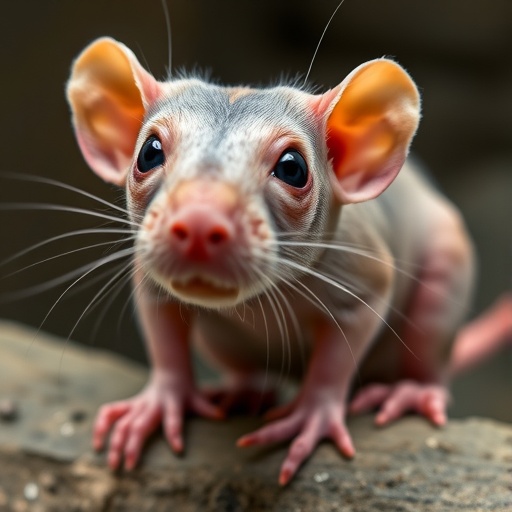
In a groundbreaking study poised to reshape our understanding of longevity, researchers have uncovered a remarkable molecular mechanism in naked mole-rats that may hold the secret to their extraordinary lifespan. The study, recently published in the prestigious journal Science, reveals that subtle evolutionary mutations in the enzyme cyclic guanosine monophosphate–adenosine monophosphate synthase (cGAS) dramatically enhance the animal’s DNA repair capabilities, potentially delaying aging and age-related decline.
Naked mole-rats (Heterocephalus glaber), despite their modest and wrinkled appearance, are exceptional within the rodent family, demonstrating lifespans nearing four decades, almost ten times longer than similarly sized rodents such as mice. Unlike other rodents, their genetic architecture intriguingly aligns more closely with humans than with mice, rendering them an invaluable model to decode the biological foundations of longevity at the molecular level.
Central to cellular health and longevity is genome integrity—the capacity to safeguard and accurately repair DNA damage accumulated over time. Age-associated genomic instability is a hallmark of aging and is linked to degenerative diseases and cancer. One critical pathway of DNA repair is homologous recombination (HR), responsible for faithfully correcting harmful double-strand breaks; defects in this pathway are known to accelerate aging processes. Strikingly, previous studies in humans and mice have identified cGAS as a suppressor of HR, paradoxically contributing to genomic instability by inhibiting DNA repair and potentially facilitating cancer progression.
Against this backdrop, Yu Chen and colleagues embarked on an incisive investigation to determine whether the cGAS system behaves differently in long-lived naked mole-rats. Their research uncovered that four specific amino acid substitutions unique to naked mole-rat cGAS significantly alter its biochemical behavior. Normally, cGAS undergoes ubiquitination—a process tagging the protein for degradation. However, in naked mole-rats, these amino acid changes mitigate ubiquitination, thereby stabilizing cGAS and prolonging its presence in the nucleus following DNA damage.
This enhanced stability of cGAS heightens its interactions with pivotal DNA repair proteins FANCI and RAD50, instrumental components of the HR pathway. By fostering these interactions, cGAS in naked mole-rats amplifies DNA repair efficacy following genotoxic stress. Experimental depletion of cGAS from naked mole-rat cells resulted in a marked accumulation of DNA damage, reaffirming the protein’s protective role. These findings uncover an unexpected, pro-repair nuclear function for cGAS that contrasts sharply with its suppressive role in human and mouse cells.
The implications of these molecular insights extend beyond naked mole-rats. To test the evolutionary functional impact of these specific amino acid alterations, the researchers engineered fruit flies to express a modified human cGAS protein harboring the four naked mole-rat substitutions. Remarkably, these genetically modified flies exhibited increased lifespans relative to controls expressing wild-type human cGAS, highlighting the mutations’ capacity to promote longevity beyond species boundaries.
This discovery illuminates a fascinating duality in cGAS biology, with species-specific adaptations dictating its influence on genome stability and organismal aging. The naked mole-rat variants transform cGAS from a potential suppressor to an enhancer of DNA repair, possibly contributing decisively to their protracted healthspan and resistance to cancer. The study underscores the nuanced complexity of innate immune signaling pathways intersecting with DNA repair mechanisms to modulate aging.
John Martinez and colleagues, in an accompanying Perspective in Science, emphasize the broader implications of this revelation, acknowledging that cGAS’s nuclear functions may have evolved distinct regulatory roles in short- and long-lived organisms. They call for intensified investigations into cGAS activity across diverse species to unravel its full spectrum of functions and identify therapeutic avenues that could mimic the naked mole-rat’s longevity advantage.
From a translational perspective, these findings open compelling possibilities for developing interventions that stabilize or modulate cGAS in human cells to enhance DNA repair and delay aging or mitigate cancer risk. The precise engineering of cGAS variants or targeting its ubiquitination pathways may pave the way for innovative anti-aging therapies.
Furthermore, this study adds to the growing body of literature highlighting the naked mole-rat as a unique biomedical model, its molecular adaptations providing blueprints for combatting human age-associated diseases. By elucidating the molecular underpinning of its exceptional lifespan, researchers can refine strategies for genome maintenance and cancer prevention.
In summary, this pioneering work reveals that evolutionary modifications to cGAS in naked mole-rats fortify DNA repair by stabilizing the enzyme and enhancing its interaction with HR machinery. This molecular tuning likely underlies their remarkable longevity, challenging previous conceptions about cGAS function and offering new vistas into the biology of aging. Continued exploration of these pathways promises to deepen understanding of how longevity can be mechanistically extended across species.
Subject of Research: Molecular mechanisms of longevity in naked mole-rats, focusing on cGAS-mediated DNA repair enhancement
Article Title: A cGAS-mediated mechanism in naked mole-rats potentiates DNA repair and delays aging
News Publication Date: 9-Oct-2025
Web References: 10.1126/science.adp5056
Keywords: naked mole-rat, longevity, cGAS enzyme, DNA repair, homologous recombination, ubiquitination, genome stability, aging, FANCI, RAD50, innate immune system, molecular evolution
Tags: aging and age-related declinecyclic guanosine monophosphate synthaseDNA damage and repair processesenhanced DNA repair mechanismsevolutionary mutations in rodentsgenetic architecture of naked mole-ratsgenome integrity and healthhomologous recombination pathwaysimplications for human aging researchinsights from rodent models of longevitymolecular mechanisms of longevitynaked mole-rat longevity secrets