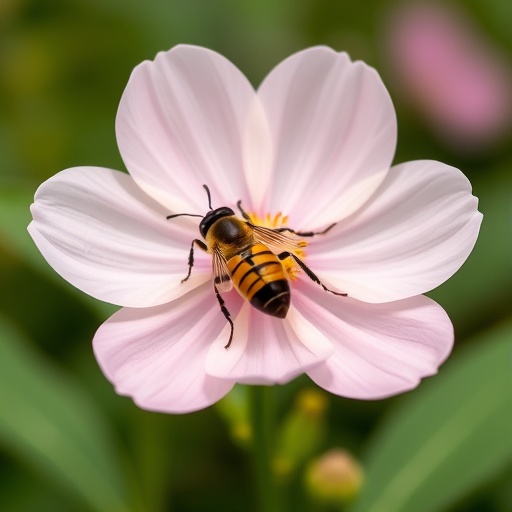
In a groundbreaking study set to reshape our understanding of plant-pollinator-microbe interactions, researchers from Germany’s Marburg University have unveiled intricate dynamics linking floral scent diversity, insect pollinator behavior, and bacterial communities inhabiting flowers. Published in the prestigious journal New Phytologist, the study provides compelling evidence that the complexity of a flower’s chemical scent profile plays a pivotal role in structuring both the diversity of its pollinating insects and the populations of bacteria it hosts. This research introduces the “Filthy Pollinator Hypothesis,” a novel conceptual framework that sheds light on the evolutionary significance of floral scent complexity.
Floral scents, long recognized for their role in attracting pollinators, consist of a myriad of volatile organic compounds (VOCs). These VOCs vary considerably in their chemical structures and functional properties. The study reveals that flowers emitting a rich tapestry of these compounds, a trait described as floral scent chemodiversity, tend to attract a broader spectrum of insect visitors. This phenomenon suggests floral scent complexity acts as an ecological cue, facilitating enhanced pollinator discrimination and promoting visitation by a diverse insect assemblage.
However, the research uncovers an intriguing paradox: while high chemodiversity amplifies pollinator richness, it simultaneously corresponds with a marked reduction in bacterial species richness on floral surfaces. This counterintuitive finding challenges previous assumptions that increased pollinator activity would universally elevate microbial diversity via enhanced microbial dispersal. Instead, the chemical heterogeneity of floral scents appears to selectively mediate the establishment of specific microbial taxa, effectively curbing the colonization of potentially harmful microbes while allowing beneficial bacteria to persist.
Central to this dynamic is the Filthy Pollinator Hypothesis, which posits that flowers with highly diverse scent profiles leverage their chemical arsenal to moderate microbial colonization. According to this hypothesis, the variety of chemical compounds emitted functions as a selective filter, fostering the transmission of advantageous microbes through a broader range of pollinators while simultaneously deterring pathogenic or detrimental microbial colonizers. This delicate balance ensures the maintenance of floral health and reproductive fitness.
The implications of this hypothesis are profound, providing a mechanistic explanation for the evolutionary persistence of floral scent chemodiversity across diverse plant lineages. By enhancing pollinator attraction and strategically regulating floral microbiomes, plants optimize reproductive success while mitigating ecological risks posed by pathogenic microorganisms. This dual function of floral scents illustrates a sophisticated ecological strategy that integrates chemical signaling with microbial community management.
The research team employed advanced chemical analyses to quantify the spectrum of volatile compounds present in alpine flower species, correlating these profiles to comprehensive surveys of insect visitors and microbial populations. The meticulous approach combined gas chromatography-mass spectrometry (GC-MS) techniques with cutting-edge microbial community sequencing methods, bridging chemical ecology with microbiome science. Such interdisciplinary methodology underscores the complexity of plant interaction networks.
Further insights emerge when considering the role of insect pollinators as vectors of microbial transmission. Diverse pollinator communities not only facilitate genetic exchange between plants via pollen transfer but also serve as conduits for microbial dispersal. The interplay between flower scent chemodiversity and the behavioral ecology of pollinators influences which microbes are transported and successfully established on floral surfaces. Consequently, flowers navigate a fine ecological line between attracting beneficial partners and deterring microbial antagonists.
The findings of this study invite a reevaluation of floral scent functions beyond mere pollinator attraction. They highlight scent chemodiversity as a multifunctional trait intricately linked to ecosystem health and plant-pathogen dynamics. This perspective opens novel pathways for understanding how plants employ chemical strategies to modulate their immediate biological environment for adaptive advantage.
Moreover, this research provides foundational knowledge with potential applications in conservation biology and agriculture. Understanding how floral scent profiles influence pollinator communities and microbial assemblages could inform strategies aimed at enhancing pollination efficiency and disease resistance in crop species. Engineering or selecting for specific scent chemistries might offer sustainable approaches to optimize plant health and ecosystem services.
The authors emphasize that floral scent chemodiversity’s evolutionary maintenance likely hinges on its combined roles in pollinator attraction and microbial community regulation. This duality aligns with broader principles in ecology where signal complexity enhances both communication efficacy and selective filtering. Future research should aim to elucidate the precise chemical mechanisms driving microbial selectivity and explore the functional consequences for plant fitness in diverse ecological contexts.
This meticulous investigation into the chemical ecology of flowers represents a significant advance in plant science, integrating molecular, ecological, and evolutionary perspectives. The study’s comprehensive data sets and innovative hypothesis formulation set a new standard for exploring the multifaceted interactions shaping terrestrial ecosystems. Such knowledge is critical as environmental changes increasingly disrupt pollinator populations and microbial dynamics globally.
In conclusion, the discovery that floral scent chemodiversity simultaneously attracts a diverse array of insect pollinators while suppressing bacterial richness compels a paradigm shift in how we conceptualize plant-environment interactions. The proposed Filthy Pollinator Hypothesis encapsulates the complexity and elegance of evolutionary adaptations enabling plants to thrive amidst biotic challenges. This study stands as a testament to the power of interdisciplinary research to unravel nature’s intricate webs.
Subject of Research: The study investigates the chemical ecology of alpine flowers, specifically how floral scent chemodiversity influences both insect pollinator diversity and bacterial community composition on flowers.
Article Title: Floral scent chemodiversity is associated with high floral visitor but low bacterial richness on flowers
News Publication Date: 22-Oct-2025
Web References:
New Phytologist journal: https://nph.onlinelibrary.wiley.com/journal/14698137
DOI link to the article: http://dx.doi.org/10.1111/nph.70600
References: The article is published in New Phytologist, DOI 10.1111/nph.70600.
Image Credits: Not provided
Keywords
Flowers, Plant sciences, Bacteria, Insects, Ecosystems
Tags: bacterial communities on flowersbacterial species richnesschemical scent profileecological cues for pollinatorsevolutionary significance of floral scentsFilthy Pollinator Hypothesisfloral chemodiversity effectsfloral scent diversityinsect pollinator behaviorinsect visitation patternsplant-pollinator-microbe interactionsvolatile organic compounds in flowers