• HOME
  • NEWS
  • EXPLORE
    • CAREER
      • Companies
      • Jobs
    • EVENTS
    • iGEM
      • News
      • Team
    • PHOTOS
    • VIDEO
    • WIKI
  • BLOG
  • COMMUNITY
    • FACEBOOK
    • INSTAGRAM
    • TWITTER
Sunday, May 10, 2026
BIOENGINEER.ORG
No Result
View All Result
  • Login
  • HOME
  • NEWS
  • EXPLORE
    • CAREER
      • Companies
      • Jobs
        • Lecturer
        • PhD Studentship
        • Postdoc
        • Research Assistant
    • EVENTS
    • iGEM
      • News
      • Team
    • PHOTOS
    • VIDEO
    • WIKI
  • BLOG
  • COMMUNITY
    • FACEBOOK
    • INSTAGRAM
    • TWITTER
  • HOME
  • NEWS
  • EXPLORE
    • CAREER
      • Companies
      • Jobs
        • Lecturer
        • PhD Studentship
        • Postdoc
        • Research Assistant
    • EVENTS
    • iGEM
      • News
      • Team
    • PHOTOS
    • VIDEO
    • WIKI
  • BLOG
  • COMMUNITY
    • FACEBOOK
    • INSTAGRAM
    • TWITTER
No Result
View All Result
Bioengineer.org
No Result
View All Result
Home NEWS Science News Chemistry

How do slow anomalies beneath subducting slabs affect giant megathrust earthquakes?

Bioengineer by Bioengineer
April 26, 2021
in Chemistry
Reading Time: 2 mins read
0
IMAGE
Share on FacebookShare on TwitterShare on LinkedinShare on RedditShare on Telegram

IMAGE

Credit: IOCAS

Earthquakes and volcanoes in subduction zones may cause great human catastrophe. Previous studies on subduction zone structure and causal mechanisms of giant megathrust earthquakes (M ≥ 9.0) have mainly focused on aspects like subducting plates and plate interfaces.

In contrast, the oceanic asthenosphere structure beneath the subducting slab (at depths of 100-250 km) and its influence on the nucleation of giant megathrust earthquakes have not been well studied.

Recently, Dr. FAN Jianke from the Institute of Oceanology of the Chinese Academy of Sciences (IOCAS) and Prof. ZHAO Dapeng from Tohoku University turned their attention to this problem by investigating the oceanic asthenosphere structure of six subduction zones where giant earthquakes have occurred.

Their findings were published in Nature Geoscience on April 26.

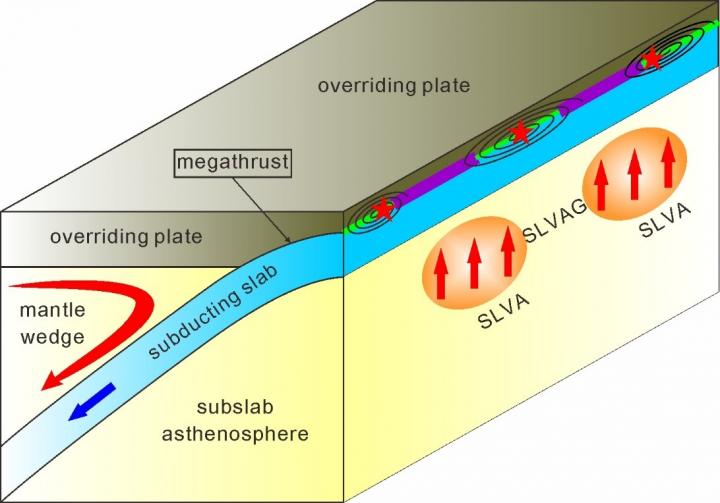
The researchers adopted P-wave tomographic inversions and compiled updated tomographic models. The tomographic images clearly reveal subslab low-velocity (slow) anomalies beneath forearc regions in the six subduction zones.

“The giant earthquake hypocenters are generally located above the edges of the slow anomalies or above the gaps between them. Large coseismic slips of the giant earthquakes mainly occur above gaps between the slow anomalies,” said Dr. FAN.

The buoyancy force of a subslab slow anomaly can increase interplate shear stress by enhancing interplate normal stress. Interplate shear stress increases the critical stress threshold for rupture, and the critical shear stress above the slow anomaly gap is slightly smaller than that above the slow anomaly.

However, critical shear stress is still large enough and relatively easier to reach. As such, it can induce a giant megathrust earthquake above the slow anomaly gap, which is primarily controlled by structural heterogeneity on and around the plate interface.

In addition, the buoyancy force of the slow anomaly can cause a morphological response from the subducting slab, thus increasing the shear stress on the plate interface. Thermal conduction or thermo-mechanical erosion from the slow anomaly may result in transformation of the interface rheology from frictional to viscous shear.

This transformation may partly account for the occurrence of slow-slip earthquakes above slow anomalies. The slow-slip area can impede rupture propagation and host afterslip of a giant megathrust earthquake.

“It’s necessary to conduct seismic tomography to investigate more detailed asthenospheric structures beneath a subducting slab, which may pinpoint the potential location of a future giant megathrust earthquake,” said Dr. FAN.

###

This study was supported by the Strategic Priority Research Program of the Chinese Academy of Sciences, the National Natural Science Foundation of China, and the Japan Society for the Promotion of Science.

Media Contact
YANG Fengfan
[email protected]

Related Journal Article

http://dx.doi.org/10.1038/s41561-021-00728-x

Tags: Earth ScienceGeophysics/GravityPlate Tectonics
Share12Tweet8Share2ShareShareShare2

Related Posts

Miniature Sensor Uses Light to Detect Touch — Chemistry

Miniature Sensor Uses Light to Detect Touch

May 8, 2026
Iron Minerals Determine Whether Dissolved Organic Matter Fuels Microbes or Becomes Long-Term Carbon Storage — Chemistry

Iron Minerals Determine Whether Dissolved Organic Matter Fuels Microbes or Becomes Long-Term Carbon Storage

May 8, 2026

Kate Evans Appointed Associate Lab Director for Biological and Environmental Systems Science at ORNL

May 8, 2026

Advancing Multiscale Modeling and Overcoming Operational Challenges in Autothermal CO₂-to-Methanol Reactors

May 8, 2026
Please login to join discussion

POPULAR NEWS

  • Research Indicates Potential Connection Between Prenatal Medication Exposure and Elevated Autism Risk

    840 shares
    Share 336 Tweet 210
  • New Study Reveals Plants Can Detect the Sound of Rain

    727 shares
    Share 290 Tweet 181
  • Scientists Investigate Possible Connection Between COVID-19 and Increased Lung Cancer Risk

    68 shares
    Share 27 Tweet 17
  • Salmonella Haem Blocks Macrophages, Boosts Infection

    61 shares
    Share 24 Tweet 15

About

We bring you the latest biotechnology news from best research centers and universities around the world. Check our website.

Follow us

Recent News

Evaluating Digoxin Use in Patients with Symptomatic Rheumatic Heart Disease

Evaluating the Effectiveness and Safety of Digitalis Glycosides in Treating Heart Failure

Urdu Fall Risk Questionnaire Adapted for Elderly

Subscribe to Blog via Email

Enter your email address to subscribe to this blog and receive notifications of new posts by email.

Join 82 other subscribers
  • Contact Us

Bioengineer.org © Copyright 2023 All Rights Reserved.

Welcome Back!

Login to your account below

Forgotten Password?

Retrieve your password

Please enter your username or email address to reset your password.

Log In
No Result
View All Result
  • Homepages
    • Home Page 1
    • Home Page 2
  • News
  • National
  • Business
  • Health
  • Lifestyle
  • Science

Bioengineer.org © Copyright 2023 All Rights Reserved.