• HOME
  • NEWS
  • EXPLORE
    • CAREER
      • Companies
      • Jobs
    • EVENTS
    • iGEM
      • News
      • Team
    • PHOTOS
    • VIDEO
    • WIKI
  • BLOG
  • COMMUNITY
    • FACEBOOK
    • INSTAGRAM
    • TWITTER
Sunday, August 9, 2026
BIOENGINEER.ORG
No Result
View All Result
  • Login
  • HOME
  • NEWS
  • EXPLORE
    • CAREER
      • Companies
      • Jobs
        • Lecturer
        • PhD Studentship
        • Postdoc
        • Research Assistant
    • EVENTS
    • iGEM
      • News
      • Team
    • PHOTOS
    • VIDEO
    • WIKI
  • BLOG
  • COMMUNITY
    • FACEBOOK
    • INSTAGRAM
    • TWITTER
  • HOME
  • NEWS
  • EXPLORE
    • CAREER
      • Companies
      • Jobs
        • Lecturer
        • PhD Studentship
        • Postdoc
        • Research Assistant
    • EVENTS
    • iGEM
      • News
      • Team
    • PHOTOS
    • VIDEO
    • WIKI
  • BLOG
  • COMMUNITY
    • FACEBOOK
    • INSTAGRAM
    • TWITTER
No Result
View All Result
Bioengineer.org
No Result
View All Result
Home NEWS Science News Chemistry

How cells zip through the stickiest mucus

Bioengineer by Bioengineer
July 25, 2022
in Chemistry
Reading Time: 2 mins read
0
Cells Zip Through Mucus
Share on FacebookShare on TwitterShare on LinkedinShare on RedditShare on Telegram

The discovery: A team led by Johns Hopkins University engineers figured out how and why human cells move much faster through thick mucus than thinner varieties. People sick with certain diseases, including asthma and COVID-19, secrete mucus that is 2,000 times thicker than normal. Cells have fin-like “ruffles” that help them sense viscosity and know when to change shape to power through the thickest mucus, they found. The findings were published today in Nature Physics.
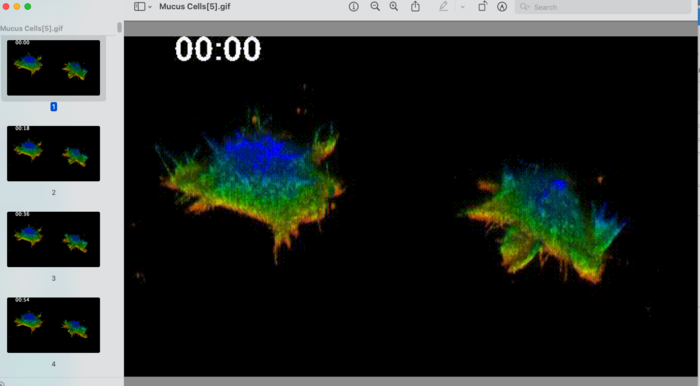
Cells Zip Through Mucus

Credit: Johns Hopkins University

The discovery: A team led by Johns Hopkins University engineers figured out how and why human cells move much faster through thick mucus than thinner varieties. People sick with certain diseases, including asthma and COVID-19, secrete mucus that is 2,000 times thicker than normal. Cells have fin-like “ruffles” that help them sense viscosity and know when to change shape to power through the thickest mucus, they found. The findings were published today in Nature Physics.

What you’re seeing here: A pair of human kidney cells move through fluid. When the fluid changes from the viscosity of water to that of honey, the cells immediately flatten to become quicker and more efficient. SEE CORRESPONDING VIDEO/GIF: https://youtu.be/U7NAkjTaHFI

Why should you care? The findings could inform and inspire new treatment for mucus-related diseases, including chronic lung diseases and mucinous cancer—the deadliest subtype for lung and ovarian cancer.

Details: Engineers discovered that certain cells don’t just passively experience the fluid that surrounds them, they use “ruffles” — cell membranes that wave up and down—to probe the fluid and adapt to its viscosity. Previously, ruffles were considered useless appendages. But the fin-like ruffles propel cells through thick mucus, helping them to swim faster in the thick stuff than more watery fluids. The research team included members from the University of Toronto and Vanderbilt University.


Journal

Nature Physics

DOI

10.1038/s41567-022-01676-y

Share12Tweet8Share2ShareShareShare2

Related Posts

Hebrew University Congratulates Haim Sompolinsky on Receiving 2026 Dirac Medal

Hebrew University Congratulates Haim Sompolinsky on Receiving 2026 Dirac Medal

August 8, 2026
New brain model reveals how regional chemistry shapes large-scale neural activity

New brain model reveals how regional chemistry shapes large-scale neural activity

August 8, 2026

Topological coupler breaks bandwidth tradeoff in broadband coupled resonator waveguides

August 8, 2026

Radical Chemistry Selectively Cleaves Strong Bonds While Preserving Weaker Ones

August 7, 2026

POPULAR NEWS

  • How Neuroblastoma Balances Replication Stress and Genome Stability Across Chromosome 17q

    29 shares
    Share 12 Tweet 7
  • Cigar, Cigarillo, and Pipe Smoking: Lung Cancer Risk and Screening Eligibility

    29 shares
    Share 12 Tweet 7
  • How Low Gravity and Pressure Affect Space Manufacturing of Carbon-Fiber Structures

    29 shares
    Share 12 Tweet 7
  • Calreticulin-targeted L-asparaginase–flagellin conjugate boosts Salmonella’s antitumor effectiveness

    29 shares
    Share 12 Tweet 7

About

We bring you the latest biotechnology news from best research centers and universities around the world. Check our website.

Follow us

Recent News

How Neuroblastoma Balances Replication Stress and Genome Stability Across Chromosome 17q

Cigar, Cigarillo, and Pipe Smoking: Lung Cancer Risk and Screening Eligibility

How Low Gravity and Pressure Affect Space Manufacturing of Carbon-Fiber Structures

Subscribe to Blog via Email

Success! An email was just sent to confirm your subscription. Please find the email now and click 'Confirm' to start subscribing.

Join 86 other subscribers
  • Contact Us

Bioengineer.org © Copyright 2023 All Rights Reserved.

Welcome Back!

Login to your account below

Forgotten Password?

Retrieve your password

Please enter your username or email address to reset your password.

Log In
No Result
View All Result
  • Homepages
    • Home Page 1
    • Home Page 2
  • News
  • National
  • Business
  • Health
  • Lifestyle
  • Science

Bioengineer.org © Copyright 2023 All Rights Reserved.