• HOME
  • NEWS
  • EXPLORE
    • CAREER
      • Companies
      • Jobs
    • EVENTS
    • iGEM
      • News
      • Team
    • PHOTOS
    • VIDEO
    • WIKI
  • BLOG
  • COMMUNITY
    • FACEBOOK
    • INSTAGRAM
    • TWITTER
Thursday, June 25, 2026
BIOENGINEER.ORG
No Result
View All Result
  • Login
  • HOME
  • NEWS
  • EXPLORE
    • CAREER
      • Companies
      • Jobs
        • Lecturer
        • PhD Studentship
        • Postdoc
        • Research Assistant
    • EVENTS
    • iGEM
      • News
      • Team
    • PHOTOS
    • VIDEO
    • WIKI
  • BLOG
  • COMMUNITY
    • FACEBOOK
    • INSTAGRAM
    • TWITTER
  • HOME
  • NEWS
  • EXPLORE
    • CAREER
      • Companies
      • Jobs
        • Lecturer
        • PhD Studentship
        • Postdoc
        • Research Assistant
    • EVENTS
    • iGEM
      • News
      • Team
    • PHOTOS
    • VIDEO
    • WIKI
  • BLOG
  • COMMUNITY
    • FACEBOOK
    • INSTAGRAM
    • TWITTER
No Result
View All Result
Bioengineer.org
No Result
View All Result
Home NEWS Science News Cancer

How brain tumors spread, become resistant to therapy

Bioengineer by Bioengineer
September 29, 2016
in Cancer
Reading Time: 2 mins read
1
Share on FacebookShare on TwitterShare on LinkedinShare on RedditShare on Telegram

Research teams from Karolinska Institutet and Uppsala University have jointly discovered that the usually protective enzyme FBW7 is commonly mutated and inactivated in childhood brain cancers causing tumors to spread and become more difficult to treat. The study, recently published in the scientific journal EMBO Journal, contribute to improving knowledge that is relevant to the development of more effective cancer treatments and future individualized treatment strategies.
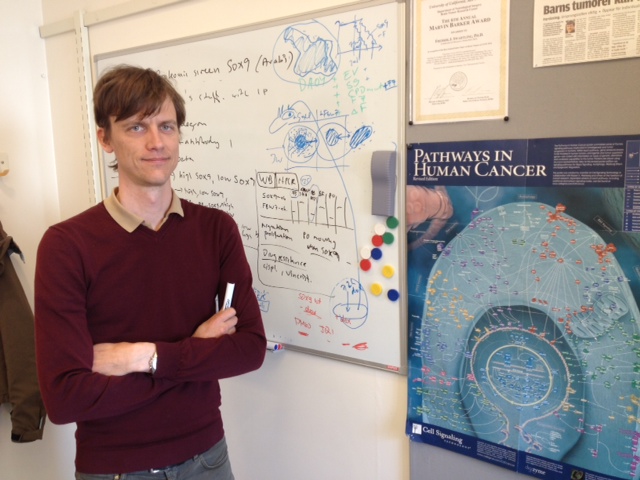
Fredrik Swartling, research group leader at Uppsala University

“We have shown that when FBW7 is functionally inactivated this leads to a block of degradation of the stem cell protein SOX9 which becomes more stable in the brain cancer cells,” said first author Aldwin Suryo Rahmanto at the department of Cell and Molecular Biology. These findings are not unique to childhood brain tumours.

“We believe this is a central mechanism for different types of cancer since an independent research team at the Rutgers Cancer Institute of New Jersey, USA, recently published similar results as ours, but instead in colon, skin and lung tumors,” says Fredrik Swartling, research group leader at Uppsala University and one of the principal investigators of the Swedish study.

The researchers examined the protein levels of SOX9 in malignant childhood brain tumours from more than 140 patients together with scientists in Germany. They found that tumours with increased levels of SOX9 more easily metastasise. In laboratory experiments the researchers mimicked the way SOX9 is stabilised in brain tumour cells and showed that SOX9 turned on 40 to 50 genes in the tumour to make it more resistant to standard treatment with cytotoxic drugs and more prone to spread.

“We also identified a way to de-stabilize the SOX9 protein by treating the brain cancer cells with small molecular drugs, which made them less resistant to chemotherapy again,” says Olle Sangfelt, the other principal investigator of the study and research group leader at Karolinska Institutet.

At the molecular level, tumours from different patients are often quite diverge, even though they belong to the same type of cancer. Certain childhood brain tumours have for instance high levels of SOX9 whereas others have relatively low levels. If it would be possible to identify tumours that have an aberrantly stabilised SOX9 protein, the drugs tested in this study could be used to prevent tumour spread in these patients and improve their response to standard chemotherapy.

Web Source: Karolinska Institutet.

Journal Reference:

Aldwin Suryo Rahmanto, Vasil Savov, Andrä Brunner, Sara Bolin, Holger Weishaupt, Alena Malyukova, Gabriela Rosén, Matko Čančer, Sonja Hutter, Anders Sundström, Daisuke Kawauchi, David TW Jones, Charles Spruck, Michael D Taylor, Yoon‐Jae Cho, Stefan M Pfister, Marcel Kool, Andrey Korshunov, Fredrik J Swartling, Olle Sangfelt. FBW7 suppression leads to SOX9 stabilization and increased malignancy in medulloblastoma. The EMBO Journal, 2016; e201693889 DOI: 10.15252/embj.201693889

The post How brain tumors spread, become resistant to therapy appeared first on Scienmag.

Share48Tweet8Share2ShareShareShare2

Related Posts

Cracking the Code: How Cancer Evades Antibody-Drug Conjugates and New Strategies to Overcome Resistance

June 25, 2026

MSU Scientists Reveal Mechanism Behind Ovarian Cancer’s Chemotherapy Resistance and Strategies to Overcome It

June 25, 2026

Rare Mixed Liver Cancer Underscores Diagnostic and Therapeutic Challenges

June 25, 2026

How Socioeconomic Factors Shape Lung Cancer Screening Experiences

June 25, 2026
Please login to join discussion

POPULAR NEWS

  • Saying Goodbye to PGY-6: Pediatric Fellowship Realities

    103 shares
    Share 41 Tweet 26
  • Multi-Hospital Study Reveals Long Covid Burden Is Twice as High as Current Estimates

    92 shares
    Share 36 Tweet 23
  • Detection of EDCs in Breast Milk and Infant Urine Up to Six Months Highlights Early Exposure Risks

    77 shares
    Share 31 Tweet 19
  • New Drug Candidate Developed at McMaster Shows Potential for Treating Brain Cancer

    58 shares
    Share 23 Tweet 15

About

We bring you the latest biotechnology news from best research centers and universities around the world. Check our website.

Follow us

Recent News

Tracking Lanthanide-Labeled Microplastics in Plants

POSTECH Researchers Slash Cost of Reconstituted Cell-Free Systems by 95%

AI and Physics Collaborate to Design Advanced Hydrogen Storage Materials

Subscribe to Blog via Email

Enter your email address to subscribe to this blog and receive notifications of new posts by email.

Join 82 other subscribers
  • Contact Us

Bioengineer.org © Copyright 2023 All Rights Reserved.

Welcome Back!

Login to your account below

Forgotten Password?

Retrieve your password

Please enter your username or email address to reset your password.

Log In
No Result
View All Result
  • Homepages
    • Home Page 1
    • Home Page 2
  • News
  • National
  • Business
  • Health
  • Lifestyle
  • Science

Bioengineer.org © Copyright 2023 All Rights Reserved.